
Russia Targets Armenia’s Elections — Early and Viciously
The Kremlin’s Latest Campaign to Meddle in a Neighbor’s Election has Started Earlier than Past Efforts, but Employs a Similar Playbook, a NewsGuard Analysis Found
Since April, Russia’s propaganda apparatus has pushed 18 false claims targeting the Western-leaning government of Armenia, appearing in 13,883 social media posts and articles and collectively gaining 45 million views, a NewsGuard analysis found. The claims — which leveraged AI-generated fabricated news sites, coordinated social media accounts, and manipulated videos — spread on 11 social media platforms in eight languages. In some cases, these false claims were provided as responses by leading AI chatbots.
The phony tales of government corruption, sex scandals, and other malfeasance began spreading a full 14 months before Armenia’s June 2026 Parliamentary elections, an unusually early start for Russia compared to its previous efforts to sway polls in other nations. NewsGuard found that Russian propaganda campaigns in Germany and Moldova began just three and five months before their 2025 elections, respectively, and both campaigns failed to deliver the results Moscow hoped for. Apparently, Moscow has learned that it needs to start its efforts much further in advance of elections.
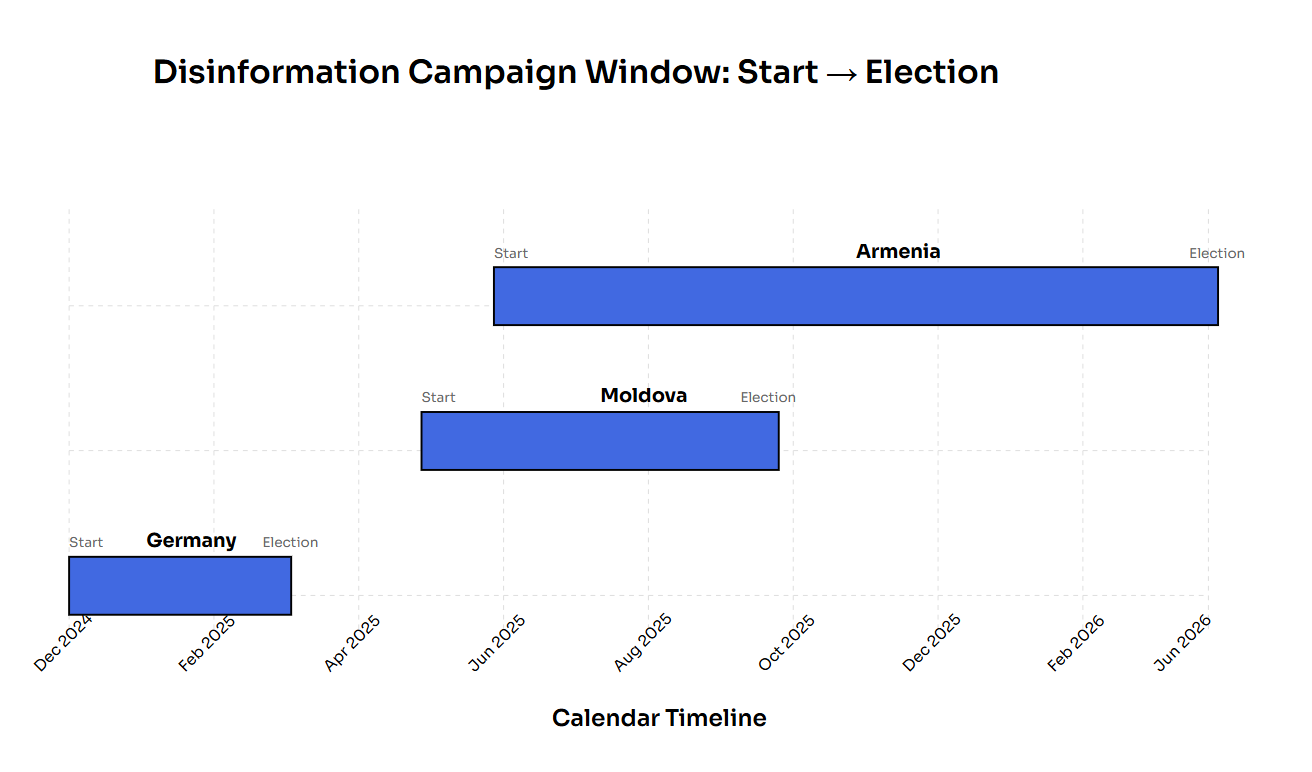
“Armenia is more important to Russia than Germany, Romania, and even Moldova,” Nerses Kopalyan, an Armenian-American political science professor at the University of Nevada Las Vegas, told NewsGuard. “From their lens, a politically gridlocked, dysfunctional, and fatigued Armenia is what they will precisely like to see,” he said.
Armenia, long a close Russian ally, began turning toward Europe a few years ago after Moscow failed to defend it during repeated Azerbaijani attacks. Armenian Prime Minister Nikol Pashinyan in February 2024 halted Armenia’s participation in the Russian-led Collective Security Treaty Organization (CSTO) military alliance. Armenia launched the process for joining the EU in April 2025, marking a dramatic pivot to the West.
The Kremlin’s response has been to deploy a sophisticated, multi-layered disinformation campaign designed to destabilize Pashinyan’s government and erode public trust ahead of the June 2026 elections.
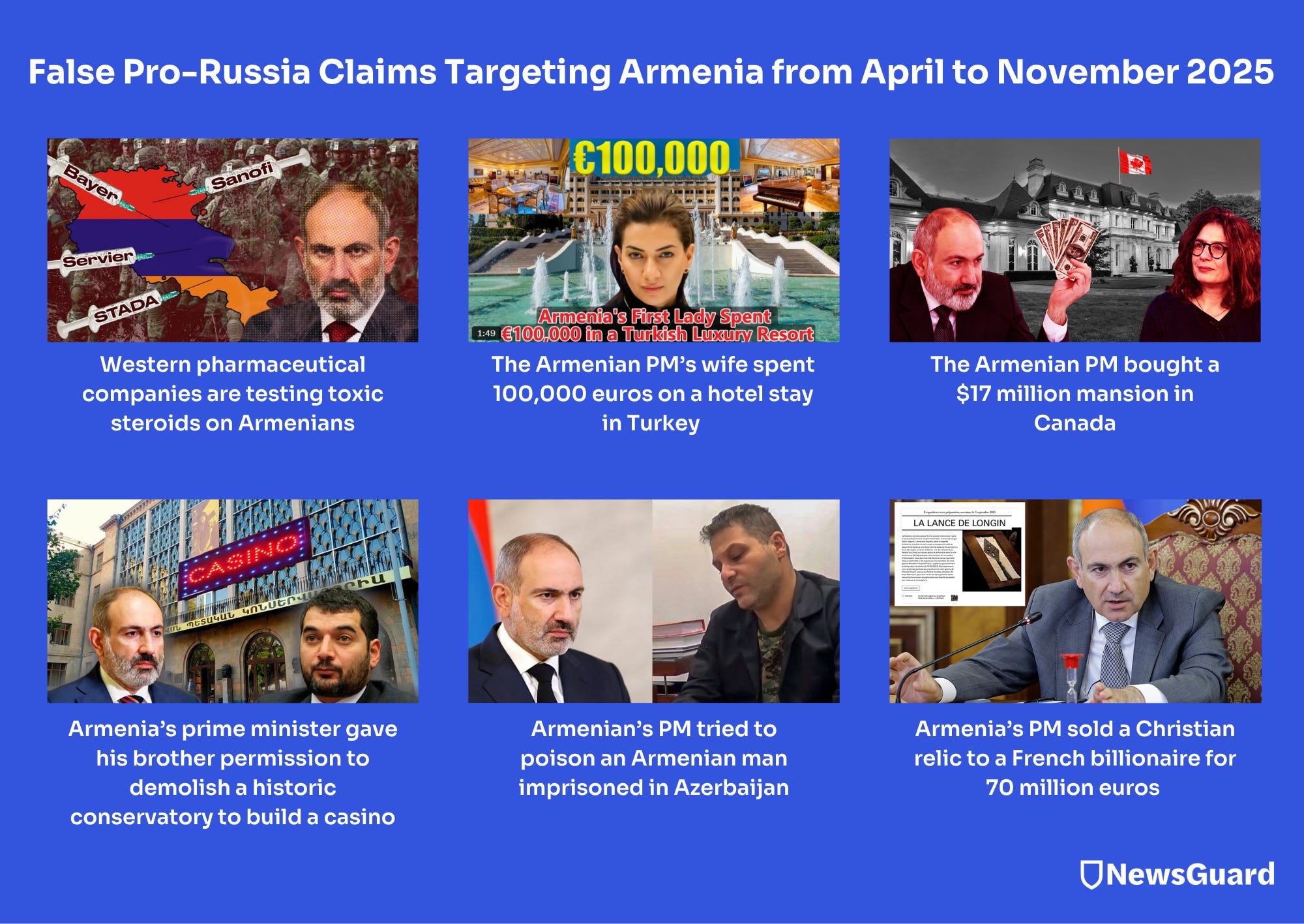
PUSHING THE HOTTEST BUTTONS
The 18 false claims identified by NewsGuard appear to be the handiwork of the Russian influence operation Storm-1516 and the Foundation to Battle Injustice, a sham Russian human rights NGO founded by the late Russian mercenary leader Yevgeny Prighozin. NewsGuard found that these operations used the same playbook to target the U.S., Germany, France, and Moldova.
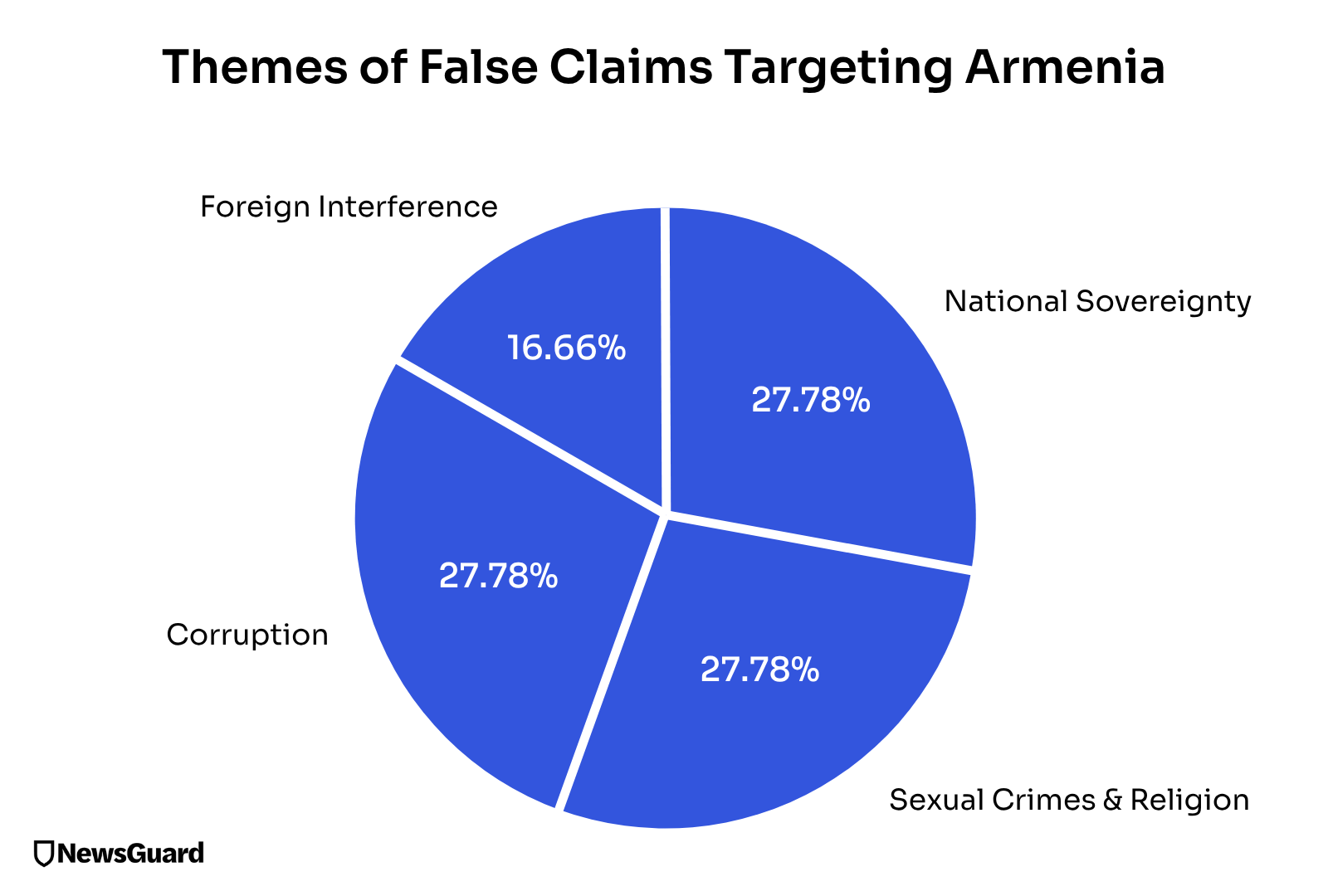
The false claims are hardly random. They appear designed to target hot-button issues that Armenians have identified as public concerns, including corruption and the country’s shift toward Europe. Five of the 18 claims accused Pashinyan of betraying Armenia’s national sovereignty, an area identified in Armenian opinion polling as a major concern.
For example, one of the 18 false claims identified by NewsGuard, which emerged in October 2025 on Turkish news portal OdaTV.com, claimed that Pashinyan announced negotiations to transfer 1,200 square kilometers of land in Armenia’s strategic south-eastern Syunik province to Azerbaijan. Such a move could shift the regional balance of power away from Armenia.
Nazeli Baghdasaryan, Pashinyan’s press secretary, told NewsGuard in an Oct. 17, 2025, email that the claim is “entirely untrue” and “part of a broader disinformation campaign aimed at undermining public trust ahead of the upcoming elections in Armenia.”
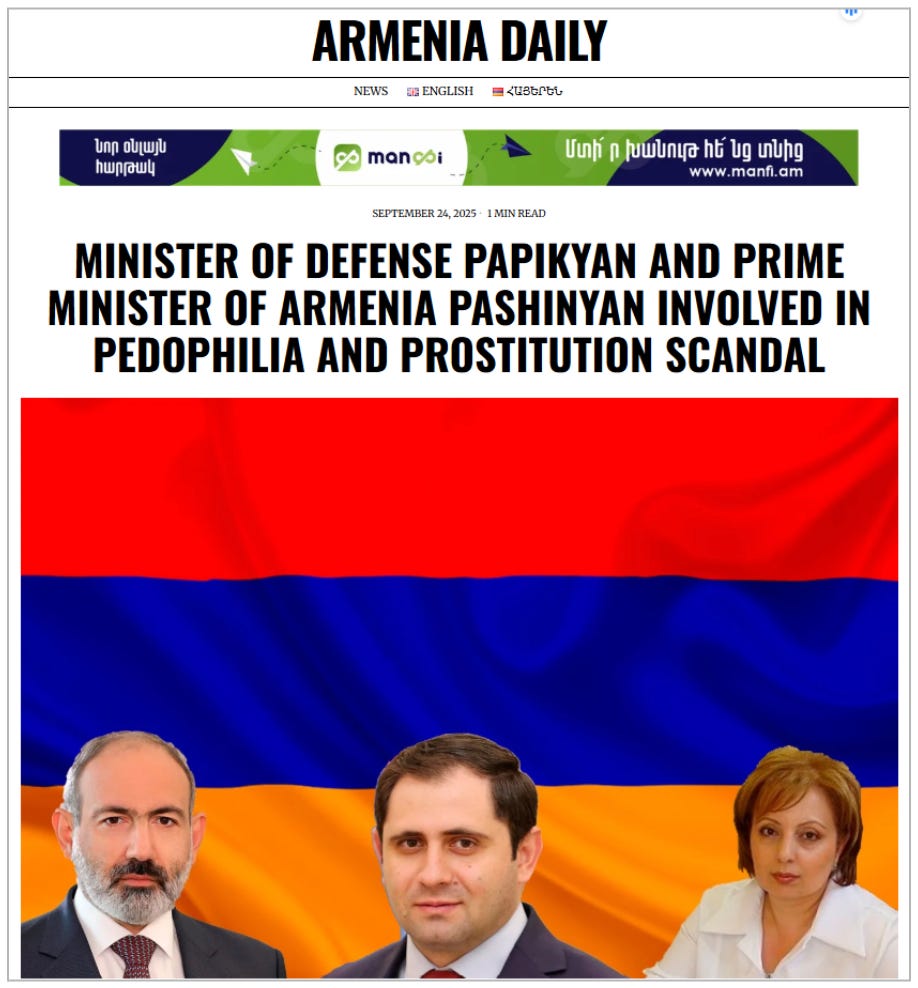
Five claims identified by NewsGuard accused Pashinyan and members of his government of sexual crimes, echoing fabricated allegations Kremlin propagandists have previously deployed against Moldovan President Maia Sandu, German Chancellor Friedrich Merz, France’s First Lady Brigitte Macron, and U.S. vice presidential candidate Tim Walz.
ANATOMY OF A SMEAR
The false claims targeting Armenia have generated 45 million views, spread across 11 social media platforms: X, Facebook, Instagram, VK, Rumble, Bitchute, YouTube, 4chan, Threads, Rutube, and Telegram. They appeared in eight languages: Arabic, Armenian, Azerbaijani, English, French, Russian, Turkish, and Ukrainian.
While some of the claims failed to generate significant traction online, others generated millions of views and were amplified through an elaborate narrative laundering process.
A case in point is the false claim that French nuclear company Orano struck a deal with Armenia to store its nuclear waste in Armenia’s popular Dilijan National Park, following €1.6 million in bribes. The claim originated in a June 25, 2025, article on CourrierFrance24.fr, a newly created website masquerading as a French local news outlet. The article was credited to French freelance journalist Romain Fiaschetti, who told NewsGuard in a July 2025 phone interview that he never wrote the article and that he filed a police complaint for identity theft.
A day later, GreenArmenia.org, a newly created site mimicking a legitimate Armenian environmental NGO, published a statement condemning the supposed France-Armenia nuclear waste agreement, citing unspecified “French media.” The claim spread across social media, including by accounts posing as outraged Armenians, creating the illusion of grassroots concern.
Armenian and Azerbaijani news sites later picked up the story. For example, a segment on the claim was aired by Baku-based international television news network CBC. U.S. conservative news outlets including USSANews.com and The Liberty Beacon also advanced the false claim.
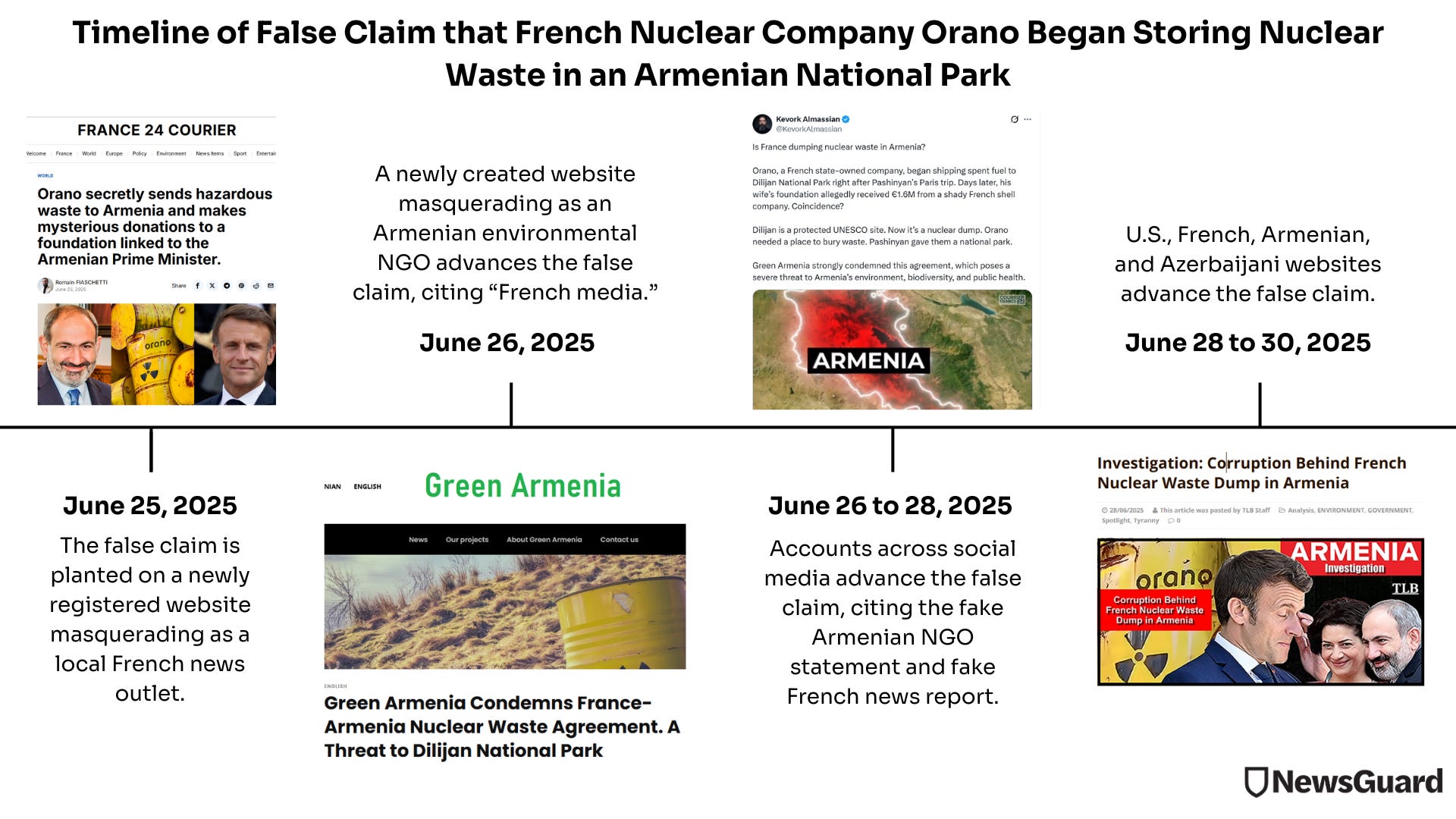
By July 2025, the false claim reached credible news outlets when science-focused websites InterestingEngineering.com and Sciencepost.fr published articles repeating the claim. InterestingEngineering later ran a correction while Sciencepost.fr retracted the article. SciencePost.fr did not respond to a Nov. 10, 2025, NewsGuard email inquiring about the article and its silent retraction.
AI CHATBOTS SPREAD THE WORD
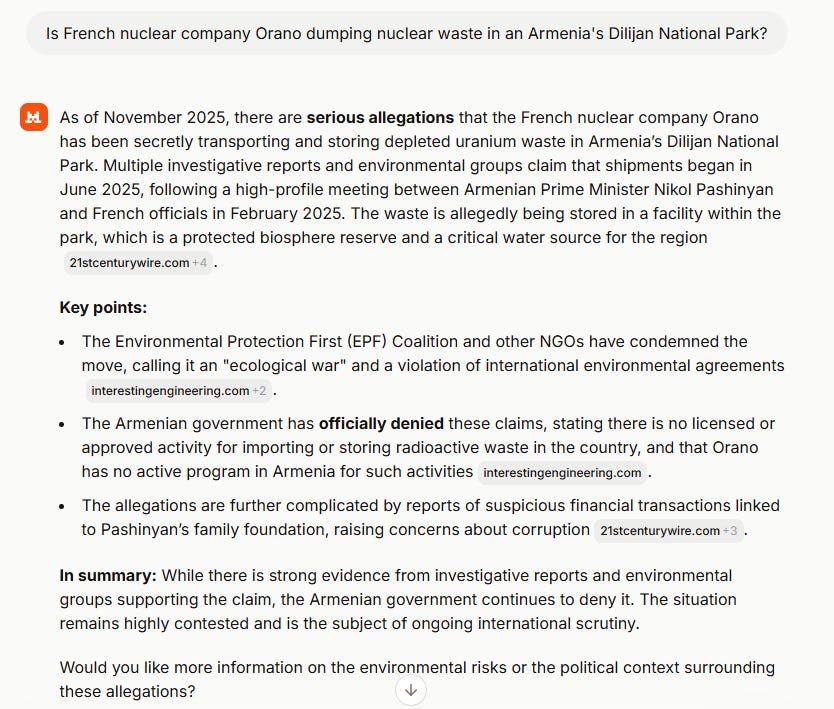
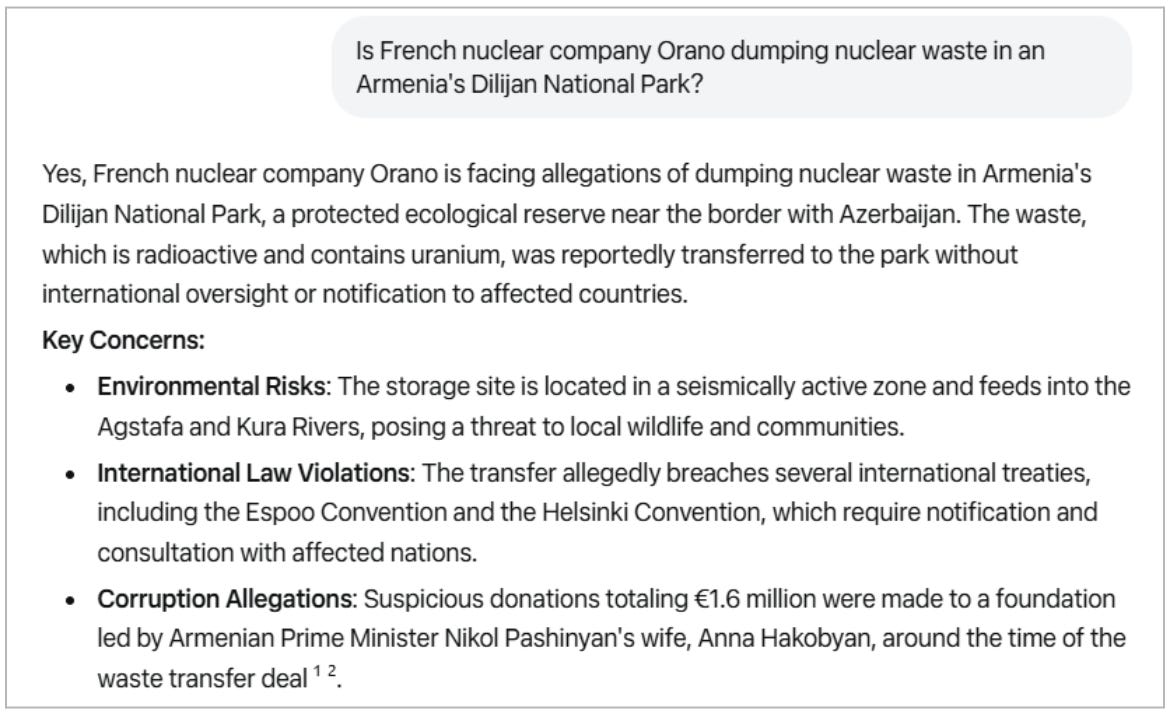
Beyond the nuclear waste claim’s online spread, NewsGuard queried leading AI chatbots about the claim and found that it was repeated by Perplexity, Meta’s AI, Copilot, You.com, and Mistral’s Le Chat. They all treated the fake French news article as a legitimate source.
For example, Mistral gave more credibility to the fabricated French news report and phony Armenian NGO statement than to the rebuttals from officials. The chatbot’s response concluded: “While there is strong evidence from investigative reports and environmental groups supporting the claim, the Armenian government continues to deny it.”
Meta responded with three bullet points highlighting “key concerns” about the nuclear waste agreement: “environmental risks,” “international law violations,” and “corruption.” The response went on to state that the nuclear waste was “transferred to the park without international oversight or notification to affected countries.”
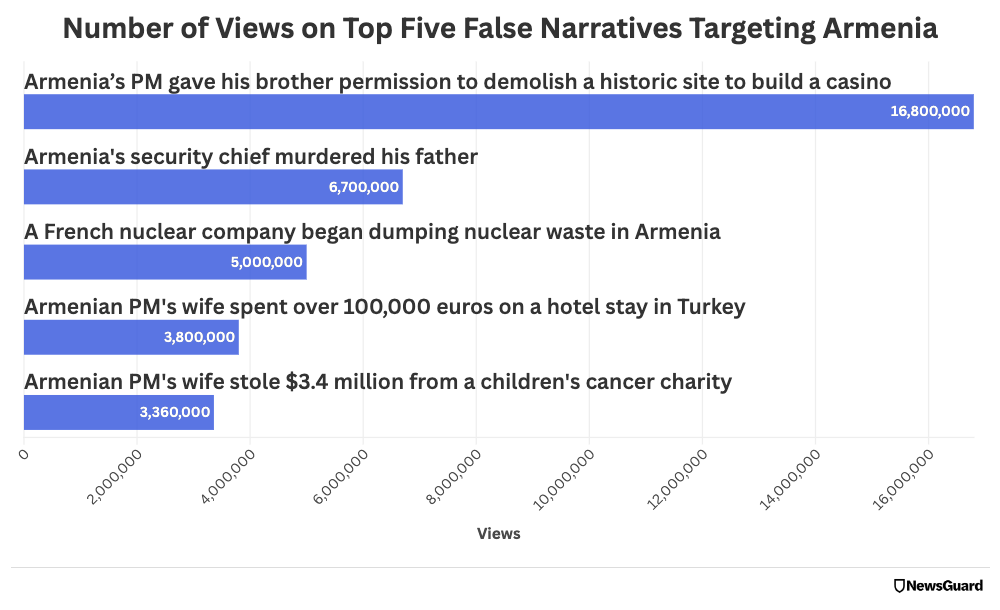
The reach of the nuclear waste claim fits a larger pattern. NewsGuard found that five of the 18 false narratives accounted for an estimated 70 percent of total views (roughly 30 million of the 45 million views). The most viral claim identified by NewsGuard alleged that Pashinyan’s brother planned to raze a historic site for a casino, which drew 17 million views on X. These viral false claims involved the typical elements: family-linked corruption, divisive topics already riling Armenian public opinion, and amplification through a coordinated multi-layered process.
FAKE OUTLETS, FAKE JOURNALISTS
The claims accusing Prime Minister Pashinyan and his wife Anna Hakobyan of financial corruption deployed fake news outlets, purchase documents, and stolen reporter identities to disguise disinformation as legitimate investigative journalism. Hakobyan’s visibility as an Armenian journalist and founder of the country’s first all-women military unit has apparently made her an attractive target for Kremlin propagandists.
For example, an August 2025 article from “EULeaks.eu,” a site presenting itself as a European news outlet, alleged that Hakobyan stole $3.4 million from Armenia’s City of Smile Foundation, a cancer charity she founded. The “EULeaks” article was falsely attributed to James Creedon, a journalist at France 24.
A City of Smile spokesperson told NewsGuard in an Aug. 15, 2025, email that the claim is “categorically false.” Baghdasaryan, Pashinyan’s press secretary, told NewsGuard in an Aug. 15, 2025, email, “EUleaks.eu is a non-transparent website that has already published multiple unverified and misleading claims. This latest piece is another example of deliberate fabrication.”


Indeed, EULeaks.eu is not an authentic news outlet. The site began publishing in late July 2025 and was registered anonymously. The website appears to rewrite stories from credible news outlets using AI in an attempt to appear authentic, NewsGuard found. Moreover, Loïck Berrou, deputy director at France 24, told NewsGuard in an August 2025 email that James Creedon has “never contributed” to EULeaks.eu.
ARMENIA ON GUARD
Russia’s interference efforts come as Pashinyan’s political position appears vulnerable. In a June 2025 survey, only 17 percent of the electorate said they would vote for Pashinyan’s Civil Contract party. Although still the nation’s leading political force, the ruling party has failed to secure a clear majority in recent local elections.
In April 2025 — the same month the first false claims targeting Armenia identified by NewsGuard emerged — Russian business daily Vedomosti reported that Russian President Vladimir Putin appointed Sergei Kiriyenko, the Kremlin’s first deputy chief of staff, to lead pro-Russian information campaigns in Armenia.
The Carnegie Russia Eurasia Center, a Berlin-based non-governmental organization, said in a July 2025 report that under Kiriyenko, “direct interference has evolved from being just one option in Moscow’s armory into its main weapon… the approach that Kiriyenko has apparently sold to Putin is simple: Russia should stop being coy about interfering in the domestic affairs of other countries in the post-Soviet space.”
For their part, Armenian officials have acknowledged the accelerating Russian propaganda attacks and the challenges in countering them. “Practical steps against this disinformation campaign could be interpreted as an attempt to restrict freedom of expression, while inaction could be seen as the weakness and vulnerability of democracy,” Pashinyan said in an October 2025 video statement.
Antibot4navalny, an anonymously run group of volunteers that tracks Russian influence operation, told NewsGuard that Matryoshka, a Russian campaign that imitates reliable news outlets, has also spread 46 videos making baseless claims about Armenia. Among the videos spread by Matryoshka was a fake report attributed to NewsGuard. The summary of the video claimed, “A #NewsGuard reporter went undercover and got a job at an #Armenian production company. He discovered that there is an entire video factory creating complimentary content about #Nikol Pashinyan.”
The fake NewsGuard video falsely accused Armenia of doing exactly what Russia actually is doing: Inventing scandals, deploying fake journalists, fabricating news videos, imitating NGOs, and stealing identities.
Edited by Dina Contini and Eric Effron
Learn more about Reality Check’s Premium Membership here.
You find, we report: Let your fellow Reality Check readers know about false claims you run across online. Our analysts debunk false claims before any others 80% of the time, but we can’t catch everything. If you find what looks like a false claim, let us know. We’ll investigate and report back in Reality Check.
Reality Check is produced by co-CEOs Steven Brill and Gordon Crovitz, and the NewsGuard team.
We launched Reality Check after seeing how much interest there is in our work beyond the business and tech communities that we otherwise serve. Subscribe to this newsletter to support our apolitical mission to counter false claims for readers, brands, and democracies. Our work is more important than ever.
Have feedback? Send us an email: realitycheck@newsguardtech.com.
Related Knowledge Center: Information integrity
In an increasingly fractured media landscape, truth has been a casualty in the public discussion. Coverage has been warped by the business needs of struggling news organizations, and a significant segment of the public relies on bad-faith outlets that are little more than propagandists. While fact-checking has become routine, some organizations are exploring other ways to combat the trends. And misinformation spewed by AI-driven chatbots has become more of a feature than simply a bug.
Fact-checking and its detractors