
Russia Falsely Claims U.S. Planes Are Seizing Venezuela's Gold
Welcome to Reality Check, NewsGuard’s newsletter that tracks the false claims and conspiracy theories that shape our world — and who’s behind them. Support us by becoming a premium member or sharing our work.
Follow us: X | LinkedIn | Instagram | Bluesky
Russian Media Baselessly Accuses U.S. Cargo Planes of Seizing Venezuelan Gold Following Maduro’s Capture
What happened: Russian state media and pro-Kremlin accounts are advancing the baseless claim that the United States following the capture of Venezuelan leader Nicolás Maduro deployed cargo planes to Venezuela in order to seize the country’s $3 billion gold reserves.
Context: On Jan. 3, the U.S. captured Maduro and his wife, Cilia Flores, and transported them to New York City to stand trial on drug and narco-terrorism charges. At a press conference the same day, U.S. Secretary of Defense Pete Hegseth said, “This is about the safety, security, freedom and prosperity of the American people.”
Critics of the Trump administration argued that Maduro’s capture was motivated by a desire to take control of Venezuelan oil and other natural resources, including gold.
A closer look: Amid these accusations, anti-West social media users began claiming that the U.S. had deployed C-17 transport aircraft to Venezuela to seize the country’s gold reserves. As evidence, some users cited a video of what appears to be a military aircraft flying over a city.
The claim apparently originated on the X account of Russian state-owned outlet RT, which posted the video on Jan. 4, stating, “C-17s ‘COME IN TO LOOT VENEZUELA’S $3B TONNES OF GOLD.’” The post garnered 222,400 views and 2,500 likes in two days.
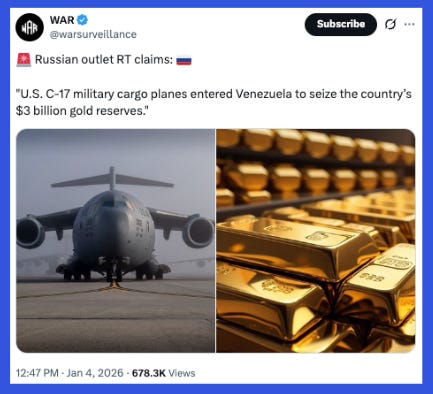
Hours later, anti-Western X user @warsurveillance posted: “Russian outlet RT claims: 🇷🇺 ‘U.S. C-17 military cargo planes entered Venezuela to seize the country’s $3 billion gold reserves.’” The post received 678,000 views and 19,000 likes in two days.
Actually: There is no evidence that any U.S. cargo planes were deployed to Venezuela, to seize the country’s gold reserves or for any other reason. (According to USA Today, Venezuela currently has 161 metric tons of gold in its reserves, valued at $22 billion by financial news site Benzinga. Approximately $2 billion of Venezuelan gold remains frozen in the Bank of England.)
NewsGuard reviewed the flight data for all U.S. registered C-17 planes from Jan. 3 to Jan. 6, and found no such planes entering Venezuelan airspace during that period.
The closest any C-17 planes came to entering Venezuelan airspace was an unnamed location in Puerto Rico, where four planes flew in and out between Jan. 3 and Jan. 6. These flights are consistent with credible reports about the deployment of cargo planes from American military bases to Puerto Rico, to transport soldiers wounded during the Maduro operation to a medical center in Texas.
As for the video shared by RT advancing the claim, it does not show a U.S.-registered C-17 plane entering Venezuela in January 2026.
Rather, it depicts a C-17 registered to the Royal Australian Air Force rehearsing for an August 2025 air show in Brisbane, Australia, according to reverse image searches conducted by NewsGuard.
A spokesperson for the U.S. Department of Defense did not immediately respond to NewsGuard’s Jan. 6 emailed request for comment. RT also did not respond to NewsGuard’s emailed request for comment.
Learn more about Reality Check’s Premium Membership here.
In Case You Missed It … Phony Visuals of Maduro’s Real Capture
Apparently, readily available, compelling real images of headline news events are no longer good enough for some Trump enthusiasts. Social media users praising U.S. President Donald Trump for capturing Venezuela’s leader Nicolás Maduro are flooding online platforms with AI-generated images and outdated footage claiming to show the military operation in Caracas.
While many of these visuals do not drastically distort the facts on the ground, the use of AI and dramatic, out-of-context video represents another tactic in the misinformers’ arsenal — and one that is harder for fact checkers to expose because the visuals often approximate reality.
Read more in yesterday’s Reality Check.
You find, we report: Let your fellow Reality Check readers know about false claims you run across online. Our analysts debunk false claims before any others 80% of the time, but we can’t catch everything. If you find what looks like a false claim, let us know. We’ll investigate and report back in Reality Check.
Reality Check is produced by co-CEOs Steven Brill and Gordon Crovitz, and the NewsGuard team.
We launched Reality Check to shed light on the false claims spreading online, how they spread, and the forces behind them. Each day, we aim to bring you the story behind your news feed and help you stay informed about the false claims circulating in the news. Support our work by becoming a premium member.
Have feedback? Send us an email: realitycheck@newsguardtech.com.