
Running as a Democrat, in a Trump +30 State.
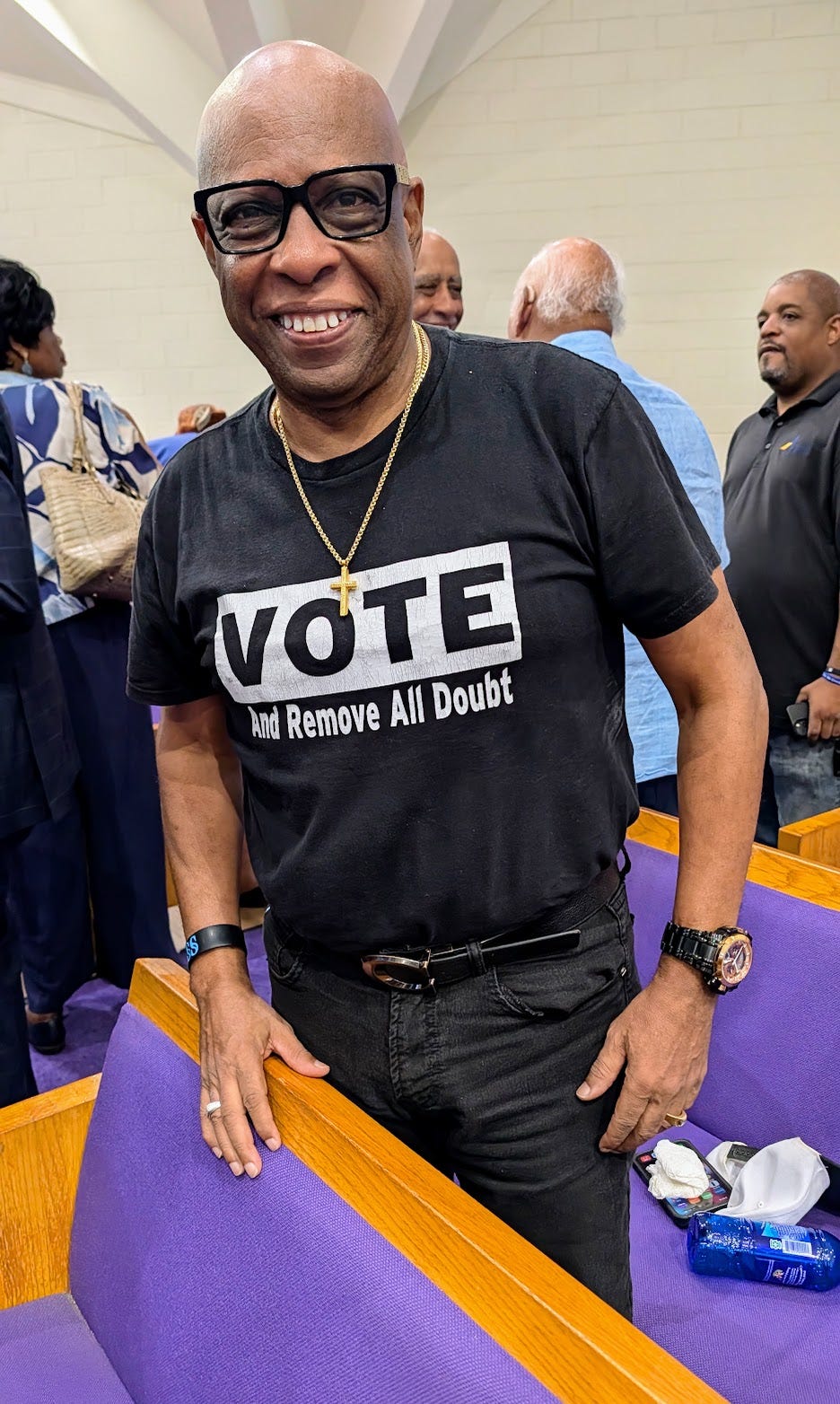
Omar Neal, a former mayor of Tuskegee, Alabama, after a town hall for Democratic governor candidate Doug Jones last week at the Washington Chapel AME Church in Tuskegee. Voting rights are central to the Democrats’ message in Alabama, and voter turnout will be central to the outcome. (All photos JF.)
Over the years I’ve seen candidates and campaign staffs who knew they were going to win an election, and candidates and staffers who knew they were going to lose.
This past week in Alabama, I had glimpses of a candidate and campaign in the far more interesting, tense, and dramatic limbo situation of “underdogs who have a chance.”
In politics as in sports, upsets happen. Polls and the odds-makers’ spread can be completely wrong. Anyone who has been through a campaign knows that it can all come down to tiny things. The last rally you hold—or cancel. The last neighborhood your staffers canvass—or skip. The last-minute gaffe that you avoid, and your opponent makes. The last-minute issue that motivates voters to show up, rather than stay home. Until election day you just can’t know what will matter, and may not be sure even then. So you have to act as if everything might make a difference.
Thus the outcome of a close campaign comes down to the unpredictable combination of luck, timing, and effort. Since the only element a campaign can control is effort, everyone gets raccoon-eyed, on the theory that you can sleep after election day.
‘The only Alabama Democrat with a prayer of competing statewide…’
The person I saw last week in Alabama knows very well that upsets can happen. This is Doug Jones, a Democrat from the Birmingham area, who nine years ago had a squeaker-upset victory, in a special election,1 over a scandal-ridden Republican candidate who had nonetheless led in the polls. Jones then took a seat in the US Senate.
Jones, who is white, had come to statewide and national attention more than 25 years ago, as the prosecutor who finally won convictions against two former Klan members who had carried out the “Birmingham Church Bombings” back in 1963.
Jones served in the Senate for three years after the 2017 special election. Then Alabama politics returned to normal, and in 2020 he lost by 20 points to former college football coach Tommy Tuberville.
Now Doug Jones is in another uphill race, to become the first Democrat in this century to be elected governor of Alabama. Again he is facing Tommy Tuberville, who is generally referred to as “Coach” and is widely considered among the dimmest current members of the US Senate. You can think of Tuberville as Ken Paxton without a law degree. As with Paxton, even his place of residence is an issue. In Coach’s case, the question is whether while representing Alabama he has actually been living in Florida. (Courts have so far ruled in Coach’s favor.)
Why is Jones running for governor this time, rather than for his former seat in the Senate? He told Alabama Public Television this year that it was because “The governor’s office and the state government is where the rubber meets the road. That’s where you can do the most good for the most people.” And why is Tuberville stepping down from the Senate for this run? He told local news source 256 Today that it was because “I’m a football coach, I’m a leader, I’m a builder, I’m a recruiter.”
When Jones announced for governor in late 2025, polls showed any Democrat far behind any Republican, and the governor’s seat “safely Republican.” After all, Donald Trump had carried Alabama by 30 points just a year earlier. Also last year, the Cook Political Report said that Jones would be a “longshot” yet was also “quite possibly the only Alabama Democrat with a prayer of competing statewide.”
But a longshot is better than no shot! And in the past few months, the polls appear to have narrowed—one recent report had Tuberville “only” 10 points ahead in an average of polls, and falling. The same Donald Trump who carried Alabama in a landslide two years ago is barely above water in approval polls there now. And the same Tuberville who has lashed himself to the mast of the sinking dreadnought MAGA is having to explain away rising diesel prices, tariffs, Trump’s support for data centers, the war in Iran, and other heavy negatives.
As this weekend’s NYT reported in a politics piece, for these reasons and others, odds appear to be changing in many races in “safe” GOP areas across the South. More and more, the reasons appear to include new motivation for Black voters to turn out, precisely because of Trump/MAGA/Supreme Court efforts to keep them from doing so.
As I heard several times this past week in Alabama and Mississippi: If the right to vote didn’t matter, why would people be trying so hard to take it away?
This will bring us to Doug Jones talking with Black voters in Tuskegee, after a brief back-story digression.
The back-story digression ….
Long ago, starting when I was age 18, I worked for several months at a civil-rights newspaper called The Southern Courier. It was based in Montgomery, Alabama; my reportorial territory stretched from southwest Georgia on one side to eastern Mississippi on the other; and mainly I covered voter-registration and voter-suppression efforts across the South, which in the late 1960s was still putting the Voting Rights Act into effect. There is now a historical plaque about The Southern Courier in downtown Montgomery, at the corner of Commerce and Bibb streets, where the headquarters in the now-departed Frank Leu Building were located.
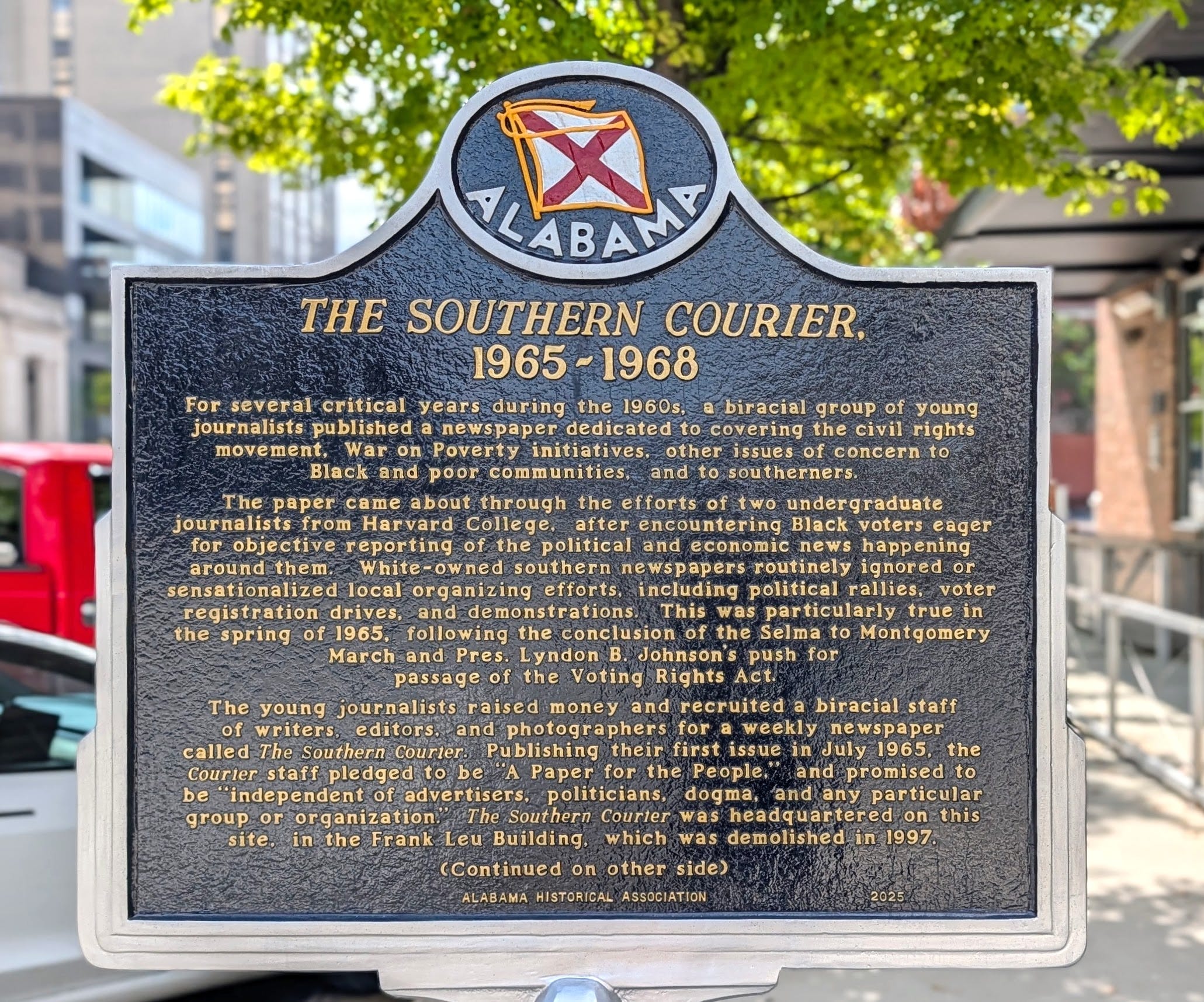
This month I made a week-long road trip through this territory with my longtime friend the lawyer and author Eric Redman, seeing many of these same venues. These included Birmingham, Montgomery, Tuskegee, Selma, and Demopolis in Alabama, plus Columbus and the surrounding “Golden Triangle” of Starkville and West Point in Mississippi. (Deb and I reported on the Golden Triangle extensively for the Our Towns book and movie.) I’ll have more to say about many of these places in the days ahead.
Town hall in Tuskegee.
This brings us to Doug Jones’s town hall last week in Tuskegee. This city is of course the historic home of the Tuskegee Airmen and the Tuskegee Institute, and the current home of Tuskegee University. It is a treasured center of Black excellence in the South, from Booker T. Washington’s era onward.
You can watch the whole hour-long event on the YouTube link shown below. To an extent, if you’ve seen one town hall, you’ve seen them all. It’s like watching C-Span. But just as C-Span reveals important currents in American politics and civic life, town halls offer no-BS looks at American Democracy, Circa 2026.
Below the video, a few time-marked guides to interesting and/or revealing segments.
Time 01:00. [All times approximate.]
Near the very start of the video, you’ll hear the welcome from Washington Chapel’s pastor, Trevor Woolridge. He goes through analogies to football, in this land of Auburn and the Crimson Tide: “Now we’re in the fourth quarter of the election cycle….The quarterback who will speak to us tonight, and lead this state, he needs everybody on the team help him get to the end zone.”
But then he spells the message out explicitly: If people don’t vote, nothing will change:
For all of my white brothers and sisters that are present here [a handful of us]—let me just talk to these other folks here, for half a second.
I need Black mothers and Black fathers to tell their children—to tell them with their eyes, without words—that they’ve got to go and vote. Don’t come to this house looking for no greens or mac and cheese or anything else until I can see that you have voted.
You’ll get the idea of the pastor’s style and command.
Time 5:50
Doug Jones has taken the stage after the pastor introduces him, and is contrasting his background to Tommy Tuberville’s. He touches on his role in prosecuting and convicting the Klansmen who bombed children in Birmingham, but he puts that in the larger context of the duty of a public servant.
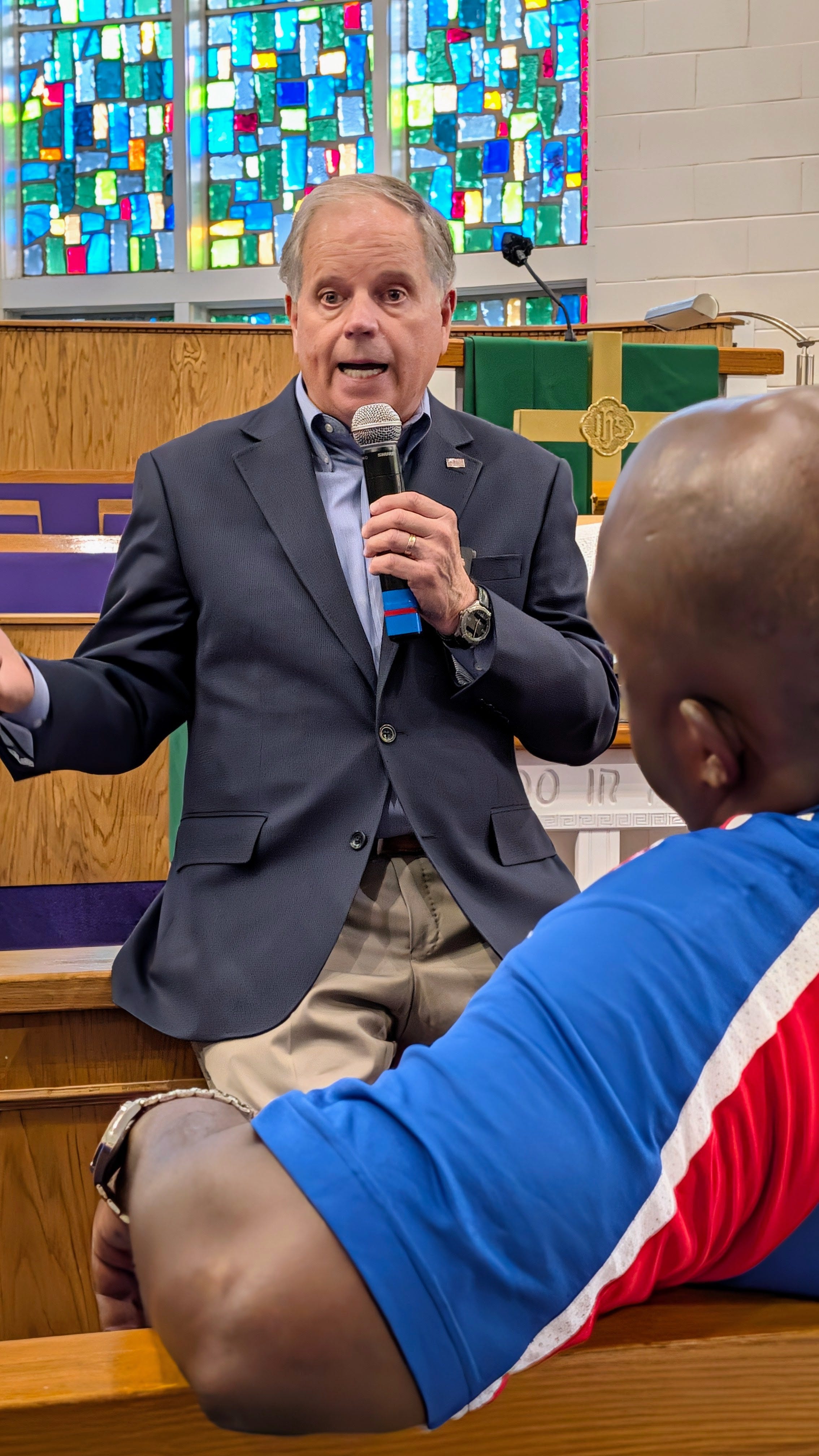
Doug Jones taking town hall questions in Tuskegee last week.
Starting at time 10:30
This is where the “town” part of town hall really kicks in. Jones takes unscreened questions from audience members. What’s on their minds?