Rozina Ali’s new book, Seasons of Fury, opens with a memory of herself growing up in California’s rural San Joaquin valley in 2001. On the day that planes flew into the World Trade Center in New York, her father quietly pulled her aside and gave her a warning she would never forget: “Don’t tell anyone you’re Muslim.”
It was the first time Rozina was made directly aware of her Muslim identity, and in that awareness was born a call to more deeply understand the human impact of the War on Terror, Islamophobia, and the Muslim community. In culminating her years of discovery, Ali traces America’s post-9/11 reckoning through the intimate stories of four Muslim families across eight decades. She makes the case that America’s brand of Islamophobia is not simply one of prejudice or religious intolerance, but rather, about the complex and elusive machinery of American global primacy — one that has unexpected roots in the Israel-Palestine conflict.
“[This book reveals] the way that U.S. foreign policy is shaped. It is about our willingness to allow an administration to use the powers of surveillance, entrapment, and material support laws against certain groups that it disagrees with. It is a story about how much money has been allowed to become a part of politics,” Ali tells me.
Learn from top longform journalists and find the best in-depth reporting. Subscribe to Depth Perception:
In suggesting that American Islamophobia goes beyond hate against Muslims, Rozina’s new book invites the questions: What were the long-term effects of 9/11 on people’s lives? And how was that impact seeded long before the towers fell?
Ali has interrogated this question for years through her reporting — which has been published in TheNew York Times Magazine, The New Yorker, Harper’s, Foreign Affairs, The Nation, The American Prospect, and others — in efforts to reveal the ways America’s domestic treatment of Muslims has been shaped by its global ambitions. Now, at last, the question is brought into full force in Seasons of Fury.
In this edition of Depth Perception, Ali gives us a peek behind the curtain into her sweeping narrative history of the U.S. government’s broken compact with its Muslim citizens, and what that history reveals about America itself. — Kelly Kimball
In your book, you reveal the long tale of America’s history of Islamophobia through the stories of four families across eight decades, which is quite the undertaking. Who are these families? How did you find them, and what was it like to trace their stories across such a vast expanse of time?
I’m, first of all, a reporter, and so when I came into this book idea, I was thinking about how families were affected after 9/11. I know this seems like kind of a simple question, and perhaps an answered one, but what I really, really wanted to understand was: What were the long-term effects of 9/11 on people’s lives? I didn’t know what I was going to find, and I realized that what I was actually investigating was turning out to be a much deeper question, which then led me to really expand my lens of what I was looking at. The more I dug, the farther back I kept going in time, and I realized ultimately that if I’m thinking about the rise of Islamophobia in the U.S., I had to understand it through four different pillars.
So, for example, there was how U.S. foreign policy plays a really big role in perpetuating Islamophobia here at home. [Then there is] counterterrorism measures and surveillance. The third is anti-immigration policies and laws, and how that has also encouraged Islamophobia. And the fourth is hate crimes, [which] is how people normally think about Islamophobia, or any sort of discrimination. But I realized that is just one of the many pillars and many layers of this form of discrimination.
When I was thinking about these four families, I was thinking about how they each represent one of these different pillars.
These pillars represent big, beefy themes with sweeping impacts. But you choose to focus on the human experience at the center of these impacts. Was this challenging?
I mean, one of the trickiest things about narrative nonfiction writing is: How do you balance the research and the big-picture question with the intimate texture of people’s lives? There were definitely times where I was just sitting there thinking, “How do I bring in something that is happening 5,000 miles away, or that is happening behind closed doors in D.C., and make it relevant to this person in Michigan that I’m talking about?”
Of course, this is such a vast history, and there is so much that I do not include in the book because I did not want to get bogged down in so many of the details. You will see in the book that there is a lot of stitching together. I do get into the history of certain policies, and I tried to make a rule for myself, which is that I would not discuss policies at length unless they had a real, direct impact on people’s lives.
Why did you decide to begin your book with your own personal story first?
That was the first time I became aware of myself as Muslim. And this is not to say that I did not know I was Muslim before. But my interaction with the world around me was that I was a brown immigrant, and people first and foremost saw me as brown or South Asian. I don’t think hardly anyone in my hometown registered that we were Muslim, and it was not until 9/11 that being Muslim all of a sudden had a connotation that I did not know what to do with.
It became a natural starting point for the book itself because it was an entryway for me to understand what it means to be Muslim in this country when, all of a sudden, it is seen through a very particular lens.
“It is remarkable to me, for example, that we still have material support laws on the books that are now being used against left-wing activists, after being used so prominently against what the U.S. considered Muslim terrorists in the wake of 9/11.” —Rozina Ali
Your book makes the case that Islamophobia was rooted long before 9/11, and it permeates U.S. politics and society today. In terms of the historical patterns that you see continuing today, can you identify what those look and feel like, even as the War on Terror has receded from public attention?
I think what we’ve been seeing over the past few years is a resurgence of the very policies and narratives and laws that encouraged and perpetuated anti-Muslim discrimination in the first place.
For example, one of the things that was quite remarkable for me to find as a journalist was how so much of anti-Muslim discrimination and targeting was rooted in, and kind of came from, how the U.S. considered and thought about the Israel-Palestine conflict. One thing that I want to point out, too, is that Islamophobia is — and I would love for a historian to correct me otherwise — the only time in U.S. history when the country has so systematically and so pervasively targeted a religious group. I wanted to understand, like, how does that even happen? A country that is built upon the tenet of freedom of religion, how does it justify that to itself?
So much of that justification is rooted in national security: justifications and explanations and policies that extend back to our fight against Islamic terrorism even before 9/11, and further back into how we were targeting Arabs and Palestinian activists in the U.S. All of the policies that made that possible are still on the books today.
It is remarkable to me, for example, that we still have material support laws on the books that are now being used against left-wing activists, after being used so prominently against what the U.S. considered Muslim terrorists in the wake of 9/11, and even before that, against Arab activists.
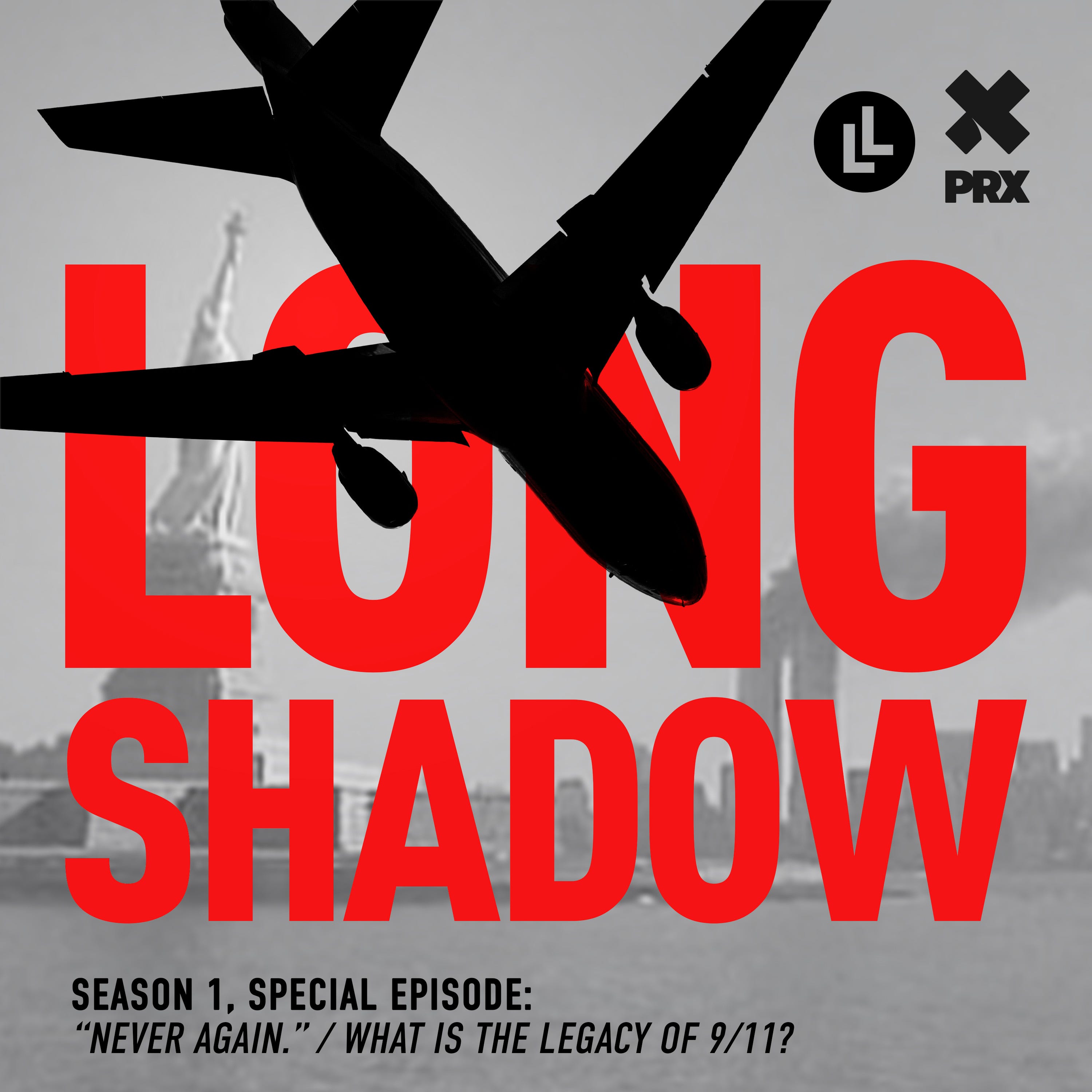
What is the legacy of 9/11? You’re living through it right now
In the wake of the September 11 attacks, the U.S. government embarked on the largest bureaucratic overhaul in half a century, consolidating 22 federal agencies under the banner of the Department of Homeland Security. Fueled by post-9/11 fear, the new bureau’s mission was simple: Keep the nation safe and stop the next attack at all costs. But over the years, the obligation to safeguard the homeland slowly laid the groundwork for a different kind of terror — one we’re seeing on America’s streets today.
Out now, a special episode of Long Shadow, released 25 years after the attacks, traces how the government’s response to the events of September 11 led to the buildup of a massive federal police force, an apparatus that was overtaken by a wave of corruption and criminality amounting to one of the most destructive scandals U.S. law enforcement has ever faced.
Hosted by Pulitzer-finalist historian and journalist Garrett Graff and distributed by PRX, Long Lead presents a new episode of Long Shadow: 9/11’s Lingering Questions. Listen wherever you get your podcasts.
Let’s drill down further into how you believe the fears about American Muslims are linked to the Israel-Palestine conflict. How does the Israel-Palestine conflict relate to this overall, very long view of America’s relationship with the Muslim community?
One of the things that the U.S. ultimately decided, through law enforcement, through policies being made in D.C., and through public narrative, was that radical Islam was one of the biggest threats facing the country. That is quite broad and abstract. That paved the way to thinking about certain aspects of Islam or Muslim expression as being inherently criminal or inherently dangerous.
Now, if we think about that national security problem, it did not just happen right after 9/11. What we were seeing before 9/11 was a growing concern about Islamic terrorism and about terrorism as a whole. That idea of terrorism as one of America’s biggest enemies really started entrenching itself in the ‘80s and ‘90s, and it was a direct result of how we were thinking about the Israel-Palestine conflict. In the ‘60s and ‘70s, there was a resurgence of Palestinian militant groups that were fighting for Palestinian liberation and Palestinian nationhood, and there was pushback against that in the international community and certainly in the U.S.
What we saw over the next few decades was this blurring of the lines between the fight for Palestinian statehood and terrorism. At the same time, the way we considered terrorism became increasingly vague. We started thinking about terrorism not just as a tactic, but as an end in itself. So it lost all of its political meaning.
You identify four families that lived in four distinct eras in the history of Islamophobia: one family from the 1940s, two families in the ‘90s, and a fourth after 9/11. I’m curious how you identified those four eras, and what about these families specifically really spoke to you?
When looking for people to write about, one question is: What is their story? How have they been changed? How did they understand what happened to them? How did they react to what happened to them?
I’m not necessarily interested in writing about Muslims for the sake of them being Muslims. I want to understand how they were shaped by the world around them, and how they, in turn, shaped the world around them. What was so remarkable to me about all these families that I was speaking to was that they were really contending with the forces at play that were shaping their lives. They weren’t passive actors. They were really struggling and thinking about, “What is my place in this country?”
What I also loved about these four families — and within these four families, I speak to many different family members — is that they all have very, very different relationships to Islam and to politics. In addition to thinking about the pillars of Islamophobia that I explained earlier… they come from extremely different walks of life. They’re working-class families, or they’re middle class, or they’re upper middle class and feel that they really made it in America. They all have varying levels of spirituality, and yet all of them have been affected, in some shape or form, by Islamophobia.
So what I really wanted was to create this tapestry of human experiences that are not just one-dimensional or two-dimensional, but that really showcase and highlight the fact that Muslims in America are so diverse. Which makes the entire notion of anti-Muslim discrimination absurd. Because what Islam are we targeting?
“As I was doing the reporting for this book, I really appreciated just how much this story is not a Muslim story. It is an American story.” —Rozina Ali
Given your research and your work — not only in this book, but also writing for the likes of The New Yorker,Foreign Affairs, and The New York Times Magazine — what do you think would have to change politically, culturally, or maybe educationally, to meaningfully disrupt these longstanding patterns of Islamophobia that you’ve documented?
You know, I really, really appreciate people talking about Islamophobia now and really contending with it. I have noticed that there is perhaps more willingness to discuss the rising levels of hate crimes against Muslims, but there are a lot of holes in that reading of Islamophobia. I think what we have not done as a country is really contend with the forces that made anti-Muslim discrimination so acceptable today.
Even though we have, for example, a Muslim mayor in New York City, we also have high-level politicians saying that Islam is evil and that Muslims should not be allowed in the country. Both of those things are happening in tandem. We have to reckon with the fact that we do have policymakers at the highest levels perpetuating discrimination against a religious group in this country. And we also have to reckon with the fact that too many people are OK with that.
One of the things that really disappoints me when I think about the way in which Islamophobia has been analyzed, or at least understood, is that people sometimes contend with it as though it is a “Muslim problem.”
As I was doing the reporting for this book, I really appreciated just how much this story is not a Muslim story. It is an American story. It is about this country because it is about the way that U.S. foreign policy is shaped. It is about our willingness to allow an administration to use the powers of surveillance, entrapment, and material support laws against certain groups that it disagrees with. It is a story about how much money has been allowed to become a part of politics. It is also about the ways in which, in our public narrative and popular imagination, we conflate Muslims and Arabs, and yet that does not translate into, for example, hate crime statistics.
All of these things are so intrinsically tied together and explain how Islamophobia became so pervasive. All of them are rooted in a very American system. I don’t think this discrimination is going to completely go away until we actually reckon with what it is that helps perpetuate it.
Are there any questions that I’m not asking, or anything else you want to mention at all?
I do want to nod to two things that have happened over the last 20 years that I don’t think we’ve fully grappled with, and that often get sidelined in these conversations.
One is that we’re in this unique moment in history where American Islam is represented not mostly by immigrants who came here and settled here, but increasingly by Muslims who have been born and raised here. We’re entering a new generation.
As the number of Muslims grows in this country, there has been a desire to establish Islamic institutions, not just mosques, but also Islamic community centers, bookstores, and other spaces. There has also been a corresponding backlash to that. What we’ve seen over the last 20 years is Muslims trying to, for example, build mosques [during] one of the highest numbers of attempts to reject those mosque applications.
I think what it really gets at is that, in addition to what we’re hearing from policymakers in D.C. about how terrible Islam is, there is also an effort on the ground to reject Islamic spaces in towns and cities. That is a shocking level of discrimination when we think about ourselves as a tolerant society that allows for freedom of religious expression for all.
What does it really mean, then, for Muslims to have a place in American society where they can actually live as Muslims?
We’re launching briefing.center with a focus on the press and media.
And we’re adding Citizen Cartwright, a daily quick-read news summary by veteran Washington journalist Linda Cartwright. (Sign-up for a dedicated morning email is available at Citizencartwright.com.)
We’re readying our first policy briefing.center, on energy and climate. We’d love to hear from you in what our other policy priorities should be.
You can use briefing.center as the center of your information management, or just one of your tools. We’re happy to discuss your connectivity needs.