
Retiree Builds a Home Hydropower System That Generates 36 kWh a Day From Nothing but Moving Water
Marc Nering looks at the Cheakamus River the way most people look at a power line. He sees energy moving past his farm in British Columbia every second, and unlike most of us, he built a machine to catch it. In his garage, the former hydro plant manager fabricated an aluminum water wheel that now powers his entire house. The system produces up to 36 kilowatt-hours of electricity each day without a dam, without fuel, and without shutting down when the sun sets or the wind dies.
The wheel is not a prototype. Nering uses it daily. “I use it to power my house,” he told Hydro Leader magazine in an October 2021 interview, noting that surplus electricity feeds into the grid through a converter. The project has since drawn interest from off-grid communities and overseas engineers who see a practical answer to a stubborn problem.

What sets the project apart is consistency. Solar panels go dark at night. Wind turbines idle in calm weather. Nering’s run-of-river hydro setup spins as long as the current holds, delivering a baseline of renewable energy that few residential systems can match.
How the Wheel Captures a River’s Force
Nering’s design skips the reservoir entirely. The wheel rests on a concrete pad along the bank and turns because the river pushes it, not because water drops from a height. He borrowed the idea from early millwright manuals, then modernized it with computer-assisted drafting and a permanent magnet generator.
Aluminum keeps the wheel light. Carbon steel parts handle structural stress. Most of the fabrication happened in Nering’s workshop, though the permitting dragged on far longer than the build itself.
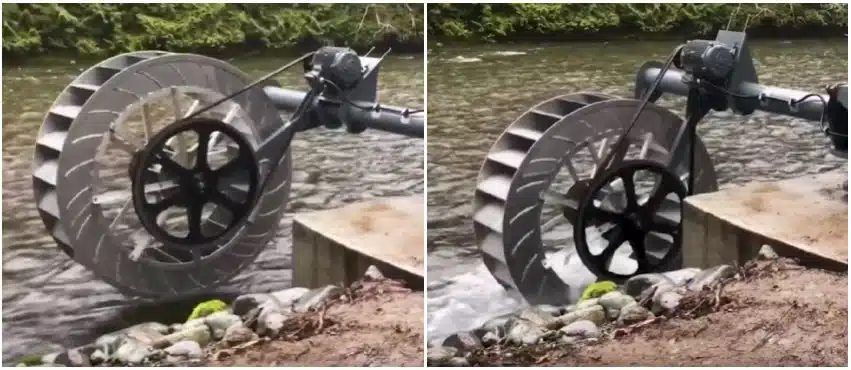
One hard limit defines where this system can work. Nering told Hydro Leader that the river must flow at “ten feet or 3 meters per second, at minimum.” Anything slower, and the wheel cannot produce meaningful wattage. That single constraint explains why the water wheel generator remains a targeted solution rather than something every waterfront homeowner can install.
Real Output, Not Lab Estimates
Nering’s numbers come from years of daily operation. The wheel typically produces between 800 and 900 watts under normal conditions. It sustains near 1,500 watts and has briefly touched 3 kilowatts. Over a full day, that steady hum adds up to roughly 36 kWh per day.
For anyone planning off-grid power, that predictability changes the equation. Solar requires battery banks to bridge nights and cloudy weeks. A river-powered wheel lowers that storage demand. In remote communities that burn diesel for electricity, the difference is even more pronounced.

Nering separates peak performance from what matters day to day. “The most I’ve made is about 3 kilowatts,” he said, but the daily total is what keeps appliances running and lights on.
What Broke and How He Fixed It
The project has mechanical scars, and Nering does not hide them. The biggest headache is belt slippage. At low rotational speeds, the wheel produces enormous torque. When river spray soaks the belts, they slip. He has looked at switching to a chain drive, a gearbox, or a direct-drive generator, but those changes are still on the drawing board.
Bearings failed faster. Two sets of high-quality SKF bearings, installed with the best seals available, lasted less than nine months each. Water found its way in. The eventual fix came from a much older playbook: lignum vitae wood bearings. Nering sourced them from a U.S. company called Lignum Vitae North America. After two years of service, he summed up the switch in three words: “It’s been great.”
The wheel also needs hands-on attention. When rain or snowmelt changes the river level, Nering adjusts the elevation manually. There is no automated system for that task.
The Real Gauntlet Was Regulatory
Fabricating the wheel was straightforward compared to getting permission to place it in the river. As documented in Hydro Leader, the process involved municipal, provincial, and federal agencies, plus First Nations consultation and input from local kayakers.
Regulators kept treating the project like a dam. “The Province of British Columbia and the British Columbia Ministry of Environment looked at it as if it were a dam-based hydro plant and asked how much water I was retaining,” Nering said. He had to explain repeatedly that his wheel holds nothing back.
Even without a reservoir, he commissioned environmental studies. One concern tracked salmon that migrate downstream at night to avoid predators. Officials wanted evidence that the wheel would not injure fish the way a conventional turbine might. Nering also had to lodge a financial bond with the government to cover dismantling and site restoration whenever the project ends, a cost he called a substantial fraction of the total expense.
Where the Idea Travels Next
Nering has never pitched the micro hydro wheel as a competitor to grid electricity. He told Hydro Leader flatly that it will never be cheaper than utility power. The use case sits elsewhere: remote communities, locations beyond the reach of transmission lines, and places that currently burn diesel or rely on intermittent solar and wind.
He has no plans to manufacture or sell the system. Still, his blueprints have traveled farther than he expected. An Italian company and a Chilean firm have each adopted elements of the design. The Chilean project took an unexpected turn, adapting the wheel to collect plastic from rivers instead of generating electricity. Nering, now managing a carbon-capture company while running his farm, remains open to sharing what he knows with anyone who reaches out.
“It was just something I wanted to do,” he said. “I like looking at it every day.”