
Response from NYT journalists on two complaints about Iran coverage
The New York Times is more influential and dominant than ever. After the diminishment of CBS News and the Washington Post, the threats to CNN, the precipitous decline of regional newspapers, the ever-stronger Times seems too big to fail.
But surely, not too big to criticize.
Given that the Times no longer has a public editor (the role of reader representative and internal critic that I held for four years until 2016), I appreciate it when journalists there respond to criticism, whether from me or from other observers.
Here are two examples, and you, readers, can decide about the responses and the thinking behind them. Let me know in the comments. I’ll give my take as well.
First, assistant managing editor Patrick Healy wrote to me after my last post here, in which I observed that many media outlets — including the Times — had been so focused on Iran coverage that other important stories were being downplayed, and that this was part of President Trump’s plan to deflect attention from his various troubles. My overall point is that Trump always depends on distraction and chaos, and that war is the ultimate expression of both. I compared this moment to the movie “Wag the Dog.” In that post, I also took issue with some aspects of a Times piece by David Sanger that pondered “why now?” for the Iran strike; it didn’t mention that Trump’s domestic problems (Epstein, poor approval ratings, the looming midterms) might have been a factor. I saw that as a hole in the analysis.
I described my own experience in the immediate aftermath of the strike on Iran, in which war coverage was so dominant that it was hard to find much else until very deep on most news organizations’ home pages. And I showed an image of the Sunday print front page that was dominated by the Iran story, while an Epstein piece had a spot at the bottom of the page.
Healy disagreed with my perspective, at least when it came to the Times. He wrote:
I was surprised to see The Times given prominent attention in your recent newsletter as an example of the media’s Epstein coverage being brushed aside in favor of war coverage. We’ve been covering the Epstein files comprehensively, including these pieces that ran on the first three days of the war (including some placement details):
Feb 28, 2026
- Elite Doctors Served Jeffrey Epstein While Treating His ‘Girls’ (Ran on A1 on 3/2, Top Stories homepage spot promotion, push alert, 1m+ views)
- Producers Rejected Epstein’s Offer to Help Finance a Dick Cavett Film (Top Stories homepage spot)
- QAnon Faithful See Validation in the Epstein Files
Mar 1, 2026
- Why the Epstein Investigations Took So Long and Did So Little (Homepage Top Stories promotion, ran on A1 3/1)
- Epstein’s New Mexico Ranch Gets Scrutiny at Last. It May Be Too Late. (Top Stories homepage spot Sunday and Monday)
- The U.S. Released the Epstein Files. The Arrests Are Overseas. (Top Stories/International Homepage spots)
Mar 2, 2026
I appreciate you highlighting our Epstein doctors/story. But a fair reading of your newsletter and the context suggests that The Times is by and large brushing aside Epstein coverage in favor of war coverage. We are covering both deeply — we’ve done benchmark work on Epstein, and the war is of course a major story that warrants comprehensive coverage.
As for the Sanger piece, I think his framing was smart and newsworthy, and based on factual reporting rather than opinions about “why now.” But I respect that you see it differently.
I wanted to reach out because I was troubled by the implication that we are brushing aside important reporting on other crucial topics. I don’t think a fair assessment of our reporting or our homepage and print coverage supports that judgment, but more so, as an editor who works on coverage across the newsroom (including on Epstein), I know that it’s not true.
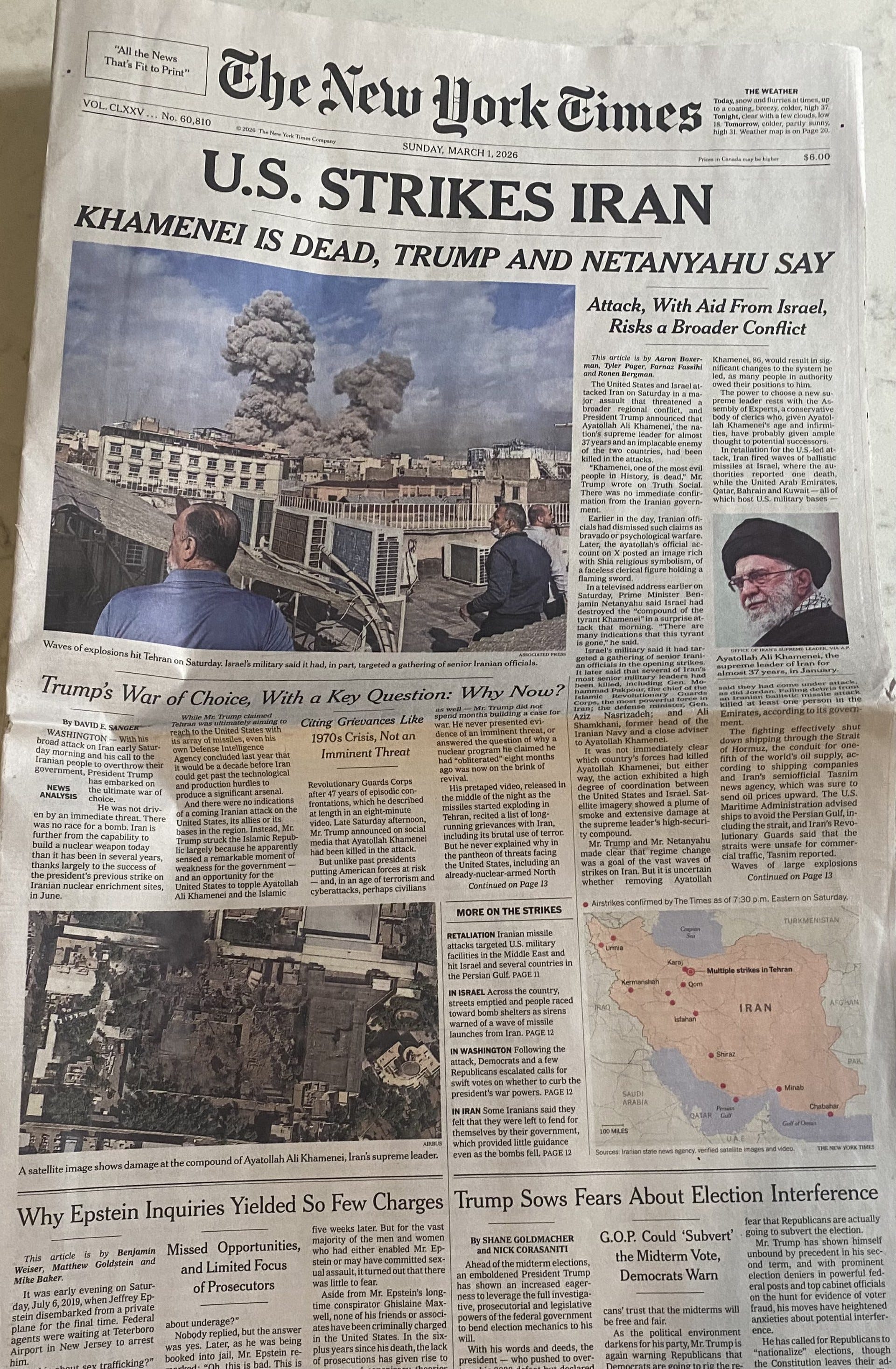
My take on the overall coverage and Patrick Healy’s response: The Times is doing a lot of impressive work on Epstein, no doubt. While the print front page is no longer the main standard for what editors consider important, it is notable that there were two front-page Epstein stories in the first few days of the war, and other good pieces, as well. So, touché. Point taken.
More generally, it seems undeniable that the media is focusing on the war and that other stories are getting shorter shrift than they otherwise would have — and that Trump loves and relies on distraction and chaos. I’ll stand by that.
I still think Sanger’s piece should have at least nodded to Trump’s domestic problems as part of the “Why now?” Those problems are facts, not flights of fancy.
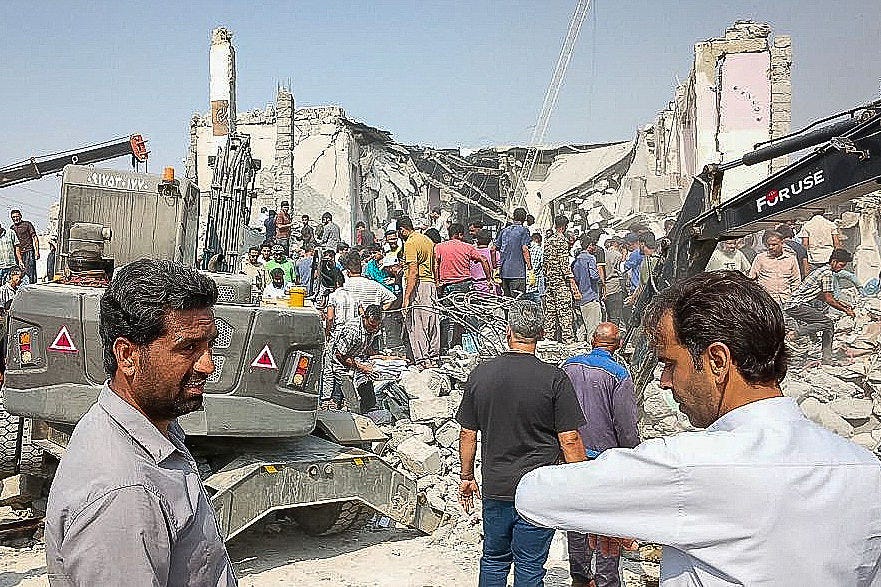
My second example comes from those who complained that the Times tried to avoid concluding, in a March 5 story, that US missiles struck a girls’ school in Iran and killed more than 100 children. The headline, which was the focus of the complaints, read “Analysis Suggests School Was Hit Amid U.S. Strikes on Iranian Naval Base.”
Here was one complaint on X, from scholar Assal Rad: “They’re trying so hard to justify it and avoid saying ‘US Strikes Elementary School in Iran.” She offered a rewrite: “Girls Elementary School was Hit Amid US Strikes in Iran, Killing 175, Mostly Children.”
Malachy Brown, who does visual investigations at the Times, responded at length on X, saying that he had been heavily involved in the story. His response, in part, read: “While it appeared obvious to many, early on, that the U.S. or Israel hit the school, it takes days to sift through, analyze and pinpoint the evidence.” He added that all that cross-checking and reporting takes time, but that doing it “allows us to more confidently assert U.S. responsibility, explain our rationale and add to the body of reporting that officials should be challenged with.” Three days after the initial story, a Times headline went further: “US Tomahawk Hit Naval Base Beside Iranian School” and an accompanying news alert connected the dots: “New video adds to evidence that a U.S. missile likely hit an Iranian school where 175 people, mainly children, were reportedly killed.” (Trump, naturally, has blamed Iran.)
Brown agreed to Rad’s point that language matters but that, in making the complaint, “you diminish the reporting.”
Rad responded that she does appreciate the reporting but she sees a larger problem — a pattern of narrative framing that “diminishes the significance of an atrocity.” And the journalist Mehdi Hasan chimed in: “I am frustrated that the headline you didn’t write almost ruins what is such a key piece of reporting on this war so far.”
My take on the school strike headline: I appreciate Malachy Brown’s explanation and the investigative reporting behind it. The headline was particularly indirect, though, and the one that Rad offered strikes me as truthful without being fuzzy. Something like that would have told the story of the reporting better. Reuters on March 5 (the same day as the Times initial story), was both direct and careful: “Exclusive: US investigation points to likely US responsibility in Iran school strike, sources say.”
American Crisis is a community-supported project where I explore how journalism can help save democracy. Please consider joining us!
It’s almost too easy to pick apart headlines (Jack Shafer calls it the lowest form of press criticism), but they do matter. Not everyone subscribes or reads deeply into a story; many scan headlines or catch news alerts. And when there’s a pattern of passive-voice avoidance and obfuscation, that’s a problem.
Here’s one to ponder: “Slurs Filled a Chat Created by a Republican Party Official in Florida.” (As Fordham professor John Pfaff quipped on Bluesky: “The slurs somehow have more agency than the Republicans.”)
And, how about the chatty tone here? Headline: Trump Wants to ‘Take Over’ Elections. These States are Prime Targets. Summary: “President Trump thinks Republicans should control voting procedures in parts of the United States. But where? Here are some possibilities.”
The democracy is at stake. This is a five-alarm fire, not a quiz show.
Readers, what do you think of these complaints and responses? Do you agree that picking apart headlines is the lowest form of press criticism or do headlines actually matter a lot?
Separately, some good reading or listening from the past few days:
The great Julie K. Brown (give her a Pulitzer, already!) has more strong reporting at the Miami Herald on Epstein’s death in prison.
Lydia Polgreen’s Sunday Times column, as always, is excellent. Here’s a gift link to “Trump’s Fantasy is Crashing Down.”
Great observations in the Bulwark from Mark Hertling, former commander of US Army Europe, about the damage done when Pete Hegseth pits the military against the media with slurs like “fake news.”
A podcast in The Interview by David Marchese of brilliant author Rebecca Solnit offers some positive perspective on our dark moment, noting the advances made across the globe on progressive issues. She says:
Even the right tells us something encouraging, if we listen carefully to what they’re saying. They tell us: You are very powerful. You’ve changed the world profoundly. All these things that are often treated separately — feminism, queer rights, environmental action — are connected, so they’re basically telling us we’re incredibly successful, which is the good news. The bad news is that they hate it and want to change it all back. There is a backlash, and it is significant. But it is not comprehensive or global.
Readers, thanks so much for being here and caring about the connection between democracy and journalism. Please continue to read, share, subscribe and comment.
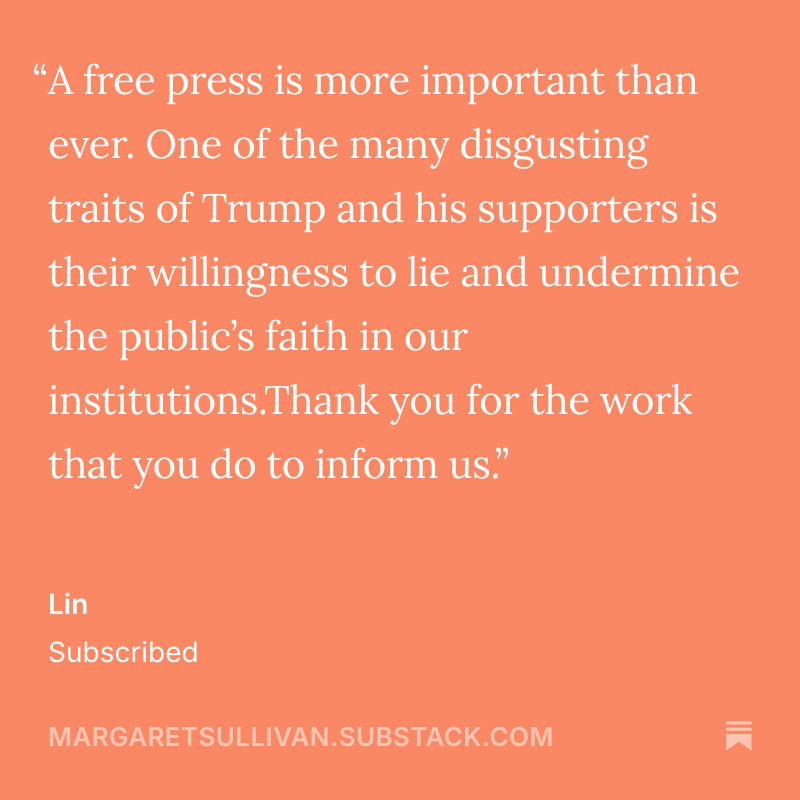
I hope to keep the paywall down and this newsletter free for all. If you’re able, you can help by subscribing for $50 a year. Here’s why one reader decided to become a paid subscriber, and beneath that, some information for newcomers about me and what I’m trying to do here.
My background: I am a Lackawanna, NY native who started my career as a summer intern at the Buffalo News, my hometown daily. After years as a reporter and editor, I was named the paper’s first woman editor in chief in 1999, and ran the 200-person newsroom for almost 13 years. Starting in 2012, I served as the first woman “public editor” of the New York Times — an internal media critic and reader representative — and later was the media columnist for the Washington Post. These days, I write here on Substack, as well as for the Guardian US. I’ve also written two books, taught journalism ethics, and won a few awards, including three for defending First Amendment principles.
The purpose of ‘American Crisis’: My aim is to use this newsletter (it started as a podcast in 2023) to push for the kind of journalism we need for our democracy to function — journalism that is accurate, fair, mission-driven and public-spirited. That means that I point out the media’s flaws and failures when necessary.
What I ask of you: Shortly after Trump’s election in November of 2024, I removed the paywall so that everyone could read and comment. I thought it was important in this dire moment and might be helpful. If you are able to subscribe at $50 a year or $8 a month, or upgrade your unpaid subscription, that will help to support this venture — and keep it going for all. Thank you!