
Report confirms climate change shrinking Milwaukee winters. How much?
Report confirms climate change shrinking Milwaukee winters. How much?
Great Lakes winter ice forecast is out. Here’s what to expect
The Great Lakes winter ice forecast predicts normal ice conditions, a break from the recent trend of declining ice coverage.
- A new report finds winters in many U.S. cities, particularly in the Great Lakes region, are getting shorter.
- Milwaukee’s winters are now about 11 days shorter than they were a half-century ago.
- These changes are part of a broader trend of a warming, wetter climate in Wisconsin and the Great Lakes area.
A new report finds that winters in Milwaukee, along with many other Great Lakes cities, are now more than a week shorter than than they were a half century ago.
The analysis, released by Climate Central, looked at 245 cities around the U.S. and found that winters in 80% of these cities are getting shorter. On average, winters have shrunk by nine days in these cities.
Milwaukee’s winters, in particular, were on average 11 days shorter now than they were from 1970 to 1997.
The report adds to the mounting evidence that winters around the world’s largest surface freshwater system are undergoing rapid shifts due to climate change. Shorter winters disrupt recreation and can have lasting impacts on lake ecosystems, agriculture and public health.
Here’s what to know.
Shorter winters in about 200 U.S. cities
Climate Central, a nonprofit organization of scientists and communicators, used weather station data from 245 U.S. cities to determine how winters are changing. The report defined winter as the coldest 90 consecutive days of the year and compared 1970 to 1997 with 1998 to 2025. In many cities, winters are both starting later and ending earlier now than they did between 1970 and 1997.
Out of the 245 cities, the Alaskan cities of Juneau and Anchorage had winters that shortened the most with 62 and 49 days, respectively. According to the report, 13 cities have shrunk by three weeks or more.
Shorter winters in Green Bay, La Crosse, Madison, Wausau
Out of the Wisconsin cities included in the new Climate Central report, Milwaukee has experienced the biggest decline in winter days since 1970. Here’s how many days winter as shortened by in other Wisconsin cities:
- Green Bay: 10 days shorter
- La Crosse and Eau Claire: 6 days shorter
- Madison: 7 days shorter
- Wausau: 5 days shorter
More: Wisconsin’s 2024 climate review: A year of unprecedented weather, and record highs and lows
Winters is some Great Lakes cities have shrunk by more than two weeks
According to the report, 13 cities in the Great Lakes basin have winters that are more than a week shorter. Here are the cities:
- Traverse City, Michigan: 21 days shorter
- Erie, Pennsylvania: 16 days shorter
- Rochester, New York: 12 days shorter
- Milwaukee, and Alpena, Michigan: 11 days shorter
- Grand Rapids, Michigan; Buffalo, New York; Green Bay: 10 days
- Lansing, Michigan; Saginaw, Michigan; Duluth, Minnesota: 9 days
- Detroit, and Toledo, Ohio: 8 days
Warming winters impact Great Lakes ice, mixing, water quality
Winter is an especially challenging time for scientists trying to figure out what changes are occurring to the Great Lakes themselves because the conditions are too treacherous for research vessels and monitoring equipment. In fact, a rogue buoy that broke free from its mooring last winter collected some of the first data scientists have on what happens when waves and ice collide.
However, in addition to this new report, models and weather data continue to support that winter is the fastest changing in the Great Lakes region, growing warmer and wetter with less snow. A 2025 study that analyzed when the lakes mix found that winters have shrunk by more than two weeks. Another 2025 study found that Lakes Michigan and Huron don’t consistently separate into layers, or stratify, in the winter anymore due to warming from climate change.
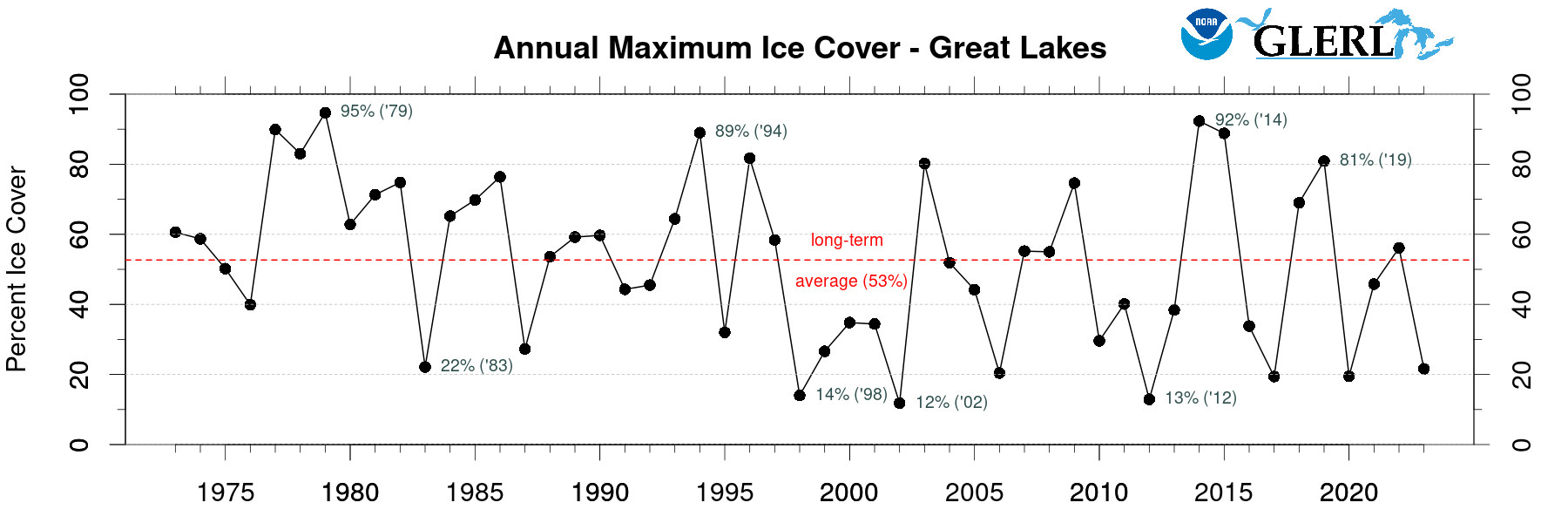
Most of the information scientists have gathered during the winter has been on changes in ice cover, showing a steady overall decline over the past half century, accompanied by extreme swings between years with extensive or minimal ice cover. Low ice cover years can threaten the region’s $7 billion fishing industry and coastal infrastructure as well as incite harmful algae blooms later in the year.
More: In winter, the waters of Lakes Michigan and Huron separate into layers. Not anymore. Why?
More: Oh buoy! Runaway research buoy gets data on Great Lakes winter waves
Trump changes make climate change harder to track
The science is clear that climate change is driven by human activity, largely the use of fossil fuels, like coal, oil and gas. These fuels are responsible for 75% of greenhouse gas emissions, which capture heat and warm the planet.
However, on Feb. 12, U.S. Environmental Protection Agency is expected to repeal a finding that greenhouse gases contribute to climate change. And the latest State of the Great Lakes report, released by the U.S. EPA and Canada, failed to mention climate change.
Changes by the Trump administration are making it more difficult to track climate change impacts across the country. For example, the administration has scrubbed mentions of climate change from government websites; begun dismantling the leading climate and weather research center; stopped updating the website that keeps track of billion dollar climate and weather disasters; and cut jobs and grants to many federal agencies that collect these data.
The impacts aren’t just on the environment. They’re economic, too. According to a recent analysis by the Center for Public Integrity, extreme weather events will cost Wisconsin up to $16 billion over the next 15 years.
More: Great Lakes report card outlines wins, losses. But what’s missing?
Caitlin Looby covers the Great Lakes and the environment for the Milwaukee Journal Sentinel. Reach her at clooby@gannett.com and find her on X @caitlooby. All of her work and coverage decisions are overseen solely by Journal Sentinel editors.
Caitlin is an Outrider Fellow whose reporting also receives support from the Brico Fund, Fund for Lake Michigan, Barbara K. Frank, and individual contributions to the Journal Sentinel Community-Funded Journalism Project. The project is administered by Local Media Foundation, tax ID #36-4427750, a Section 501(c)(3) charitable trust affiliated with Local Media Association.