
Reasons for encouragement, even amid the madness
The initial name of this newsletter (back when it was a fledgling podcast) was “Can Journalism Save Democracy?”
A wise counselor at Substack, Dan Stone, suggested something a little punchier, and I immediately responded, “American Crisis.” And here we are a few years later.
But that initial question of whether journalism can help save democracy has continued to be at the heart of what I look at here, and something that I know many of you care about, too.
Maybe it’s just the glorious effects of spring in Central Park, but I’m feeling surprisingly encouraged, despite all the craziness of the recent past. It’s strange to recall that it was only a week ago that Trump made his unhinged social media post heard ‘round the world.
More horrible things have happened since then. The president of the United States has threatened Pope Leo, and posted an image of himself as a Jesus-like figure. After criticism from even his most loyal supporters such as the ultra-conservative Knight Templars, he retreated and took it down by Monday afternoon. Many have died as a result of his misguided war, including hundreds of Lebanese civilians (you can see a full breakdown by country of the casualties, from Reuters here).
I don’t need to tell you what to worry about.

But here are my reasons for believing that journalism can at least help to save democracy, and I am hopeful that better days are ahead for the United States.
First, Hungary’s rejection of autocrat Viktor Orban in last weekend’s election. One major reason he lost so overwhelmingly is that Hungarian citizens were disgusted by corruption in government, and knew about it because of investigative journalism that remained strong despite Orban’s all-out effort to control the legitimate press. As Brian Stelter of CNN wrote:
Analysts say that pervasive corruption in Hungary was a key factor in the fall of Orbán’s illiberal Fidesz party. Outrage about corruption, CJR’s Ivan L. Nagy wrote before the election, has a “lot to do with the tireless work of investigative journalists.”
Some Hungarian reporters held onto their independence and found ways to be heard, and their investigations “helped Magyar build a strong anti-corruption platform,” Nagy wrote.
Overnight, THR’s Steven Zeitchik also highlighted the recent release of a documentary that uncovered “a wide network of bribery and blackmail.”
Independent and investigative websites “brought out a steady stream of scandals” during the campaign season, Eddy Wax wrote for Euractiv. He quoted Hungarian media entrepreneur Martón Kárpáti saying “this campaign showed the importance of the free media. If you had only just read or watched the pro-government websites or outlets then you would have no idea about what’s going on in the country.”
Second, American journalists are prevailing in court against the Trump administration’s efforts to control and punish them, over and over. A federal judge tossed out Trump’s suit against the Wall Street Journal for its story on the infamous “birthday letter” from Trump to his then-buddy Jeffrey Epstein. As Kyle Cheney of Politico put it, the claim of actual malice was “completely undermined by the article itself, which showed the paper’s due diligence and included Trump’s objection in the story.” The story was certainly damning but methodically careful. Separately, another federal judge rejected the Pentagon’s latest press policy, siding with the New York Times in saying Hegseth is attempting to “dictate” what journalists report. And he called this the “mark of an autocracy, not a democracy.” And one more: Trump Media (the parent company of Trump’s Truth Social) last week withdrew its suit against the Guardian over its reporting on the organization’s financing.
Third, journalism has revealed so much about Jeffrey Epstein, a storyline that simply won’t go away for Trump and his regime. One of the heroines, of course, is investigative journalist Julie K. Brown of the Miami Herald (who, by the way, deserves to win a Pulitzer Prize); but she’s far from alone in this.
Julie herself shared on social media a gift link (and here’s one for you) to a New York Times story that helps to explain why Melania Trump made her strange public statement last week. Brown noted “this story has legs.” Yes, it does, and so does the overarching Epstein story.
Even amid the troubled and chaotic state of American journalism (the weakened Washington Post and CBS News, among many other developments), journalism is doing its essential job. The New Yorker did a deep dive into Sam Altman and Open AI; the New York Times described how deeply influenced Trump was in entering the Iran War by Israel prime minister Netanyahu; and let’s face it, we may be disgusted by Trump’s constant grifting but we do know about it. We know about it because of journalism at every level, including here on Substack from such a wide array of writers and reporters.
Zooming out, I happen to agree with Dan Pfeiffer that the answer to Trump’s dangerous behavior is not going to come from the 25th Amendment. The former Obama advisor and co-host of Pod Save America put it this way: “The best way to rein in Trump is not to appeal to his cabinet — it’s to elect a Democratic Congress.” He sees the 25th as something of a fantasy idea.
What really matters is people-power and an overwhelming vote in the midterm elections, now only six months away.
American Crisis is a community-supported project where I explore how journalism can help save democracy. Please consider joining us!
Speaking of people power, the Media and Democracy Project’s report card on coverage of last month’s No Kings protests gives A grades to the Washington Post, the Los Angeles Times, and the Philadelphia Inquirer. The New York Times gets a C-minus and the Boston Globe a C.
Executive director Milo Yasallo told me he will “never forgive or forget the editorial decision to juxtapose the Times for the ‘primal scream’ opinion headline with #NoKings photos.” You can see the full report here on more than 75 front pages. My own consideration of the Times coverage was somewhat more positive; I saw it as a vast improvement over the paper’s past protest coverage. You can revisit my comments here.
A few other items of possible interest:
A Guardian podcast about the Ellisons, who now control CBS and will probably soon control CNN. And here’s my appearance on WNYC radio, along with the Wall Street Journal media reporter Isabella Simonetti, in which Brian Lehrer interviewed us on the role of AI in newsrooms. (He had seen my piece here in which I pledged to always write my own stuff and looked askance at AI writing news stories.
And a six-minute treat — with the 50th anniversary of the movie version of “All the President’s Men,” check out this clip. I was in high school during Watergate, and the Senate hearings as well as the Washington Post’s investigative work helped to draw me into my lifelong craft. I love this clip and hope you’ll enjoy it, too. Accountability journalism is every bit as important today as it was then, and yes, it may at least help to save democracy. As you know, I’m often disappointed and critical about how the press fails its mission by normalizing, both-sides-ing, and sane-washing — but its overall value endures. We need it. And we need it to be better.
Here’s my question for you this week: many media owners seem to think there’s a huge swath of America that is desperately seeking “middle ground” journalism. My Guardian colleague Jeremy Barr (who, I also worked with at the Washington Post) wrote a good piece about how this theory doesn’t line up with reality. This idea failed at CNN under Chris Licht and seems to be tanking at CBS News, whose evening newscast has sunk deeper into last place among the three major broadcasters under the guidance of the Ellisons and editor Bari Weiss.
Do you consider yourself a “centrist” and are you seeking journalism that takes things down the middle? Or is something else driving your media choices? And if so, what is that something? Is it independence? A mission to serve democratic goals? Authentic voices that bring a sense of perspective and sanity? Please tell me in the comments here. I’m sure I’ll be writing more about this, and would love your help.
Thank you, and thank you for being here, for caring about these intertwined issues of media and democracy at a critical time. I deeply appreciate your comments and your subscriptions, or your reading and sharing. All of this means a lot, and is surely an element in staying reasonably positive in the months ahead.
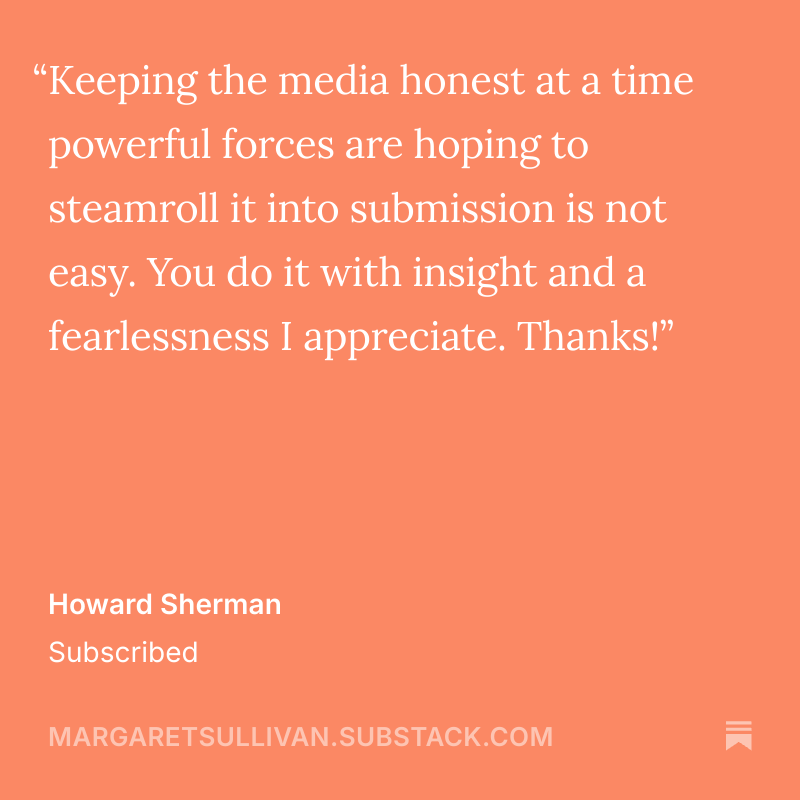
Here’s why one reader decided to subscribe. And below that is some information about what I’m trying to do here on American Crisis.
My background: I am a Lackawanna, NY native who started my career as a summer intern at the Buffalo News, my hometown daily. After years as a reporter and editor, I was named the paper’s first woman editor in chief in 1999, and ran the 200-person newsroom for almost 13 years. Starting in 2012, I served as the first woman “public editor” of the New York Times — an internal media critic and reader representative — and later was the media columnist for the Washington Post. These days, I write here on Substack, as well as for the Guardian US. I’ve also written two books, taught journalism ethics, and won a few awards, including three for defending First Amendment principles.
The purpose of ‘American Crisis’: My aim is to use this newsletter (it started as a podcast in 2023) to push for the kind of journalism we need for our democracy to function — journalism that is accurate, fair, mission-driven and public-spirited. That means that I point out the media’s flaws and failures when necessary.
What I ask of you: Shortly after Trump’s election in November of 2024, I removed the paywall so that everyone could read and comment. I thought it was important in this dire moment and might be helpful. If you are able to subscribe at $50 a year or $8 a month, or upgrade your unpaid subscription, that will help to support this venture — and keep it going for all. Thank you!