
A Reading List for America's Birthday.
As a pre-holiday special, this post is an old-style grab-bag listicle, with items I’ve been “meaning” to write about further. Who knows when that will happen. But for now, some reading and viewing tips:
1) A China book: ‘Breakneck’
I’ve started reading another book about China that seems worth attention. “Another,” because last month I recommended Patrick McGee’s excellent new Apple in China, which is a gripping reportorial narrative and which, I predict, will change the way you look at any piece of Apple equipment from now on. Or the way you read any story about tariffs, “decoupling,” and US-Chinese economic dealings overall.
These good China-themed books keep coming. The most recent one I’ve seen is by the tech analyst Dan Wang and is called Breakneck. Its subtitle might make you think it’s just another in the tedious “who is number one?” series. That subtitle is China’s Quest to Engineer the Future. I can say that, 150 pages in, it’s far subtler and more interesting than that.
Breakneck got my attention in its very first paragraph, which in fact is all one sentence.1 It reads as follows:
Every time I see a headline announcing that officials from the United States and China are once more butting heads, I feel that the state of affairs is more than just tragic; it is comical too, because I am sure that no two peoples are more alike than Americans and Chinese.
As they would put it in a rom-com: You had me at “no two peoples are more alike.” That’s a main message Deb and I took from our years of living in China, and to me it’s a crucial “tell” about whether someone is worth listening to on the subject.
These are similar people, separated by different systems,2 each dealing with the plusses and minuses of their respective national approach. These plusses and minuses are Wang’s main theme—the differences between the “lawyer” system in the US, and the “engineer” system in China.
Another “tell” for me about books: After reading the first few chapters, do I feel like going on? This far into Breakneck, I want to read the whole thing. Check it out.
2) A film: ‘Facing Tyranny.’
Last week PBS aired an 83-minute film about Hannah Arendt, in its American Masters series. It’s called Hannah Arendt: Facing Tyranny, and it is very much worth seeing in our times.
Hannah Arendt died nearly 50 years ago, when the news about US governance revolved around Vietnam, Watergate, and the Nixon resignation. So she had nothing specific to say about the collapse of governance in the Doge/MAGA age. The last news coverage she might have read about Donald Trump was how Roy Cohn guided Trump and his father through racial-discrimination complaints filed by Richard Nixon’s Department of Justice.
But the film is full of reminders of why Arendt’s first famous book, The Origins of Totalitarianism, which came out in the 1960s, is such a relevant guide to the politics of our immediate moment. And why “totalitarian” is indeed the right term to describe the MAGA era.
Just two samples. First, about the kind of people attracted to serve a totalitarian cult leader:
Totalitarianism in power invariably replaces all first-rate talents, regardless of their sympathies, with those crackpots and fools whose lack of intelligence and creativity is still the best guarantee of their loyalty.
Look at the roster of Trump appointees, and weep.
And, about “truth” and “lies”:
One of the greatest advantages of the totalitarian elites of the twenties and thirties was to turn any statement of fact into a question of motive.
She was talking about the “twenties and thirties” of the 1900s, but we see this every day in our own “twenties.” Trump in his disordered Q-and-As, the histrionic Karoline Leavitt in her “press briefings,” the likes of Kristi Noem and Pete Hegseth—they all meet any question of fact with an attack on motive. “You’re from the fake media, so you would say that…”
It’s worth seeing the film for the many unsettling Arendt resonances.
2a) A lighter film.
The Netflix eight-part series The Residence is set in a (fictional) White House, and has a totally different vibe. Funny, smart, wry, suspenseful. Like a highly sophisticated version of Clue. You may feel worse after watching any news. You’ll feel better after watching this.
3) A loss: Bill Moyers.
Bill Moyers died last week, at 91. He was a phenomenally productive and principled journalist and explainer. He was also a very complicated man: A seminarian who became a precocious White House press secretary. A newspaper publisher who became a broadcast icon. He was personally closer to LBJ than most other still-living people whom Robert Caro might have interviewed for his epic book series. But Moyers famously declined ever to discuss LBJ with Caro.
I had close dealings with Moyers in the 1970s, when I was in my 20s and he, at age 40, was undergoing his metamorphosis from political practitioner to revered journalist and public voice. I highly recommend Eric Alterman’s piece about the Moyers of those years, which in turn cites a long Q-and-A he did with Moyers back in 1991. He says this about Moyers’s reluctance to talk with Caro:
He did not feel right about trying to justify himself to Caro. It felt too egotistical to him, he said….
My own theory, however, was that he was deeply, and I mean deeply, pained by some of the things he went along with as a young man in the Johnson administration, though these are not the ones he has sometimes been accused of. He was, he explained when I questioned him in some detail on some of the allegations in the 1991 interview, “I was a very flawed young man, with more energy than wisdom.”
Based on my more limited involvement with Moyers, this rings true. You’ll see more details in Alterman’s pieces. (With a caveat I mention below.3)
Here’s a relevant point about Moyers now. Through his career he appeared frequently on Fresh Air, with Terry Gross. One of his last interviews there was in 2017, near the start of Trump’s first term, when Kellyanne Conway was still his press secretary. By comparison with her successors, Conway seems almost like Diogenes. But Moyers told Terry Gross then that the level of facile lying from Trump and his representatives was new and unknown in American life:
MOYERS: Look, I was not a perfect press secretary. I made a lot of mistakes. But I did feel that the job was to try to help the reporters get what they needed to tell their stories and help the president understand what the reporters were trying to do. I never did think of myself as a propagandist for the administration or the White House.
But these people I’m listening to and have been watching in the Trump administration are really just, you know, they’re lying. They’re deceiving us.
And if you don’t call that out, then the lie becomes a part of the lived experience of the people who are watching or listening.
Part of our lived experience. This takes us right back to Hannah Arendt. The Trump team lies about everything, so as to make people think that nothing can be true. Last year’s movie The Apprentice dramatized Roy Cohn teaching Donald Trump exactly how this process worked. The press has become inured to it. Trump’s delusions and flat-earth lies, and those of people who speak on behalf, are no longer “news,” because they’re no longer new. But they matter. For reasons Arendt and Moyers, in their different ways, explained.
No one (to my knowledge) has done a full biography of Billy Don Moyers and his many lives. I’ll read that one when it comes out.
4) ‘A government as good as its people.’
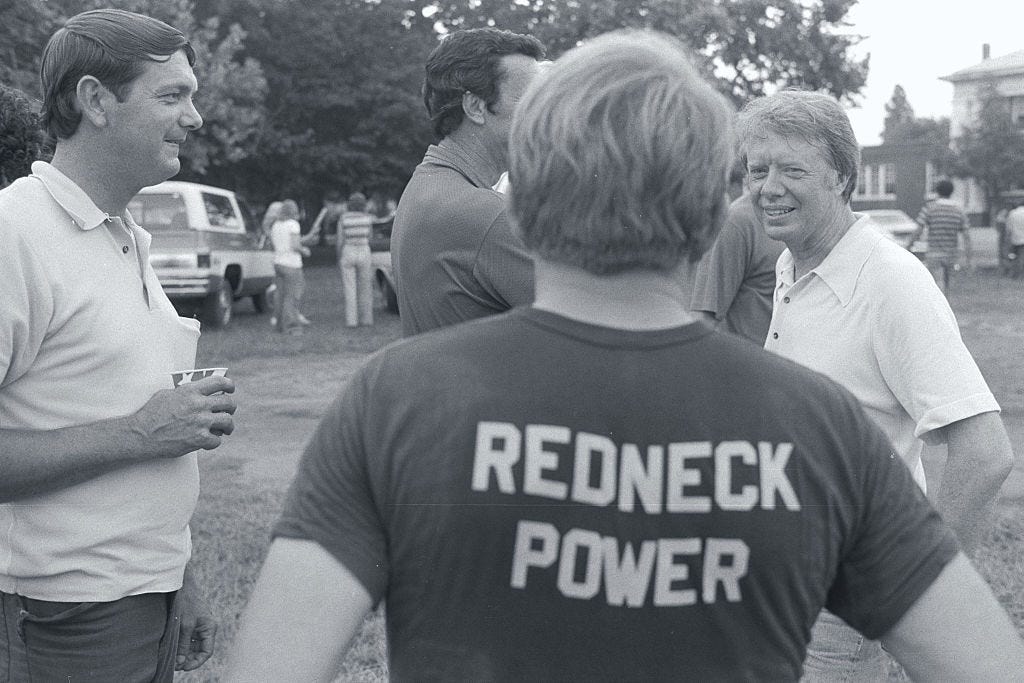
At a summertime gathering in Plains, Georgia, in 1976, Billy Carter with a shirt prefiguring the political culture wars of our times. (Owen Franken/Corbis, via Getty Images.)
Fifty years ago, during his still-unmatched run from obscurity to the White House, Jimmy Carter liked to say that America needed “a government as good as its people.”
Carter had a sardonic edge, and he fully recognized the catty way that line could be read. (“Yeah, our government is as good as our people—that’s the problem!”) But he could project his belief in its earnest, positive side, with its hope for redemption. And I think the way he explained it, just before election day in 1976, is worth attention in our current predicament.