
Read the Room Sac County Supervisors: Another Solar Farm Approval is Another Failed Experiment
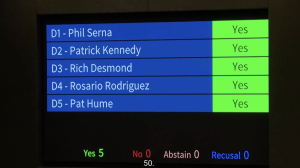
In a glaring case of willful stupidity, a proposed 2,700-acre solar farm project east of Rancho Cordova in Sacramento County was just unanimously approved by the Sacramento County Board of Supervisors in an effort to provide “carbon-free power.”
The project will also require the removal of nearly 3,500 native trees, but will preserve 13,000 oaks under conservation easement. Trees provide shade and in one year, a mature tree can absorb a half a Metric ton of carbon dioxide equivalent, if anyone on the Board of Supervisors legitimately cares about carbon sequestration. Trees absorb carbon dioxide and release oxygen. Solar farms destroy the land and fry birds right out of the sky.
The 200-megawatt solar project is anticipated to increase the Sacramento Municipal Utility District’s supply of solar power, ABC 10 reported.
The woke utility is still yammering about eliminating all of its greenhouse gas emissions by 2030.
Maybe a remodel and re-commissioning of the Rancho Seco Nuclear Power Plant in Sacramento County would help increase the region’s clean electricity supply?
Less than a year ago, we learned that California can’t even use all its solar power. SF Gate reported that California has an oversupply of solar power, and has been causing “California’s operators to regularly halt production or even pay electricity traders to take power off their hands. Sometimes, other states snag the extra energy for cheap. Meanwhile, California residents, businesses and factories pay around two to three times as much for power as the national average.”
California doesn’t need more solar farms to produce solar energy – California needs distribution capability and storage for what is already produced.
Additionally, solar farms are being decommissioned sooner than expected, catching many developers and operators off guard. While these projects were initially designed to last 25 to 30 years, they are lasting only 10 to 15 years due to changing market conditions, technological advancements, and panels failing prematurely, a solar waste company reports.
The Coyote Creek “Agrivoltaic Ranch” project is approximately 1,412 acres earmarked for “agrivoltaic” development, which would allow animals to graze under and around solar panels. The remaining 1,292 acres would not be developed, according to ABC10.
Supervisors demonstrated their unwillingness to think outside of the current woke box, filled with the usual cliches. “We’re running out of time. We have to take bold action now,” Supervisor Patrick Kennedy bravely said. “This is a business decision,” Supervisor Rosario Rodriguez said. “I’m not going to be the one that kicked the can down the road and set us back another 5 years,” Supervisor Pat Hume feebly said.

Supervisors claim the project is “a balance between agriculture and clean energy.”
Recent headlines tell us the rest of the true story on solar farms:
Napa Valley College’s $7.5 million solar field failed after 15 years
The Dangers of Solar Farms on Fertile Land | Soil Degradation & Toxic Leaching
Who pays to clean up solar farms at the end of their life?
Why California’s agricultural industry is at odds over converting land to solar farms
California has taken nuclear power plants offline while increasing mandates for wind and solar, resulting in statewide power shortages and power outages. Nuclear power is clean and reliable; wind and solar power, while “clean,” are unreliable, significantly more expensive, and emit a great deal of pollution.
There have been power outages throughout the state since the 2006 California Global Warming Solutions Act, AB 32, was passed by the Legislature and signed into law, forcing energy producers to prioritize their energy production capabilities to wind and solar.
As the Globe reported in September, one of the largest solar projects and bird killers is quietly shutting down. The $2.2 billion Ivanpah Solar Project in the Mohave Desert, which received $1.6 billion dollars in federal loan guarantees from the Obama administration, is shutting down. Larger than the Obama Solyndra solar scandal, the Ivanpah project is another California boondoggle that harmed the environment more than it provided much needed electricity to the state’s 40 million residents.
And Ivanpah incinerates more than 6,000 birds a year – over 60,000 in total since its inception.
Besides AB 32, in 2011, California passed the Renewables Portfolio Standard setting the mandate at 33 percent renewable energy throughout the state by 2020. When it became clear that California was nearly there, in 2015, the Legislature moved the bar again and passed SB 350 the “Clean Energy and Pollution Reduction Act of 2015.” SB 350 requires the state to procure 50 percent of electricity from renewable energy and double energy efficiency savings by 2030. In 2018, Gov. Jerry Brown signed Senate Bill 100, setting a 100 percent clean electricity goal for the state, and issued an executive order establishing a new target to achieve carbon neutrality – both by 2045. These mandates leave utility companies no wiggle room, and California ratepayers with the highest energy bills in the country.
The Legislature continues to move the bar, justifying more failing clean energy projects.
Using more renewable energy causes the entire electricity grid to be unreliable because sun and wind are intermittent and inconsistent. And Californa’s energy costs are already the highest in the nation, and only continue to increase due to California’s mandates of renewables in electricity production.
Only one year after adopting SB 350, the announcement in 2016 from PG&E that it was closing Diablo Canyon Nuclear Power Plant ironically came on the same day there were rolling blackouts in Los Angeles amidst sweltering temperatures. PG&E said they planned to replace the loss of the cheap, clean nuclear energy with renewable energy, the Globe reported in 2019.
How did that work out? In June, the U.S. Nuclear Regulatory Commission announced that Diablo Canyon Power Plant Safe to is safe to operate for another 20 years, in its Safety Evaluation Report. California desperately needs the power.
“The 2 BILLION dollar blight built on 3,500 pristine acres of Mojave desert has been responsible for incinerating more than 60,000 birds, created TWICE the pollution of a typical power plant, created 86 jobs instead of the promised 2000, and will abandon 173,500 thermal collectors in the environment they were trying to save,” Kevin Dalton posted to X.
California has the most expensive electricity west of the Mississippi River in the continental U.S., and has the least reliable electricity, Forbes reported six years ago. “California easily leads the nation with nearly 470 power outages a year, compared to 160 for second place Texas, which is really amazing because Texas produces 125% MORE electricity! (here).”
“California’s reliability problems will be multiplied as more wind and solar enter the power mix, intermittent resources located in remote areas that cannot be so easily transported to cities via the grid.”
According to the Department of Energy, “Ivanpah uses power tower solar thermal technology to generate power by creating high-temperature steam to drive a conventional steam turbine. Mirrors are used to concentrate sunlight and create steam, which is then converted to electricity.”
And here we are, shutting down the multi-billion dollar solar project because it just doesn’t produce the electricity expected and still relies on natural gas to even remain functional.
In January, PG&E announced it would stop buying power from the Ivanpah solar facility. Ivanpah was slated to run until 2039, Marc Morano with Climate Depot reported in February. “But Jenny Chase, a solar analyst at BloombergNEF, said the prospect for solar thermal plants like Ivanpah is poor, since existing solar projects have historically underperformed. Ivanpah never generated more than 75 percent of its planned electricity output in a year, she said. That’s partly because the technology is unwieldy with a lot of moving parts, she said.”
Just about every impulsive, crazy clean energy project the left has dreamed up and foisted on the American public has failed, or dramatically underperformed – the electric car versus the internal combustion engine car; solar power cannot replace clean natural gas, abundant coal power or nuclear power.
Someone please tell the Sacramento County Board of Supervisors. And SMUD.