
The quiet race to make space solar actually work
Space-based solar power has long been pitched as a way to deliver uninterrupted, weather-proof renewable energy. First proposed in 1968 by aerospace engineer Peter Glaser, the idea has cycled through hype and skepticism for decades. Today, a new wave of companies is rethinking the architecture, starting with the parts of the system that are actually buildable now.
Star Catcher, for example, is focusing its efforts on harvesting energy in space and using it there. Its technology will beam electricity straight to satellites, orbital data centers, and other space-based machinery.
In an interview with Interesting Engineering, Star Catcher co-founder and CEO Andrew Rush said the company’s technology is “a required stepping stone to space-to-Earth solar power”. However, he believes this is potentially decades away.
Other firms, such as Aetherflux, aim to accelerate this timeline. Rather than using a large array to harvest space-based solar power for use on Earth, it hopes to do so with a constellation of modular satellites. While this could dramatically reduce our reliance on fossil fuels, it also raises difficult regulatory questions about the over-congestion of Earth’s orbit.
Unlocking space-based solar power
In 1968, Glaser, a Czechoslovakian-born American scientist and aerospace engineer, proposed a concept for harvesting unlimited solar energy. He suggested placing large solar collecting arrays in space and beaming energy down to Earth via microwave beams. In a paper detailing his concept, Glaser lamented that “the tremendous potential of solar energy has not yet been harvested.”
Fast forward to 2025, and we still don’t have operational space power stations feeding our grids. In a 2024 report, NASA identified “several significant capability gaps” that impede progress. These include the assembly of large arrays, autonomous operation, and the challenge of operating in geostationary orbit, which is much higher than the majority of satellites in low Earth orbit.
Using existing technologies, NASA explained, space-based solar power is far more expensive than Earth-based solar energy. According to the space agency, reducing costs would require major technological advances.
Despite these hurdles, several companies are looking to tap into the potential of space-based solar power. Unlike solar farms on Earth, space-based solar could provide electricity 24/7. This is partly because solar arrays attached to satellites are unaffected by terrestrial weather. These satellites can also be placed in an orbit that keeps them constantly facing the Sun.
According to one recent report, space-based solar power could supply up to 80 percent of Europe’s renewable energy needs. Another report claims that the technology can achieve an energy density 10 times higher than that of existing terrestrial alternatives. That potential has also led to government backing, notably in China, the US, and Europe.
Using sunlight to ‘augment spacecraft power levels’
Star Catcher CEO Andrew Rush shares NASA’s outlook. His company recently set a new world record for beaming electricity over a long distance. During tests, the Star Catcher Network technology successfully beamed 1.1 kW of power. Using off-the-shelf solar panel components, the team beat the previous record of 800 W, held by the US Defense Advanced Research Projects Agency (DARPA).
In the short term, Rush believes space-based solar power can power the next generation of space vehicles and satellites. The firm is essentially bringing a power grid to orbital that will generate energy to power an influx of orbital infrastructure.
“Star Catcher is tapping space-based solar power to augment spacecraft power levels,” Rush told IE. “The services that satellites provide—like GPS, financial transactions, weather forecasting, telecommunications, and more—underpin all of modern life. But demand for those services is outpacing the current power generation abilities of satellites.”

“Existing solar panels can generate significantly more power if they receive more solar flux, in a nearly-linear fashion. So Star Catcher is concentrating solar energy to beam up to 10 Suns worth of flux to satellites and other spacecraft,” continued Rush.
“This will enable next-gen space services like data centers in space, direct-to-cell satellite communications, larger space stations, in-space manufacturing, AI-powered Earth observation and real-time remote sensing, and more resilient national security applications.” added Rush.
According to Rush, Star Catcher is on track to perform its first orbital demonstration mission in 2026. That mission will aim to demonstrate the company’s wireless power technologies in space by beaming measurable amounts of power to client satellites.
A ‘stepping stone’ to space-based solar power
Ultimately, Star Catcher’s alternative use case for space-based solar power could help address those “capability gaps” NASA mentioned in its 2024 report. As Rush told IE, the company’s technology is “a required stepping stone to space-to-Earth solar power to power large-scale in-space manufacturing and prove out in-space power beaming.”
However, the CEO believes space-based solar power operations capable of beaming continuous power to the grid are still a long way away. “Star Catcher is not currently focusing on beaming power to Earth, as we believe that application is still several decades away from becoming reality due to significant engineering and regulatory hurdles,” he explained.
Instead, his company’s “sole focus is beaming power to satellites for missions such as orbital data centers, remote sensing, in-space manufacturing, and space stations.”
Other firms are looking to accelerate the development of space-based solar power. Aetherflux, for example, aims to build a constellation of modular satellites for low Earth orbit. In his original proposal, Peter Glaser suggested placing large arrays in geostationary orbit.
From that high vantage point, they could constantly harvest sunlight as Earth’s shadow would never cover them. Those large satellites would use microwave transmitters to beam the energy to large rectennas on the ground. By using an infrared laser to beam power down to Earth, Aetherflux will be able to iteratively build upon its constellation, allowing it to harvest more and more energy.
In an interview with SpaceNews last year, Aetherflux CEO Baiju Bhatt discussed the challenges of operating large geostationary orbit arrays. “Our main observation is the reason [space-based solar power] hasn’t happened is because that design is not one that you can iterate on,” he said. “It’s all or nothing.”
Harnessing sunlight in a crowded space
Another company, Reflect Orbital, is planning to deploy a constellation of Mylar mirrors into low Earth orbit. These would reflect sunlight to ground-based stations. Both Reflect Orbital and Aetherflux have devised solutions to the problem of operating large arrays autonomously in hard-to-reach orbits.
Both also aim to perform in-space demonstrations of their technology in 2026. Despite the potential, they will likely face pushback and stringent regulatory hurdles.
With over 8,500 Starlink satellites currently in orbit, SpaceX faces mounting pressure from the scientific community for ruining astronomical observations. Space-based solar power constellations could add tens of thousands more satellites to an already congested low Earth orbit. In Reflect Orbital’s case, its mirrors could even pose a genuine risk to astronomers.
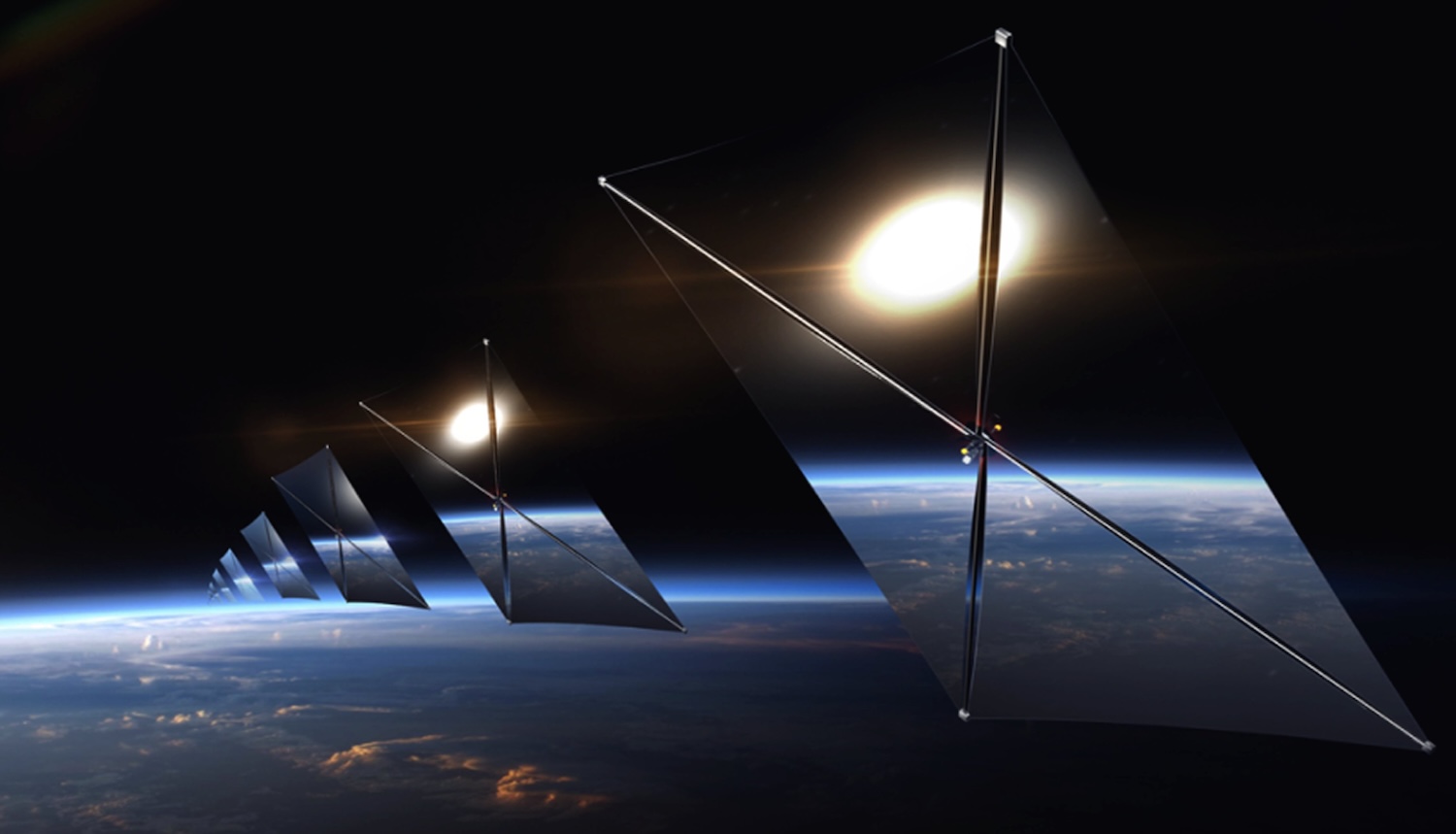
“In the early evening, it doesn’t take long to spot satellites and space junk – and they’re not deliberately designed to be bright,” astronomers Michael J. I. Brown and Matthew Kenworthy recently wrote in an op-ed for The Conversation. “To anyone looking through a telescope, the surface of each mirror could be almost as bright as the surface of the Sun, risking permanent eye damage.”
There is no easy solution to these problems. However, significant backing suggests the race is on. In April, Aetherflux reported a $50 million funding round. Two months later, Reflect Orbital announced it had raised $20 million in Series A funding. In the near term, space-based solar power could power the next generation of space technologies. However, if Aetherflux and Reflect Orbital are to be believed, we won’t have to wait long to see Peter Glaser’s vision realized, just in a slightly different form.