
Q&A: Will China and the BRICS fill the ‘leadership gap’ on climate change?
A timeline of key moments in BRICS and BASIC climate diplomacy, as well as other notable points in China’s climate diplomacy.
The framework was adopted at the BRICS summit in July, where a number of leaders gathered to sign a joint declaration demanding that “accessible, timely and affordable climate finance” is provided to developing countries.
The statement also highlighted the nations’ “resolve to remain united in the pursuit of the purpose and goals of the Paris Agreement”, featuring 21 paragraphs in a section on climate change spanning just transitions, carbon markets and critical minerals.
“It is encouraging that BRICS nations called for more climate lending, deeper green bond markets and better carbon accounting,” Mirela Sandrini, interim executive director for Brazil at the World Resources Institute, said in a statement. She added:
“South-south collaboration of this scale and ambition can inject much-needed momentum into international climate diplomacy ahead of COP30.”
However, the BRICS leaders’ declaration also “acknowledge[s] fossil fuels will still play an important role in the world’s energy mix, particularly for emerging markets and developing economies”.
Much of the recent BRICS focus on climate change is due to Brazil being “in the driver’s seat”, says Kate Logan, director of the China climate hub and climate diplomacy at the Asia Society Policy Institute (ASPI), speaking to Carbon Brief.
There has been frequent coordination between COP30, Brazilian and Chinese officials in the run-up to the conference.
Xi’s participation in the meeting also underscored growing solidarity between China and Brazil on accelerating climate action.
For the current Brazilian administration, China is an “essential partner in global climate solutions”, according to a briefing note published by the Brazilian climate network Observatório do Clima.
They add that Brazil, through its unique role in the world and current position, can help “fill the current vacuum” of climate leadership. They write:
“Brazil enjoys the respect of the international community because it often mediates the divisions between developed and developing countries in climate negotiations…The presidency of COP30 and BRICS adds to this, making the country a natural candidate to fill the current vacuum of climate leadership.”
However, the two countries’ climate approaches have diverged at times.
For example, she says, Brazil’s suggestion at COP26 of a “concentric” approach to cutting emissions, with emerging economies offering more stringent targets than other developing countries, was opposed by China, which wanted to “maintain the firewall” between developed and developing countries.
Many BRICS nations remain heavily reliant on fossil fuels, both for electricity generation and to support their wider energy systems.
However, this picture is starting to shift, with almost all BRICS members having adopted net-zero targets ranging from 2050 for Brazil, South Africa and others, through to 2060 for China and Russia, or 2070 for India.
More tangibly, the addition of new clean-power projects means that fossil-fueled electricity generating capacity now makes up less than half of the installed total in the BRICS group as a whole in 2024, as shown in the figure below.
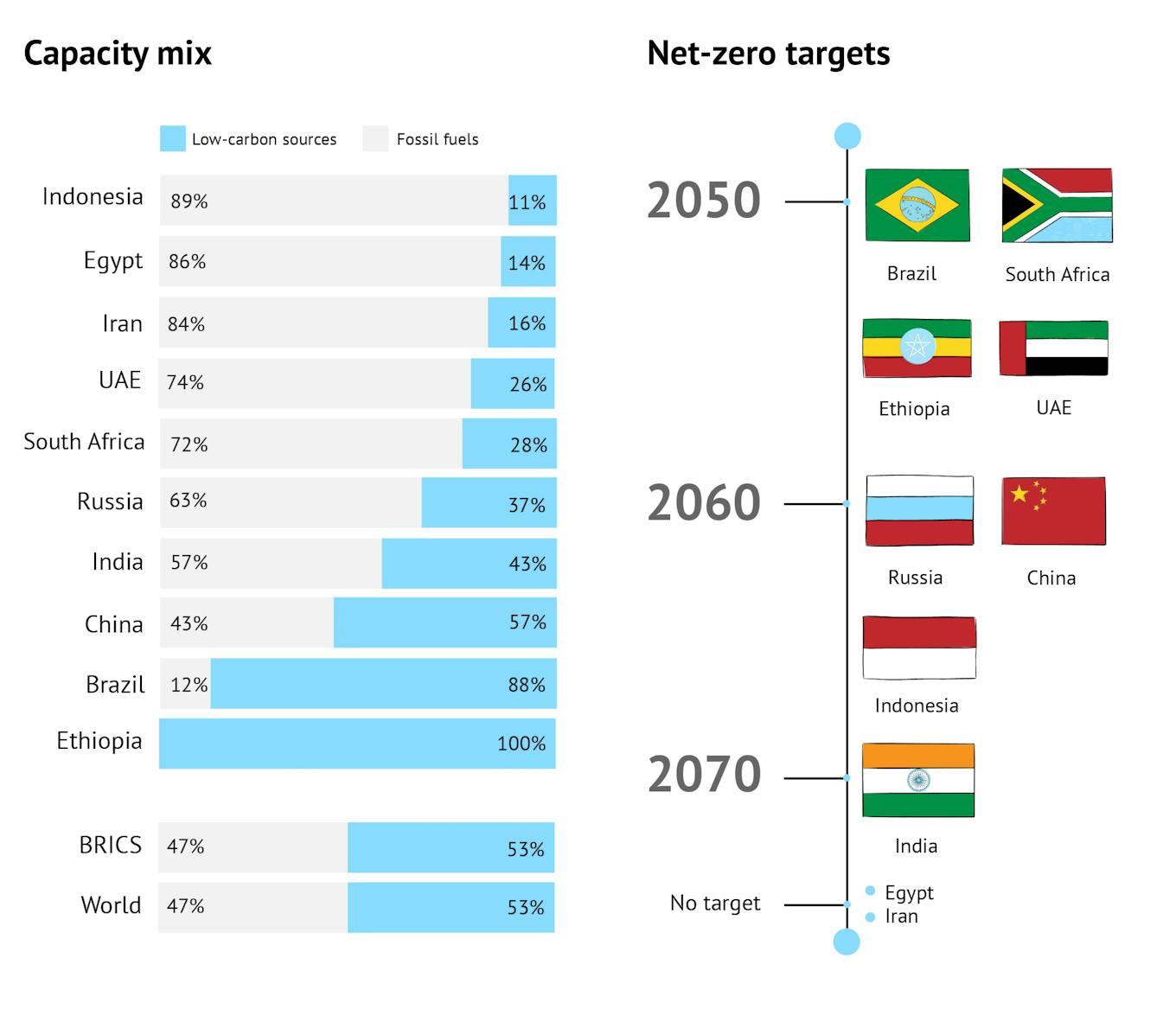
Left: The share of fossil fuels and low-carbon sources in the total installed electricity generating capacity of each of the BRICS countries, as of 2024, compared to the global average. Right: The year by which BRICS countries have pledged to reach net-zero. Source: Global Energy Monitor, Climate Action Tracker.
Non-fossil power, driven by “unprecedented” renewable energy growth in China, India and Brazil, accounted for 53 per cent of the installed electricity generating capacity in BRICS countries overall in 2024, according to recent analysis by the thinktank Global Energy Monitor (GEM). This puts them in line with the global average.
Ethiopia, Brazil and China boast higher-than-average shares of clean capacity – at 100 per cent, 88 per cent and 57 per cent respectively. India’s clean-capacity share stands at 43 per cent.
Continued BRICS focus on clean energy makes it “unlikely that fossil capacity will overtake non-fossil again”, James Norman, research analyst at GEM, tells Carbon Brief, adding that much of this is driven by significant renewable additions in some members, particularly China.
While some BRICS members are continuing to commission “significant amounts of new coal-fired capacity”, he says, it remains uncertain whether these new plants will be completed, or if they will go on to operate at full capacity.
Several BRICS members are also leading producers and exporters of fossil fuels. Russia is a major exporter of all types of fossil fuels, the Statistical Review of World Energy shows, while the UAE, Iran and Indonesia have large oil- or coal-exporting industries.
The data shows that China and India, meanwhile, are by some distance the world’s largest and second-largest coal users, respectively, predominantly fueled by domestic mining. China alone accounts for more than half of global coal production and use.
Norman acknowledges that “fossil dominance remains largely unchanged” among some BRICS members.
He states that countries such as Iran, with “entrenched modes of power production”, or with “limited strategic interest in overhauling the energy sector, such as Russia”, are on a different trajectory to countries such as Brazil or China.
Nevertheless, he says, the “strong economic case for solar and wind”, as well as the fact that nearly all BRICS countries have announced renewable energy targets, “makes continued growth in clean energy across the group highly likely”.
In the short term, meanwhile, the continued reliance of some members on fossil fuels might not lessen the BRICS group’s climate ambition overall. It is “notable” that Russia does not seem to be “blocking” the “solid outcomes” of recent BRICS climate negotiations, Logan tells Carbon Brief.
Indeed, the 2024 Kazan declaration, which featured a lengthy and detailed section on climate change, was released under the Russian BRICS presidency.
Still, the group is not a united front in all areas, for example the rivalry between China and India. Tensions remain high between the two countries on a number of issues, from border disputes to supply chains and geopolitical alliances.
This has spilled into climate-related topics, with India complaining about China’s construction of mega-dams in the Himalayas and launching anti-dumping investigations into solar imports from China.
At COP29, China and India at times took up conflicting stances during negotiations – most notably during the final stages of the climate finance deal, where China “helped prevent” efforts by India to block the deal, Logan wrote in an analysis for Dialogue Earth.
Another area of contention for India at COP29 was CBAM, which it said contributed to a “very, very competitive, hostile environment” that made it “difficult” to enable an energy transition.
By contrast, Logan tells Carbon Brief, China is “much less worried” about CBAM.
(Brazil, too, is unlikely to push hard to include CBAM and other “unilateral” trade measures in the COP30 agenda, Allan says, in order to maintain its “neutral” position as the holder of the COP presidency and the trust of other parties. Indeed, it is reportedly pushing for this issue to be taken up in a new forum, completely outside the climate talks.)
Nevertheless, India and China are united in climate negotiations by their commitment to ensuring all agreements uphold the principle of common but differentiated responsibilities and respective capabilities (CBDR-RC).
“This is something [in which] they’ll continue to be aligned”, Logan says, “but how it plays out in practice is where you start to see divergences”.
A recent rapprochement in China-India relations saw Indian Prime Minister Narendra Modi visit China for the first time in seven years.
The two countries also came together at the International Maritime Organization, where they successfully pushed for publicly-available data on shipping emissions to be anonymised.
Earlier, Brazil, China, South Africa and several other developing countries also lobbied against the creation of a global levy on shipping emissions.
Allen notes that whether or not BRICS and BASIC can align on climate may, ultimately, be a moot point, given that BASIC is just one of several coalitions that China operates in and that it is currently “less active” than other coalitions.
For example, she says, unlike the Like-Minded Developing Countries (LMDC) group, BASIC “doesn’t negotiate as a group in contact groups” at the UN climate talks. She adds:
“Multiple coalitions are a way for [a country] to multipl[y] their influence, while also perhaps hiding its individual views among those of the group.”
What is the economic impact of clean-tech?
Beyond the realms of climate diplomacy, it is increasingly clear that there is a hard-nosed economic reality to the positions being taken by China and other BRICS nations.
Indeed, as China works with Brazil and the BRICS to centre emerging markets’ concerns in climate policy, it also plays a key role in the economics of the energy transition.
The country accounts for more than 80 per cent of global solar manufacturing, more than 70 per cent of electric vehicle production and more than 75 per cent of battery production.
While most of this is consumed domestically, exports of each of these categories – which it often calls the “new-three” – are “booming”, finance news outlet Caixin reports.
Historically, these exports would have been destined for developed countries. But, in 2024, “half of all China’s exports of solar and wind power equipment and electric vehicles (EVs) [went] to the global south”, Lauri Myllyvirta and Hubert Thieriot, lead analyst and data lead at the Centre for Research on Energy and Clean Air (CREA), write at Dialogue Earth.
Separate analysis by Myllyvirta for Carbon Brief revealed that China’s exports of clean-energy technologies in 2024 alone will reduce emissions in the rest of the world by 1 per cent, avoiding some 4 billion tonnes of carbon dioxide (CO2 over their lifetimes).
Moreover, clean-energy industries accounted for more than 10 per cent of China’s GDP in 2024 for the first time ever, driving a quarter of economic growth that year.
Meanwhile, Chinese lending overseas is also increasingly focused on low-carbon infrastructure, according to the Boston University Global Development Policy Center.
Their analysis finds that the “share of renewable energy in China’s portfolio has increased significantly”, with solar and wind projects “dominat[ing]” the types of projects funded in 2022 and 2023.
This stands in sharp contrast to typical Chinese lending activity before 2021, which showed a preference for conventional power projects, such as coal and hydropower.
According to Myllyvirta and Thieriot, the “important role that clean-energy technology plays in the country’s economy and exports” will encourage China to ensure that the global energy transition “keeps accelerating”.
They add: “That will be seen in bilateral lending and diplomacy, and could also lead the country to take more forward-leaning positions in multilateral climate negotiations.”
Will China and the BRICS emerge as climate leaders?
With the withdrawal of the US from the Paris Agreement under the Trump administration, there have been increasing calls for China to take up the mantle of climate leadership.
Many are watching for signs of whether China’s upcoming international climate pledge, which may be published by the UN general assembly meeting next week, will contain ambitious targets that will encourage greater global ambition.
Beatriz Mattos, research coordinator at Brazil-based climate-research institute Plataforma CIPÓ, tells Carbon Brief that China’s position as a “major investor in the renewable energy sector” means there is “enormous potential” for both it and the BRICS to assume a climate leadership role.
China, at least publicly, is eschewing these calls. In an interview with state-owned magazine China Newsweek, climate envoy Liu Zhenmin said in response to a question about China’s climate leadership that the calls are just “the west giving us a ‘tall hat’” – an expression meaning trying to flatter China. He added:
“Of course, within their respective camps, major countries should play a more leading role, such as the EU and US in the developed countries camp, and the BASIC countries in the developing countries camp. But BASIC cannot be a substitute for all developing countries, and developing countries will still participate in [climate] negotiations within the framework of ‘G77+China’. This is the basis for cooperation in the global south.”
Notably, this does not seem to preclude China from agreeing to “demonstrate leadership” in tandem with others, as seen in an EU-China joint statement on climate change published in late July.
BASIC is “important for China in climate negotiations given the influence of other large emerging economies”, Yixian Sun, associate professor in international development at the University of Bath, tells Carbon Brief.
“On many issues (especially sensitive issues regarding its developing country status), China doesn’t want to stand out by itself,” he says, with the grouping providing cover in negotiations.
Mattos agrees, stating that “remaining part of this group serves as a way [for China] to reinforce its identity as a developing country in climate negotiations”.
More broadly, it will likely continue to align with the other BRICS nations, when this offers a way to advance its positions in climate negotiations.
Sun expects Brazil and China to sustain their elevated levels of climate cooperation even after Brazil hands over the COP presidency, based on their 2023 joint statement. However, he says there are still questions around what new bilateral climate initiatives would look like and how “concrete” they would be in practice.
Looking ahead, Logan notes, BRICS could also be in a position to sustain its influence if India hosts COP33 in 2028.
“BRICS has in multiple documents endorsed India’s bid for COP33”, she says, which, given India’s presidency of BRICS in 2026, could allow Brazil and China to “influence India in a more constructive direction” on climate, over a number of years.
This story was published with permission from Carbon Brief.