
The Problem With AI Image Detection Tools
Leading AI Image Detection Tools Mislead Online Users, Often Declaring Authentic Content Fake
AI detection tools have been known to occasionally misidentify AI-generated images as real, but a new NewsGuard audit of leading AI detection tools found what may be a more concerning weakness: Three of the five leading tools we tested often get fooled by real images. According to NewsGuard’s findings, the tools collectively declared authentic images to be AI-generated 13.33 percent of the time, and one tool got it wrong 40 percent of the time.
This vulnerability has potentially significant real-world consequences, empowering bad actors to dispute reality by citing a detection tool to argue that a given image is fake. It also unfairly maligns those posting the real images.
In late April and early May 2026, NewsGuard tested 15 authentic photos related to the war in Iran published by credible outlets, running them through five leading AI detection models — Hive, AI or Not, ZeroGPT, Sightengine, and ScamAI. All five tools market themselves as being able to distinguish AI-generated images from authentic ones.
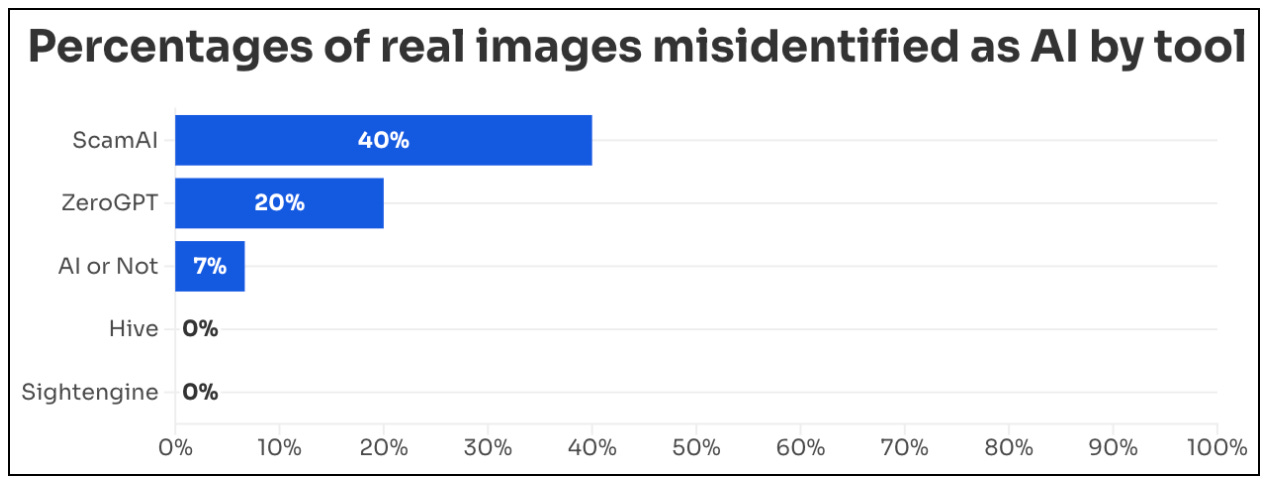
Of the five models, ScamAI — which proclaims its “Industry-leading accuracy” on its website — misidentified the most images, declaring that six out of 15 (40 percent) of the authentic images were AI-generated. ZeroGPT classified three of the 15 real images (20 percent) as fake, and AI or Not got fooled one time (6.67 percent). Hive and Sightengine correctly identified all 15 authentic images as real.
Read the full report here.
Learn more about Reality Check’s Premium Membership here.
False Claim of the Week: Ivermectin Can Prevent or Treat Hantavirus Infections
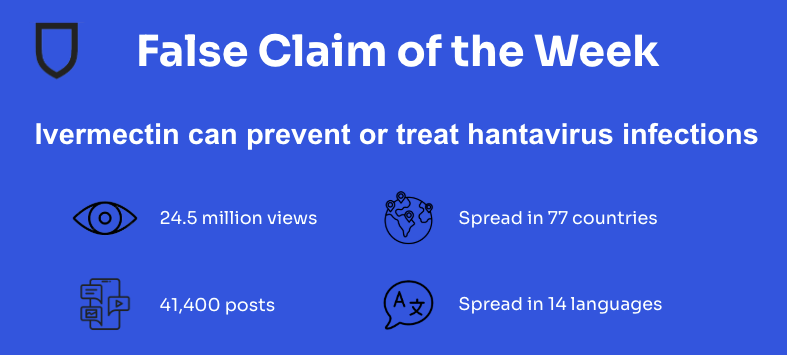
NewsGuard’s “False Claim of the Week” highlights a claim from NewsGuard’s False Claim Fingerprints, a proprietary database of provably false claims and their debunks. The claim that ivermectin can prevent or treat hantavirus infections is NewsGuard’s “False Claim of the Week” due to its widespread appearance across social media platforms and websites, its high engagement levels, and the high-profile nature of the sources promoting it. Those three factors, as well as its significant subject matter and potential for harm, make it our False Claim of the Week.
Debunk: No, Marjorie Taylor Greene: There’s No Evidence Ivermectin Treats Hantavirus
By John Gregory
What’s happening: Social media users, including former Rep. Marjorie Taylor Greene, are falsely claiming that antiparasitic drug ivermectin can treat or prevent infections from hantavirus, a virus making headlines as it spreads aboard a Dutch cruise ship headed to Spain’s Canary Islands.
Context: Hantavirus, a severe and potentially deadly virus that can cause disease affecting the lungs, heart, and kidneys, has been identified onboard the MV Hondius, an Oceanwide Expeditions cruise ship that departed from Argentina on April 1, 2026, carrying approximately 150 passengers.
- A May 6, 2026, X post from the World Health Organization stated that as of May 6, eight cases of hantavirus had been identified onboard the MV Hondius. Oceanwide Expeditions stated in a May 4 press release that three people on the ship had died.
A closer look: Almost immediately after the outbreak, social media accounts began touting ivermectin as a treatment or cure for hantavirus.
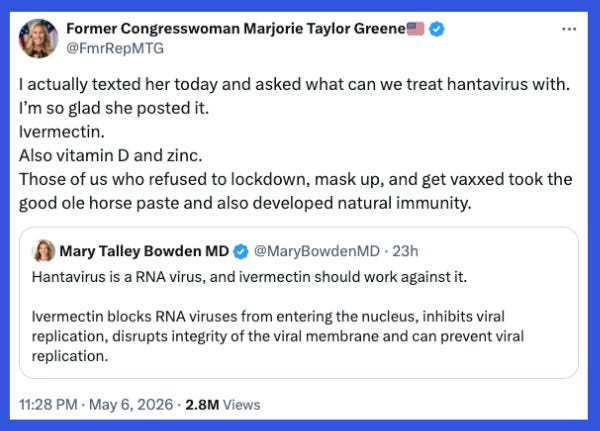
- Dr. Mary Talley Bowden — a Houston-based ear, nose, and throat specialist who often promotes the false claim that ivermectin can treat COVID-19 — said in a May 6 X post: “Hantavirus is a RNA [ribonucleic acid] virus, and ivermectin should work against it. Ivermectin blocks RNA viruses from entering the nucleus, inhibits viral replication, disrupts integrity of the viral membrane and can prevent viral replication.” Bowden’s post, which provided no evidence to support its claims, received 3.5 million views and 42,000 likes in one day.
- Former U.S. Rep. Marjorie Taylor Greene, a Georgia Republican, reposted Bowden’s post and added: “I actually texted her today and asked what can we treat hantavirus with. I’m so glad she posted it. Ivermectin. Also vitamin D and zinc.” Greene’s post received 2.8 million views and 10,000 likes in one day.
- Greene, formerly a major voice in the MAGA movement who resigned from Congress in January 2026 amid a dispute with President Trump over the Epstein files, did not respond to a message sent by NewsGuard through X seeking comment on her post.
Actually: There is no evidence that ivermectin can treat or prevent infections from hantavirus.
- Dr. Amesh Adalja, an infectious disease specialist and senior scholar at the Johns Hopkins Center for Health Security, told NewsGuard in a May 7 email, “There’s zero evidence supporting the use of ivermectin for the treatment of hantavirus.”
- The WHO said in a May 6, 2026, fact sheet posted on its website: “There is no licensed specific antiviral treatment or vaccine for hantavirus infection. Care is supportive and focuses on close clinical monitoring and management of respiratory, cardiac and kidney complications.”
Zooming out: The ivermectin claim is one of six false narratives related to hantavirus identified by NewsGuard that are going viral online.
- NewsGuard has also debunked claims that a passenger onboard the Dutch cruise ship is a “crisis actor,” that China has banned entry to U.S. citizens due to the outbreak, that no stain of the virus can spread from human to human, that WHO pandemic exercises in April 2025 and April 2026 prove that the outbreak was planned, and that hantavirus infections are a COVID-19 vaccine side effect.
This newsletter was edited by Sofia Rubinson and Eric Effron.
You find, we report: Let your fellow Reality Check readers know about false claims you run across online. Our analysts debunk false claims before any others 80% of the time, but we can’t catch everything. If you find what looks like a false claim, let us know. We’ll investigate and report back in Reality Check.
Reality Check is produced by co-CEOs Steven Brill and Gordon Crovitz, and the NewsGuard team.
We launched Reality Check to shed light on the false claims spreading online, how they spread, and the forces behind them. Each day, we aim to bring you the story behind your news feed and help you stay informed about the false claims circulating in the news. Support our work by becoming a premium member.
Have feedback? Send us an email: realitycheck@newsguardtech.com.
Related Knowledge Center: Artificial intelligence
On top of a failing business model, newsrooms must navigate the powerful — and not fully reliable — new capabilities of artificial intelligence and the deployment of large language models.
State of the business model | Copyright and intellectual property
Related Knowledge Center: Fact-checking and its detractors
Fact-checking has become a familiar tool for political reporters to hold office-holders and candidates accountable. But critics ask if fact-checkers sometimes miss the forest for the trees, and if the practice often struggles with false equivalency the way conventional political coverage does.