
In praise of an utterly human, definitely non-AI voice
Ain’t nothin’ like the real thing, baby, as Marvin Gaye and Tammi Terrell sang, way before anybody had ever heard of Artificial Intelligence.
I thought about that again for a lot of different reasons this past week.
One was a social media post by a young journalist I follow — thirty-two year-old Dale Shoemaker of Buffalo’s Investigative Post, who broke a big story a couple of months ago about a Burmese immigrant who died after being irresponsibly treated by federal customs agents. It was picked up everywhere and New York’s attorney general is investigating. (Side note: Will Bunch of the Philadelphia Inquirer, whom many of you admire, as I do, praised that reporting in an email to me: “One more case where small indie journalists are keeping the flame alive while the billionaires buy everything else.”)
Shoemaker wrote: “I write hard-hitting, deeply sourced investigations about vulnerable people in a Rust Belt city. This work involves public records requests, data analysis, door knocking, numerous phone calls, translation, etc. If you think this work can be AI-ed, you’re out of your goddamn mind.”
He was commenting on what Megan McArdle, the “center-right” columnist of the Washington Post had to say about her practices: “I use AI to do research (i.e., find things to read, explain parts of academic papers I find ambiguous or confusing), transcribe interviews, generate pushback on my column thesis, suggest trims when I’m over my word count, sharpen podcast interview questions, and perform a final fact check on columns and editorials. But mostly it’s compressing the ancillary tasks to the main job: reading, thinking, and writing.” As one professor quipped, this reminds him of students who explain they only use AI to conceive the idea, outline the paper, suggest counterarguments, and improve the language.
Separately, McArdle advised journalists to “think of your chatbot as a combination of an intern, a first-pass editor, and a fact-checker. Its job is to do grunt work and help you turn in cleaner copy, not to ‘inspire’ you.” In a nuanced piece in The Argument, which she founded, Jerusalem Demsas expressed her belief that “there’s a version of this work that can’t be replicated by a machine — journalism that’s built on judgment, voice and a willingness to say things that are true but uncomfortable.”
I agree with that point from Demsas, and with Shoemaker, who told me when I called him up Monday that he prefers to do his own work — that it is, for him, “a question of honor, almost.” What’s more, he notes, AI makes a lot of mistakes and if any of them ever crept into his published journalism, “I would be mortified.” He added: “There are too many landmines.” Indeed: The New York Times has just cut ties with a freelance book reviewer for his use of AI, which apparently borrowed from a Guardian review of the same book.
I was thinking about the kind of writing that AI could never do and in fact discourages, like a passage from Henry David Thoreau that E.B. White — in his great essay about Walden, “A Slight Sound at Evening” — admired. Here is Thoreau’s passage: “I have surveyed the country on every side within a dozen miles of where I live. In imagination, I have bought all the farms in succession, for all were to be bought, and I knew their price. I walked over each farmer’s premises, tasted his wild apples, discoursed on husbandry with him, took his farm at his price, at any price, mortgaging it to him in my mind, even put a higher price on it — took everything but a deed of it — cultivated it, and him too to some extent, I trust, and withdrew when I had enjoyed it long enough, leaving him to carry it on.” White’s comment: “A copy-desk man would get a double hernia trying to clean up that sentence for the management, but the sentence needs no fixing, for it perfectly captures the meaning of the writer and the quality of the ramble.”
The authentic sound of the human voice.
As I mentioned in an earlier post here, I do not use AI here in American Crisis or for my Guardian columns. Just like my young friend in Buffalo, I write my own stuff.
American Crisis is a community-supported project where I explore how journalism can help save democracy. Please consider joining us!
On another subject: The New York Times drew lots of angry criticism last year for not giving enough attention to the massive “No Kings” protests around the country. I dinged them myself last time for having only a small photo presence on the print Sunday front page, teasing to a story inside.
The printed newspaper is not the best indication of the paper’s priorities, but it’s still a useful window.
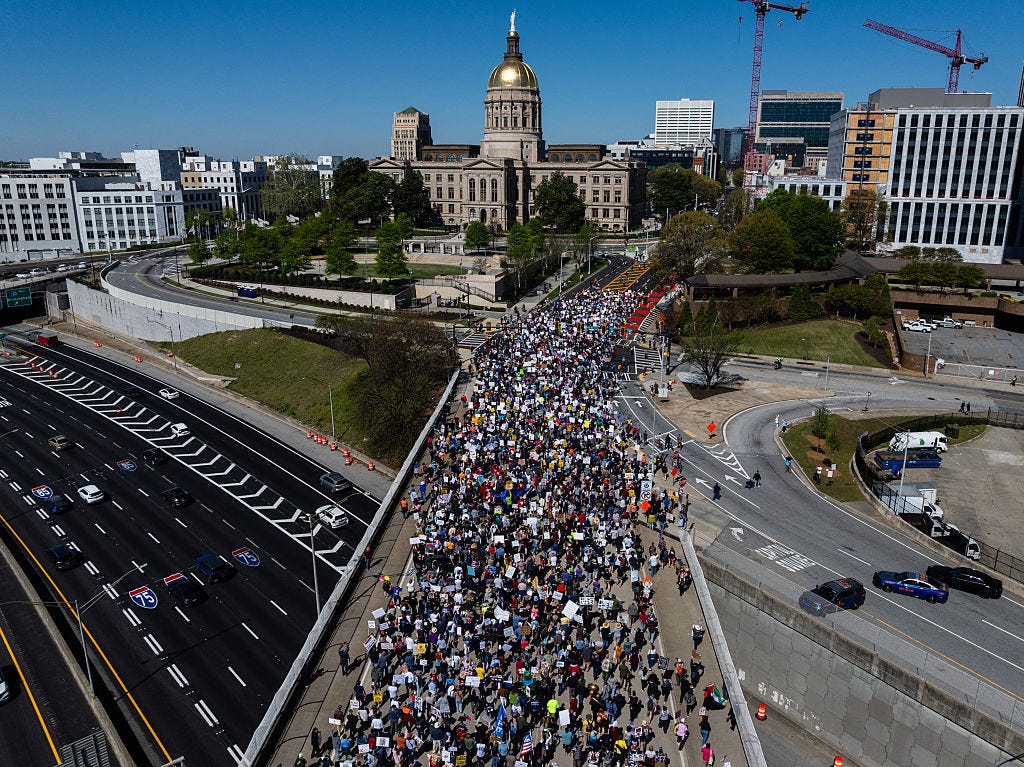
This time, the Times did give No Kings a lot of ink (quite literally), with four photographs above the fold on Sunday and a front-page story, too. The photos showed protests in Atlanta, Omaha, St. Paul and Washington, DC. Two inside pages were covered with related stories or the continuation of the first one, with multiple photographs. The front-page story, by Jeremy Peters, was headlined, “Will Primal Scream of ‘No Kings’ Echo in Voting Booths?”
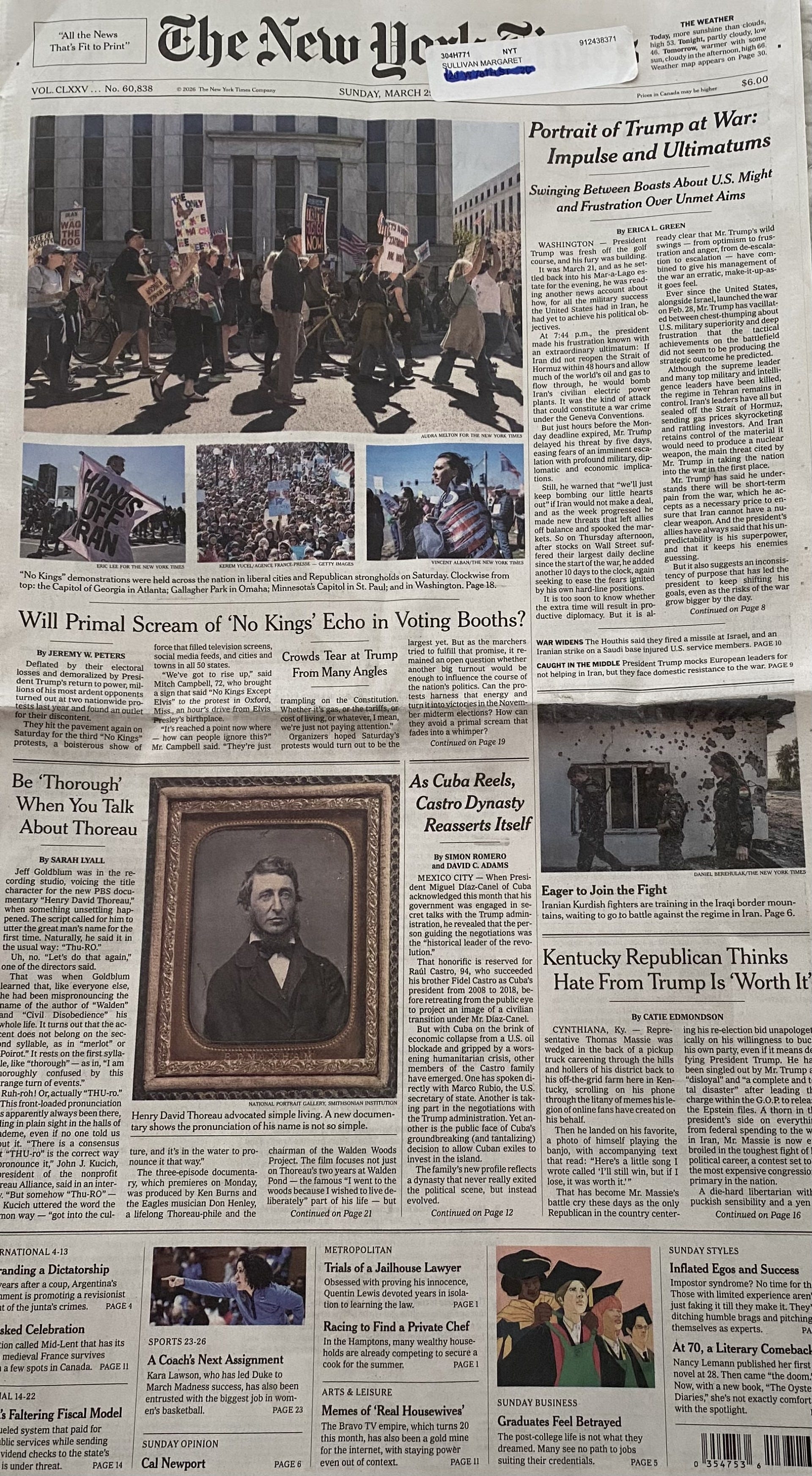
It gave voice to the protesters, and then raised some doubts about effectiveness: “….it remained an open question whether another big turnout would be enough to influence the course of the nation’s politics. Can the protests harness that energy and turn it into victories in the November midterm elections? How can they avoid a primal scream that fades into a whimper?”
The story’s underlying suggestion — the protests may not translate into change — drew criticism, including from the eminent historian Timothy Snyder, author of “On Tyranny,” with its much-quoted (and sadly much-ignored) first rule for rejecting creeping authoritarianism: “Do not obey in advance.”
Snyder’s comment: “The premise of this article makes no sense. There is no either/or between protests and organizing. It is a plus/and. Getting millions of people out is organizational work! A huge amount of it done by thousands of people. And those very same Americans are also doing the other work.”
My take: I was glad to see the amount and display of the coverage — a big change that suggests that editors found the complaints to have validity. And I also think Snyder’s point is fair, there’s no disconnect between protests and midterm voting. Quite the contrary. But if the story’s deeper question is “will the protests translate into midterm victories that begin to control Trump’s destructive excesses?” — well, that’s a question worth asking.
Readers, here’s a gift link to the story. I’d love to hear your point of view on the story itself and the deeper question — and of course, your own experience at the protests. I know many of you were planning to be out there.
One more thing about the Times: Here’s a podcast that an editor from the paper’s trust team, Mike Abrams, did recently with Columbia Journalism Review, discussing many of the issues that come up here.
And finally, in this Holy Week for Roman Catholics, Pope Leo gets the last word. He appeared to rebuke the execrable Pete Hegseth who recently prayed for violence against those who merit “no mercy.” God will reject any such prayers, the pontiff said, quoting from the Bible: “Even though you make many prayers, I will not listen. Your hands are full of blood.”
Readers, thank you so much for being here, for subscribing, sharing, commenting and caring about journalism and democracy. Your interest and support means a great deal to me, and I’m grateful.
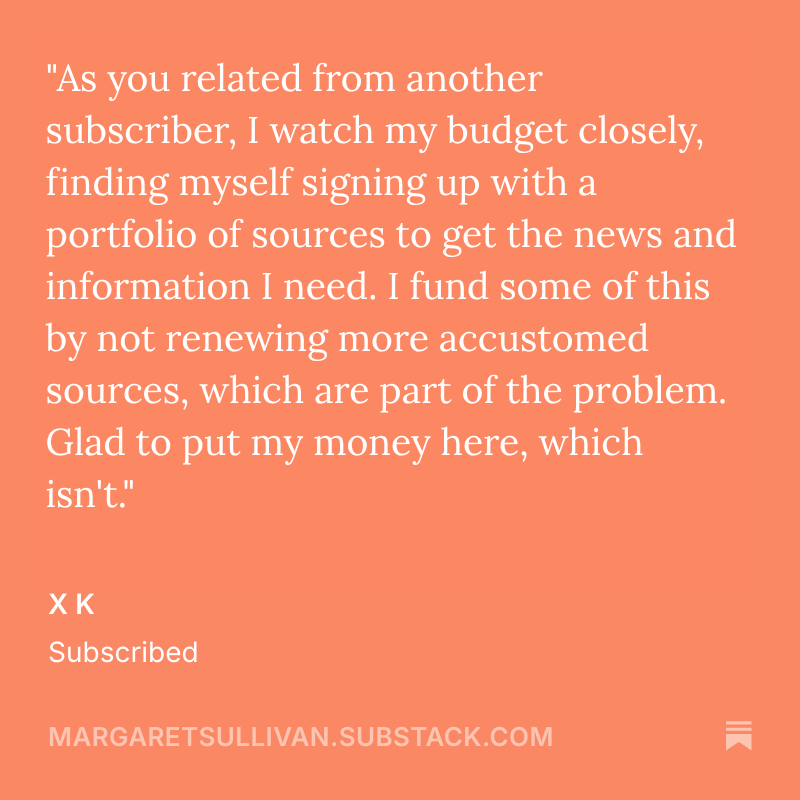
Here’s why one reader became a paid subscriber last week, and after that, some information for newcomers.
My background: I am a Lackawanna, NY native who started my career as a summer intern at the Buffalo News, my hometown daily. After years as a reporter and editor, I was named the paper’s first woman editor in chief in 1999, and ran the 200-person newsroom for almost 13 years. Starting in 2012, I served as the first woman “public editor” of the New York Times — an internal media critic and reader representative — and later was the media columnist for the Washington Post. These days, I write here on Substack, as well as for the Guardian US. I’ve also written two books, taught journalism ethics, and won a few awards, including three for defending First Amendment principles.
The purpose of ‘American Crisis’: My aim is to use this newsletter (it started as a podcast in 2023) to push for the kind of journalism we need for our democracy to function — journalism that is accurate, fair, mission-driven and public-spirited. That means that I point out the media’s flaws and failures when necessary.
What I ask of you: Shortly after Trump’s election in November of 2024, I removed the paywall so that everyone could read and comment. I thought it was important in this dire moment and might be helpful. If you are able to subscribe at $50 a year or $8 a month, or upgrade your unpaid subscription, that will help to support this venture — and keep it going for all. Thank you!