
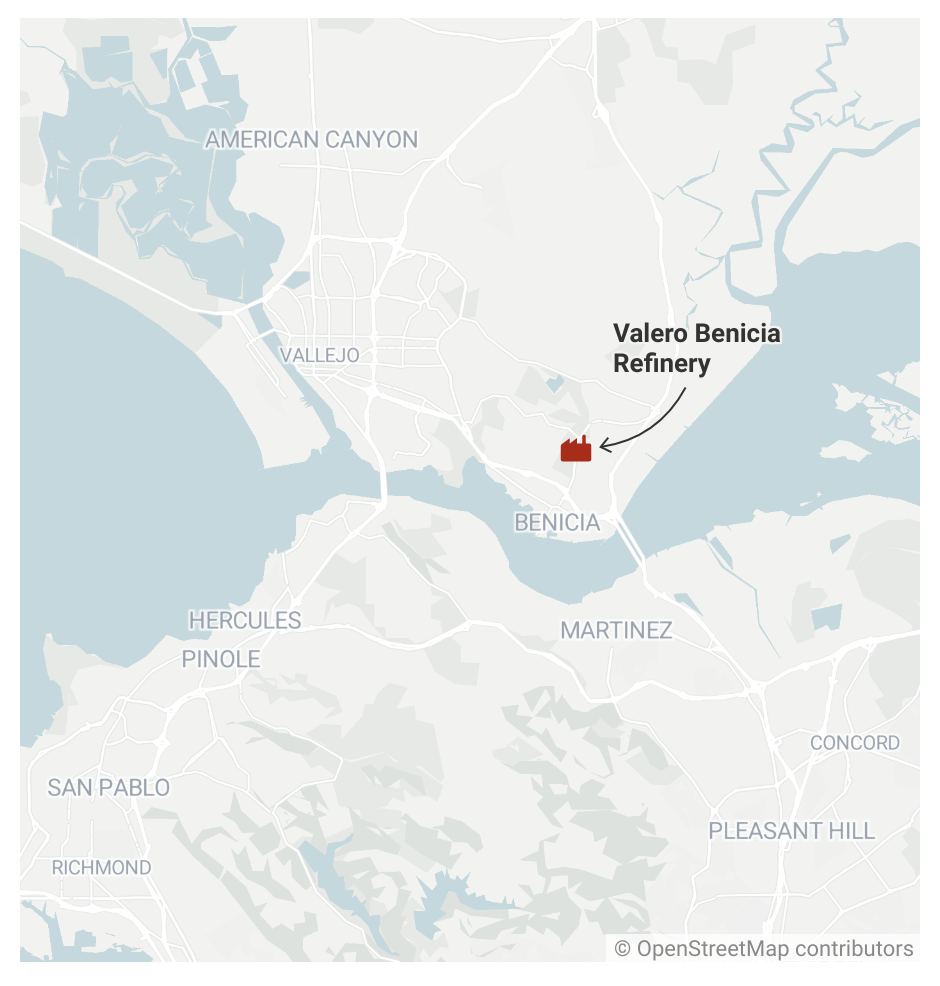
Potential Valero Refinery Closure Leaves Benicia, State Officials Scrambling for Alternatives
“We need to get moving on this quickly because 12 months is not a long time given the severity of the economic impact,” said Young, noting that nearly 20% of Benicia’s $60 million budget comes from the refinery. “I think that’s part of my frustration, is how little time we have to try to plan for some kind of an alternative.”
Shutting down the facility, he added, would also be a major blow to the hundreds of residents who work there, not to mention the scores of restaurants, hotels and other businesses that provide services to those workers in this city of some 27,000 residents.
The Valero refinery is also the exclusive supplier of jet fuel to nearby Travis Air Force Base, which it delivers through a direct pipeline.
“If that is stopped, what does that mean to the base?” Young said. “Travis uses an amazing amount of fuel to fly all their planes, much more than can be easily replaced, and certainly not replaced within a year. So I think that this becomes a matter of real concern to the Defense Department and it’s potentially a national security issue.”
Valero dropped its bombshell April 16 announcement roughly six months after regional and state air regulators fined the company a record $82 million for secretly exceeding toxic emissions standards for at least 15 years. And last month, city leaders voted unanimously to impose moderate new safety regulations on the facility.
“I suspect that compared to other refinery operators, they’re a pretty good business operator. But they’ve also had a pretty bad track record on public safety,” said Terry Mollica, who leads a group of residents that pushed for the city’s new safety rules to increase oversight of the refinery.
But Mollica said that he doesn’t think anybody in his group is particularly excited about the possibility of the facility closing altogether.
“There would be long-term and short-term impacts on the community,” he said. “People would lose their jobs. None of us want to see that happen particularly.”
Valero has owned and operated the Benicia refinery since 2000. The refinery was originally built in 1968 for Humble Oil, later called Exxon, and began operations the following year.
Its possible closure comes amid a growing exodus of traditional oil refiners in California. Phillips 66’s refinery in Rodeo and Marathon’s facility in Martinez both recently converted operations to biofuel production. Phillips 66 also plans to close its Los Angeles-area refinery — the seventh largest in the state — later this year.