
Polls, pundits and horserace coverage are NOT what we need for the midterms.
Is the mainstream news media hopeless?
If I thought so, I wouldn’t be writing this newsletter to advocate for journalism that serves the democracy.
But with the incredibly consequential midterm elections just around the corner — Election Day is only 10 weeks away — I’m not optimistic.
Just look at what’s happened in recent weeks.
Polls have badly misread two primary elections, one in Michigan and one in Wisconsin.
“This year, several Democratic campaigns have seized on unreliable polls to push the perception that their candidates are surging to try to solidify support, attract donors and scare off rivals. The rise of prediction markets has also created financial incentives for untrustworthy or even fake political polls…” according to this New York Times story published over the weekend.
Meanwhile, pundits have been laser-focused on Trump’s devoted aide, Natalie Harp. (Don’t get me wrong; this is a legitimate and certainly a captivating story, but surely not the only one, though it almost seems that way.)
The media also is hung up on sticking labels on Democratic factions — socialist! centrist! progressive! — and in pointing out the extremes on the left while normalizing the extremes on the right.
Longtime newspaper executive Melanie Sill has a great perspective on the labeling issue, and why it misses something essential.
“Political labeling — leftist, left-wing, progressive, MAGA — replaces reporting on specific candidates or local issues driving votes.”
In North Carolina, where she lives, “people picking ‘unaffiliated’ as their voter identity are now the biggest chunk of the electorate.”
She adds: “We’re seeing generational change in politics, change emerging at the grassroots. We need such change in journalism — without it, we’re missing the people and conversations driving change and instead reporting on them only in hindsight.”
And Sill believes that horserace coverage has gotten worse in this cycle. “Missing almost entirely: What are candidates promising, or what have they done about health care, inflation, and the health of our democracy?”
In New York City, the success of Mayor Zohran Mamdani makes the point. During his mayoral primary against Andrew Cuomo, there was a huge media freakout about Mamdani’s identification as a democratic socialist. (I wrote about the New York Times’s problematic coverage during the campaign in the Guardian US).
But now in office, Mamdani has proved to be immensely popular so far, with an astonishing 69 percent approval rating among NYC voters according to recent Siena University research.
He’s done that in large part by staying sharply focused on the major issue that got him elected — affordability. And by reaching voters (especially younger voters) where they are: for example, on social media, where his Instagram account has 12 million followers.
My hope for the midterms coverage is that it emphasize the issues that we know Americans care about deeply — again, as Sill puts it, health care, inflation and the overall state of the nation and its democracy.
American Crisis is a community-supported project where I explore how journalism can help save democracy. Please consider joining us!
Those who win elections will focus tightly on those issues. Those who cover elections should, too.
And journalists should reduce — if not drop altogether — the incessant labeling, the division-making, and the “democrats in disarray” obsession, which ignores and normalizes the outright insanity on the right, led by Donald Trump.
A couple of years ago, the brilliant press critic Jay Rosen of NYU coined an elegant phrase to describe the kind of journalism he recommended but rarely encountered. The media, in his vision, would cover “not the odds, but the stakes.” Not the horserace, in other words, but why particular elections matter.
These coming midterm elections matter because they hold the possibility of political change that would hold Trump accountable for his innumerable misdeeds. (I wrote about his brazen self-enrichment, for example, for the Guardian US last week.)
That point should be driven home hard and constantly. We know that the media is capable of obsessing about a topic. At the moment, it’s Natalie Harp. Once upon a time, it was President Biden’s health.
What if the obsession were about the promise of accountability and the return to some semblance of checks and balances? Those are the stakes.
Readers, I know in these last weeks of summer, it’s tempting to tune out and check out. I hope you won’t. What’s ahead is too important.
Let me know what media coverage you’d like to see more of — and less of — in the next 10 weeks. And if you agree with Melanie Sill and Jay Rosen about what needs to change.
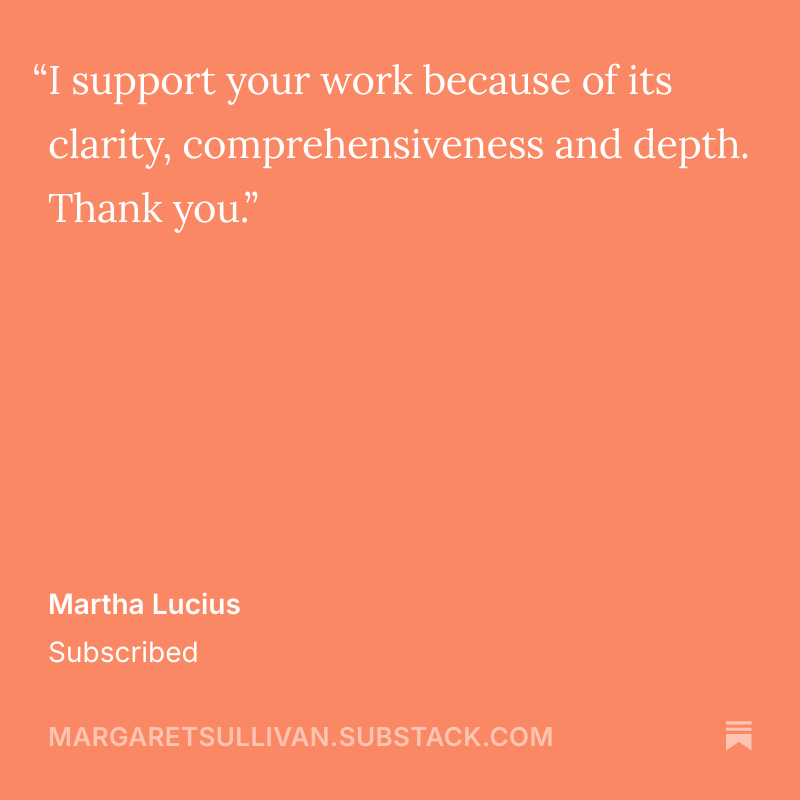
Thank you for being here and caring about these issues. I hope you’ll be with me as the midterm coverage unfolds. I appreciate your support immensely. And I especially want to thank those who have become paid subscribers, like this reader below.
My background: I am a Lackawanna, NY native who started my career as a summer intern at the Buffalo News, my hometown daily. After years as a reporter and editor, I was named the paper’s first woman editor in chief in 1999, and ran the 200-person newsroom for almost 13 years. Starting in 2012, I served as the first woman “public editor” of the New York Times — an internal media critic and reader representative — and later was the media columnist for the Washington Post. These days, I write here on Substack, as well as for the Guardian US. I’ve also written two books, taught journalism ethics, and won a few awards, including three for defending First Amendment principles.
The purpose of ‘American Crisis’: My aim is to use this newsletter (it started as a podcast in 2023) to push for the kind of journalism we need for our democracy to function — journalism that is accurate, fair, mission-driven and public-spirited. That means that I point out the media’s flaws and failures when necessary.
What I ask of you: Shortly after Trump’s election in November of 2024, I removed the paywall so that everyone could read and comment. I thought it was important in this dire moment and might be helpful. If you are able to subscribe at $50 a year or $8 a month, or upgrade your unpaid subscription, that will help to support this venture — and keep it going for all. Thank you!