
Passive vs. Active News Consumption and Updating the Pictures in Our Heads
One of the most significant problems in the news business these days seems to me to be that the pictures in our heads of how people get their news are quickly becoming outdated. I have written about this before, but this week want to try again, from a different angle, because it’s really important.
When we think about sources of news, we tend to imagine people making choices: Do they subscribe to particular newspapers, magazines, newsletters or podcasts? Do they listen to particular radio shows or stations, or watch television news or YouTube? Do they get news from social media, or, more recently, perhaps from AI agents? These are our competitors for their attention, we often think, and it’s quite a noisy jumble.
Brave new world?
But what if that’s not how it works anymore? I was moved to return to this question by a survey, passed along by a Montana publisher, that was commissioned last winter by the Greater Montana Foundation and released late last month. It found that about two thirds of Montanans were consuming news that was just delivered to them, rather than actively sought by them.
Before you reject that as a thin reed on which to base a big claim, here’s a larger national study of 12,000 people last year that found that 40% of registered voters said that “news comes to me,” as opposed to “I actively seek out news.” (And it’s worth bearing in mind that more than a quarter of adult citizens are not registered to vote—a group I think we can safely assume tends to be less active in its news consumption.) This trend toward passive news is not new, but it seems to be accelerating.
What does it mean to be a passive rather than active consumer of news? Such a posture would include getting news from friends, from a social media feed to the extent that you do not follow publishers, journalists or politicians, from screens in elevators, airports, taxis and other public places, from broadcast inserts and bulletins, maybe from print publications lying around at work or in places you visit.
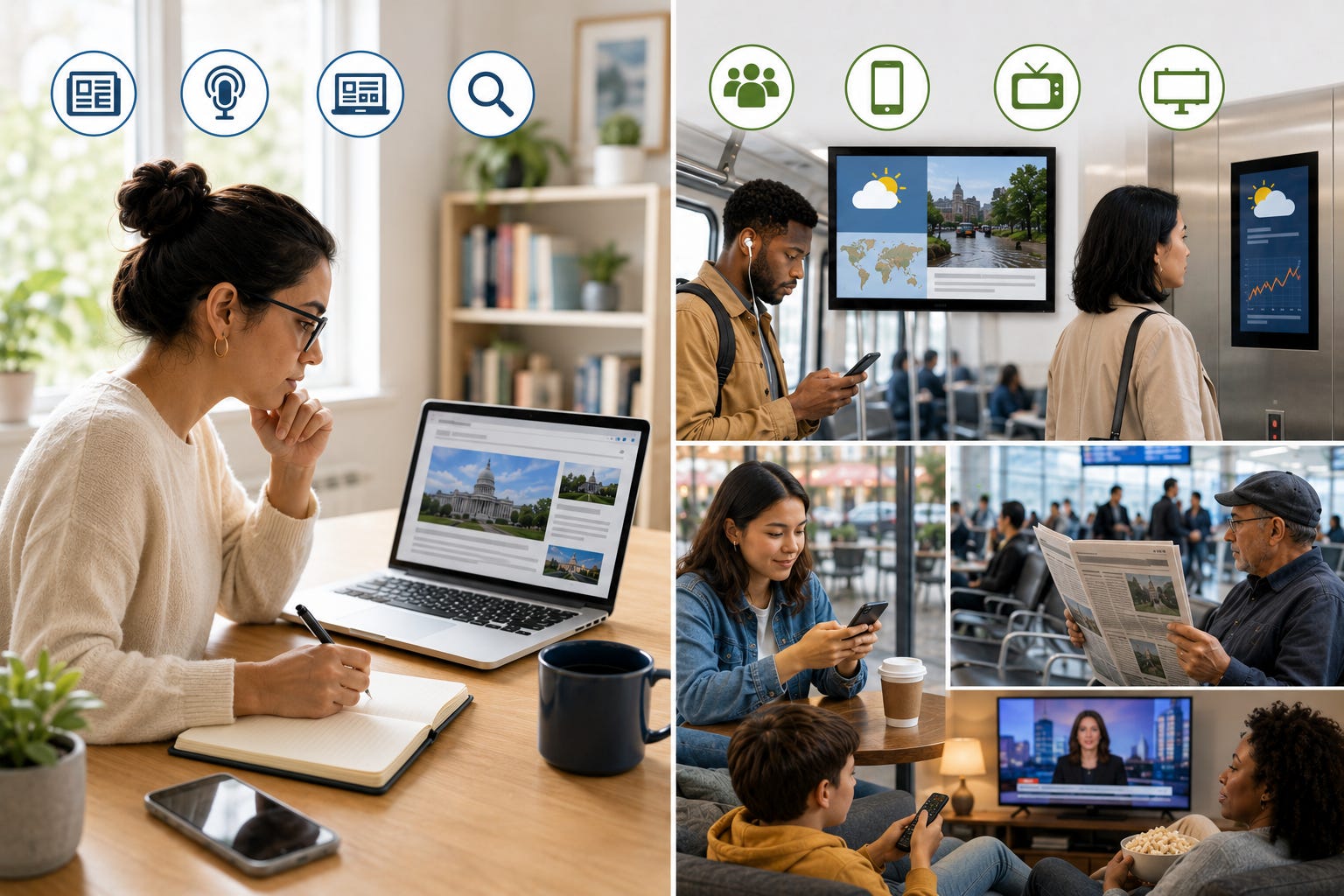
It’s also more complicated than that, of course, because even those who actively seek out news, subscribing as they will, engaging in appointment listening and viewing, and carefully curating their feeds, will also get news from friends, keep scrolling after clicking with intention, bump into news in the physical world in the same manner as passive news consumers.
We don’t know enough about how this really works
We know all this is happening, but have precious little quantification of it. What data we do have, moreover, may not be all that reliable. When asked by a researcher where you get your own news, for instance, would you be inclined to include the video you saw after the one you clicked on, or the screen in your office building’s elevator? Likely not.
I have frankly no more idea about how we can get those who receive news only passively to convert to active consumption than I do about how to get non-voters to register. (Actually, it’s less—as we know automatic voter registration legislation works.) But I do think a passive approach to news is becoming more widespread, likely in response to the seeming ubiquity of information, possibly because so much of the news in recent years has been dispiriting, perhaps because some of the greatest long-term trends in our society—growing inequality and attendant corruption—seem impervious to change.
Whatever the reason, more consumers are moving beyond what consultants might call the “addressable market” for news. Passive news consumers, of course, aren’t going to subscribe or follow or donate. For passive news consumers, “good enough” is sufficient by definition, because it’s all they see.
Understanding this trend, and gathering more detail on its contours, seems imperative. The industry urgently needs better research on the true behavior of both attentive and inattentive audiences. And the rest of us need to be doing some hard thinking about how we can better serve those who remain active news consumers, using all the old and new tools at our disposal, to keep them that way.
Second Rough Draft paid subscribers support nonprofit journalism. To receive new posts become a free or paid subscriber.