
The Passings of a Rockefeller, and a Houston.
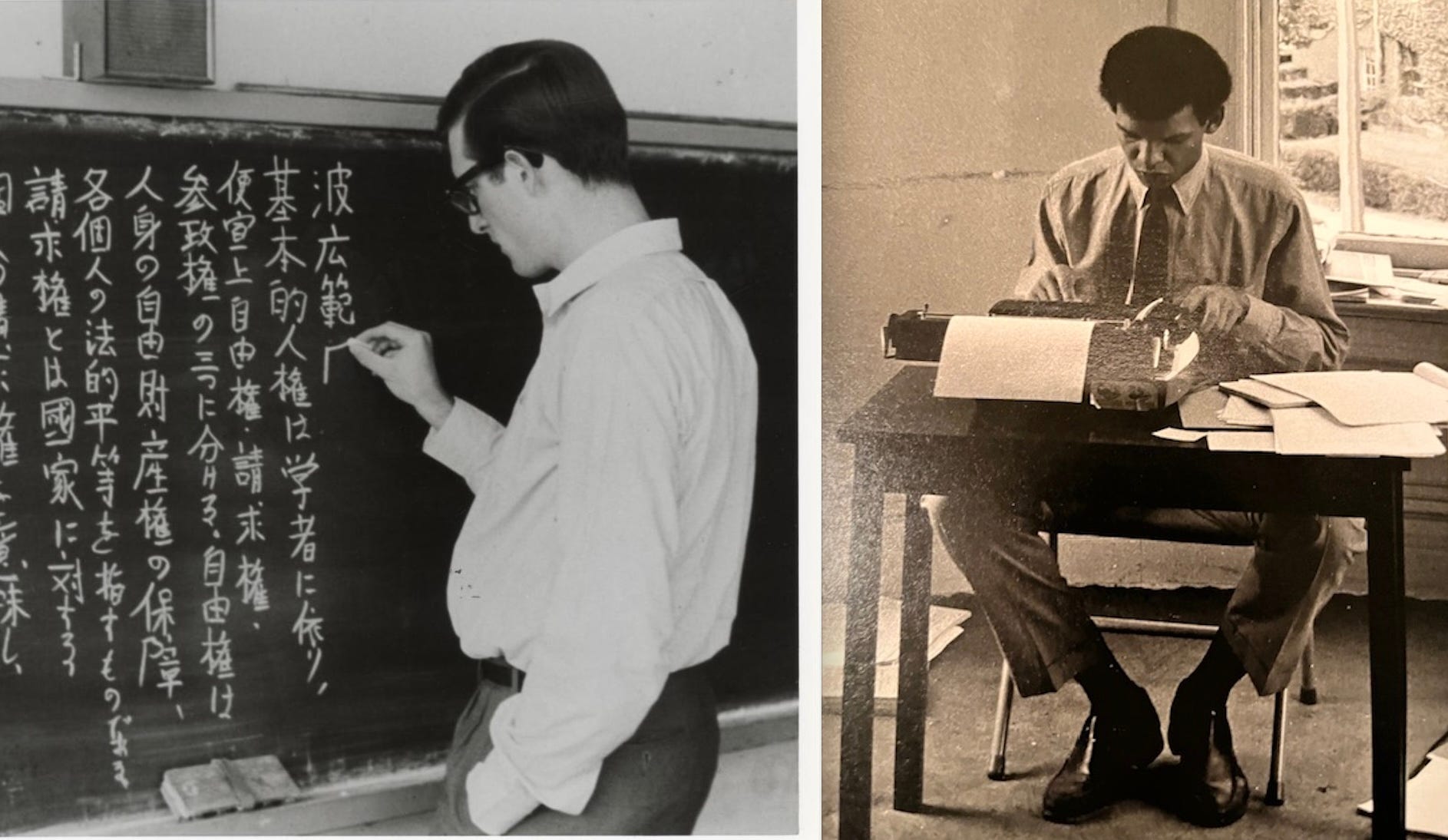
At left, John D. Rockefeller IV, known as Jay, during his three-year immersion in Japan as a language student in the late 1950s. At right, Julian Houston as a student at Boston University in the 1960s. (Photos courtesy of Regional History Center, West Virginia University, and Susan Houston.)
This post is about two Americans who from very different backgrounds dedicated their lives to the defense of American ideals, and to broader realization of the American dream. Each of them has died during this consequential 2026 election period. I was lucky to have spent time with them during other stressful periods for our country, and I want to pay brief tribute to the examples they set.
John D. Rockefeller IV, 1933-2026.
Jay Rockefeller, as is well known, was born famous and privileged. His great-grandfather was the founder of Standard Oil. One of his uncles, Nelson, was a Republican governor of New York and later Vice President of the United States. Another uncle, Winthrop, was a Republican governor of Arkansas. Jay’s marriage in 1967 to Sharon Percy, daughter of then-prominent Republican Senator Charles Percy, was on the cover of Life magazine—in those days, a pinnacle of media recognition.
Jay could have coasted his way through life. But after Exeter and two years at Harvard, he decided to move to Japan and immerse himself in language studies. “The reason I went to Japan is that I wanted to get out,” he said years later in a PBS documentary. “Out of what I thought I might become if I stayed at Harvard.” This was in 1957, just a dozen years after Japan’s surrender, and only five years after the end of US occupation under Douglas MacArthur. Americans living in Japan not as soldiers or business people but as students were a rarity, let alone a student named Rockefeller.
When our family lived in Japan during the late 1980s, thirty years after Rockefeller’s time, at 6’2” I felt like a giant who could look across other riders’ heads on a jam-packed subway car. Jay Rockefeller was 6’7,” tall enough to attract stares almost anywhere. In Japan of the 1950s, as he told me when we later compared our Japan experiences, he seemed a creature from another planet.
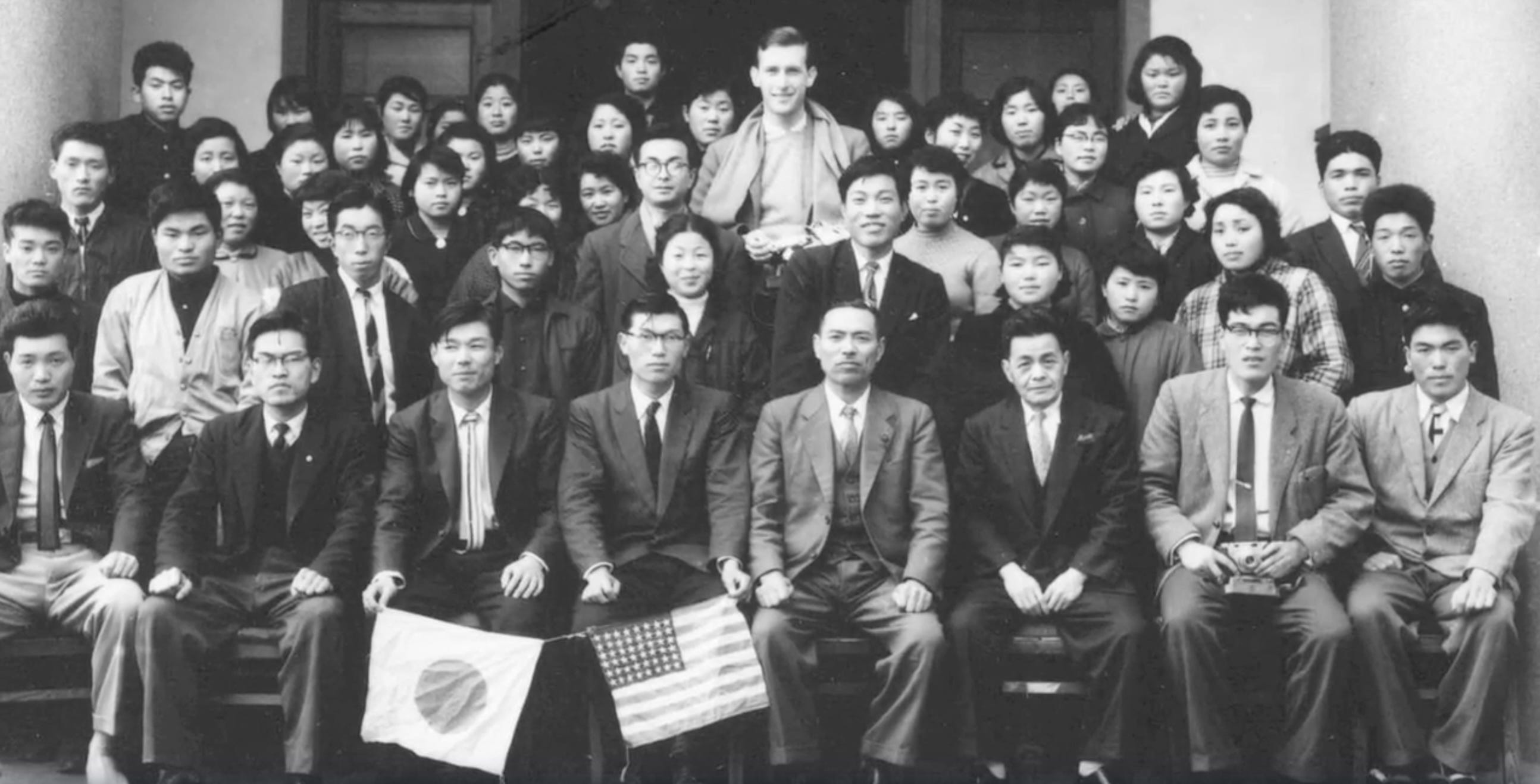
Jay Rockefeller with his Japanese schoolmates in the late 1950s. See if you can pick him out. (Photo from Jay: A Rockefeller’s Journey on PBS.)
Jay Rockefeller took Japan and its language seriously, as attested by the photo with Japanese characters at the top of this post. After three years abroad he returned to Harvard, got his degree in East Asian studies, and then immersed himself in public service through all the decades that followed.
The highlights of his career have appeared in this week’s tributes and obituaries. But he has been out of the public spotlight long enough that I think they bear a summary:
-After college, he joined the Kennedy Administration’s new Peace Corps and served as a volunteer in the Philippines. At the Peace Corps, he met Sargent Shriver, its charismatic director, and Charlie Peters, the young West Virginia politician who was part of Shriver’s team.
-That meeting with Charlie, who later became my original mentor in the magazine world, proved life-changing for Jay Rockefeller (as it did for Deb and me). At Charlie’s urging, Jay Rockefeller jointed the VISTA program as a volunteer in hardscrabble Emmons, West Virginia. He felt he “belonged” in that state; he and his wife decided to stay; and for the rest of his public life he served and represented the people of West Virginia. State legislator, secretary of state, two-term governor, five-term US Senator—in all these roles and others, including university president, he earned respect and widespread support from a state that once considered him a carpetbagger.
-Through this time, he also remained a close friend of Charlie Peters, as Charlie left the Peace Corps to launch his quixotic Washington Monthly magazine. (Which is how I first met Jay Rockefeller and stayed in touch over the years.) The two of them had adjoining season tickets at RFK Stadium for the then-Redskins. I once saw them together there: The lanky Senator, and the compact editor, making up a Tigger-and-Pooh duo.
Jay Rockefeller left the Senate in 2015, and died last week, at age 89. Press accounts have listed his many accomplishments. I sum them up this way: Our era has seen too much of the credo: With privilege, comes more privilege. And With privilege, comes profit. Like a number of others in the Rockefeller lineage, John D. IV lived by the older version. With privilege, comes responsibility.
Julian T. Houston, 1944-2026.
Julian Houston also wanted to get out. He grew up in a Black professional family in segregated Richmond, son of a school renowned teacher. At that time and place he would have been a contemporary of Arthur Ashe’s. During the time I knew Julian, I never thought to ask him whether he had known Ashe. Recently I asked his wife, Susan, and she said: Yes, they had known each other.
In 1959 Julian went north as one of the first Black students to integrate the private Hotchkiss School, in Connecticut. His very much-worth-reading novel New Boy, published in 2006, is about that experience. Apart from reading the novel, I recommend this interview he did back then with Julie Just of the NYT (plus this). It covers the difference in lived-experience memory between people of his generation, whose daily life involved in-your-face formal segregation, and those who may just read about it in history books. For instance, from Julian:
Most young people today, even those in the South, have only a superficial knowledge of the civil rights movement and segregation. I think those of us who were involved in the movement must bear the major responsibility for this.
The Jewish community has done a very effective job of teaching young people about the Holocaust. [JF note: Julian’s wife, Susan Levine Houston, is Jewish.1] On the other hand, we have been preoccupied with ideological disputes, vocabulary disputes, turf battles and celebrity worship, at the price of, among other things, laying the foundation for the younger generation to understand the significance of what we did.
Beyond recalling the names of Dr. King and Mrs. Parks, most young people, black or white, can’t tell you much about the civil rights movement and what it accomplished… One of the reasons I wrote “New Boy” was to give young people a detailed picture of what it was like to live in a segregated community in the late 1950s.
One of the most vivid passages in Julian’s book is about his character’s calculation, as he rides a train southward from Connecticut through Washington to Virginia, about whether it’s worth objecting to the conductor’s expectation that he move to the back of the train.
The real-life Julian went all-in on engagement in the civil rights era. He went from Hotchkiss to Boston University in 1962 and then took a year off, for civil-rights organizing in Harlem. He returned to BU; became the first Black person elected student body president; and was a major on-campus figure, as recounted here. Then he went to BU law school, was an influential Boston-area lawyer, and starting at age 34 served for decades as a respected judge. He pioneered many programs designed to improve relations between the local community and the police and courts. By the time of his death last month, he had earned widespread acclaim as a civic and cultural leader.

Julian Houston as an Associate Justice of the Massachusetts Superior Court.
I came to know Julian by complete chance. In the summer of 1969, Ralph Nader (then age 35) was amassing a team of “Nader’s Raiders,” to investigate and write about corruption in government. I signed up, between years in college, and was assigned to a team looking into the US Department of Agriculture’s role in disenfranchising black landowners in the South, an evergreen topic. On arrival in DC I met the other member of my two-person team, a law student named Julian Houston. When I met him he looked like the photo at the top of this post.
For ten weeks through that broiling summer, Julian and I spent five days a week in the USDA building on Independence Avenue in DC, or off campus, interviewing farmers or their lawyers or their relatives. Julian knew more people in DC than I did at that time—and the people he knew were mainly Black. On weekends we’d go to see some of his friends for cookouts. At one of these events, a cookout with a Black professional family in Northeast DC, we listened to news of a traffic accident involving Senator Edward Kennedy, at Chappaquiddick on Martha’s Vineyard. At the end of the project our work was part of a Nader book by my friend and mentor Harrison Wellford, Sowing the Wind, and of my own senior thesis in college.2
I followed the career of the Honorable Julian T. Houston in the decades since then, and I feel about his example as I do about the saga of the otherwise-worlds-different John D. Rockefeller IV. They both lived for us, not just for what was convenient or beneficial for them.
I feel lucky to have known both of them. Whatever our backgrounds and starting points, we can learn from their examples and stories.
Susan’s brother, the writer Art Levine, is a longtime friend.
In a bizarro-world detail, my roommate for that summer of 1969, in housing at the George Washington University campus, was a young Harvard Law student named Ed Cox. One morning I picked up the New York Times to see the front-page news that one Edward Finch Cox was dating Tricia Nixon, daughter of the incumbent president. Ed had discreetly kept this part of his life out of Nader-world gossip. I didn’t go to their White House wedding two years later—hey, I was living in England, and the invite must have gotten lost in the mail—but I did run into him again at the 2016 GOP convention in Cleveland.