
Parting Thoughts for 2025
This has surely been a year unlike any other, but I want to maintain what has become a tradition for this newsletter of two turn of the year columns, this week reflections on the year just ending, and, when we meet again in January, stories I would like to see in 2026.
What you might (and might not) have expected
In reviewing 2025, perhaps the first thing to say is how much of general news was foreseeable, and how little of it actually a total surprise. Yes, an American Pope was stunning, as was the scope of Israeli military activity and the election of a 34 year-old Muslim as mayor of New York, but these were much more exception than rule. In particular, Donald Trump dominated news, but in very much the ways you might have expected.
When I wrote about the journalism I wanted to see in 2025 way back in early January, I focused on two questions, assessing whether Trump II would truly be a revolutionary president and whether he would keep his campaign promises. Let’s start with the latter, which is simpler. On limiting immigration, which Trump placed first and second on his own list, the answer has to be largely “yes,” even though it’s notable that while deportations this year are accelerating, they barely top the 600,000 in 2014 under Obama. (Shouldn’t that comparison have received much more press coverage?) On controlling inflation, Trump has so far failed, which is almost certainly the primary cause of his current political troubles. On taxes, to be fair, Trump did do much of what he promised; on global peace, for all his self-congratulation, the record is decidedly mixed.
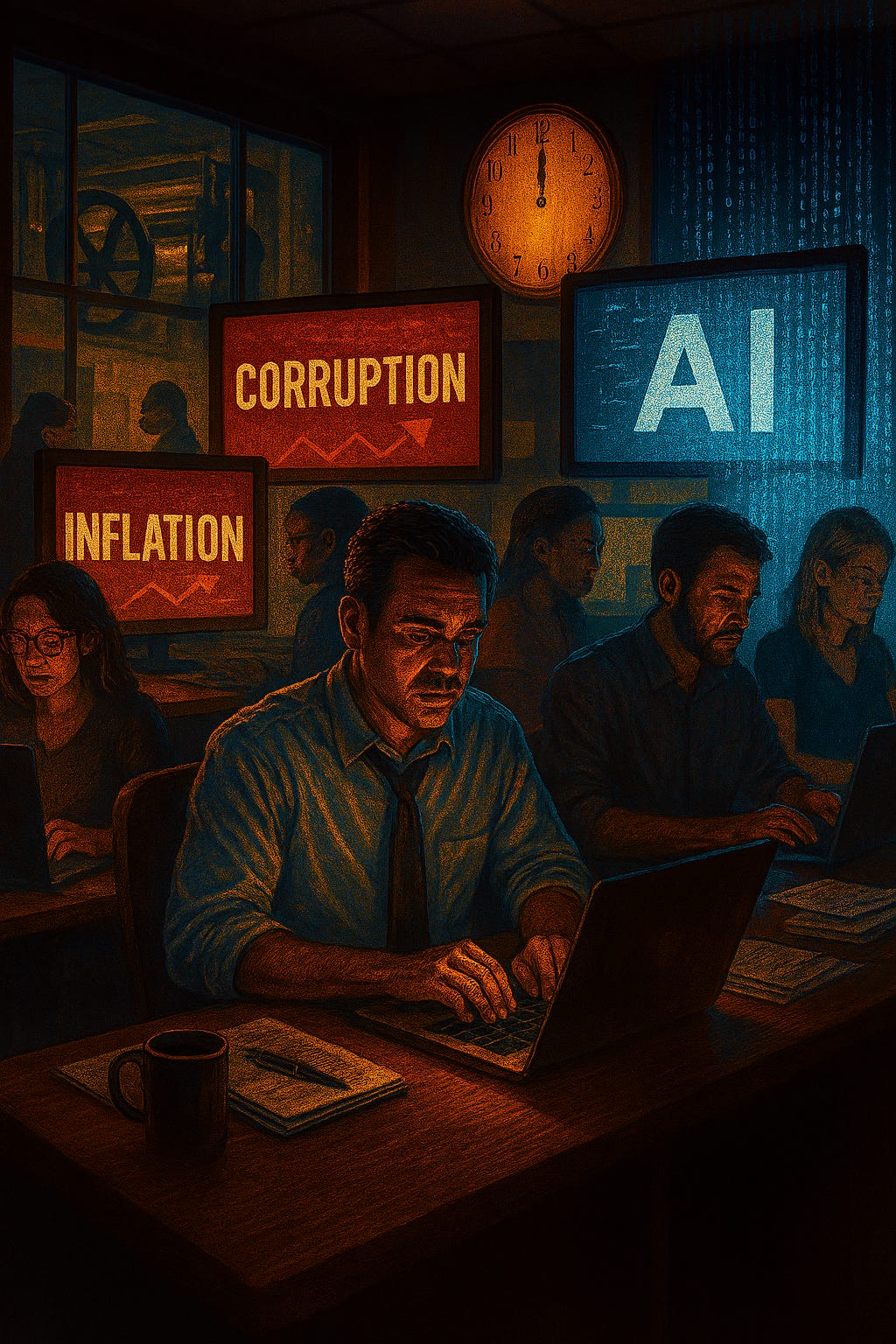
Whether this will be seen in retrospect as a revolutionary presidency seems to me still an open question. DOGE was ultimately an inconsequential failure, the Republican Party has completely surrendered on any effort to contain federal deficit spending and the high water mark for tariffs was probably months ago. The attacks on a free press, apart from thoroughgoing abuse of the FCC, remain primarily rhetorical. On the other hand, undermining the independence of the Department of Justice, and the dismantling of federal public health, international and domestic public broadcasting, international development assistance and perhaps federal aid to science and education are very much in process. Brazen corruption is rampant. The coming Chinese Century has, presumably inadvertently, been accelerated by at least a decade.
As for us
For those of us in the business of news, it’s also been a complicated year to assess. Reporters and editors largely rose to the occasion, I think. But there are lots of signs that publishers are, for the most part, having a tougher time. Audiences continue to fragment and newer creators seem to be more easily winning new subscribers than are most legacy platforms. The peak for institutional philanthropic support is probably past. The concentration in advertising revenues away from publishers continues unabated, and AI is likely to reinforce that trend.
Owners inflicted significant damage on the opinion pages of the Washington Post and CBS News. But the news pages of the Post and both the news and opinion pages of Murdoch’s Wall Street Journal have had strong years, so the story on ownership is also more complicated that some would have you believe.
Inside newsrooms themselves, I am increasingly concerned that, while AI is being employed for process improvement, relatively little good work has surfaced so far on genuine product innovation. One thing I worry is that philanthropic grant-making in this field, very much including from the AI platforms themselves, is too small-bore, and too diffuse (likely driven by marketing considerations), to fuel the sort of pathbreaking efforts that I believe are already possible. I hope this will change in 2026.
Report card
Next, in the interest of transparency, a bit of an annual report on the fortunes of this newsletter itself. I wrote 42 columns this year, down from 43 in 2024. Total readership came to nearly 400,000 views (including to the archive), and while the rate of subscriber growth slowed markedly, subscriptions now top 7400, up 29%. Regular readership of weekly columns rose from just above 6000 to 7500-8500 most weeks. (Interestingly, that is well more traffic than things I have written on similar topics garner on specialized journalism sites these days.)
Open rates continue to fall as readership widens, and now hover around 49-50%, down from 53-54% a year ago. LinkedIn continues to be an important source of traffic, but less so since a seeming algorithm shift apparently discouraging self-promotion a few months back. Substack’s own network also appears to have recently trailed off somewhat as a traffic source, perhaps disfavoring free products (like this one) a bit.
Last year, for the first time, a column topped ten thousand views, and five columns reached that milestone. This year, eight did so. The traffic standout for 2025 was my August observations on the state of nonprofit fundraising, although it remains below October 2024 thoughts on issues at the Knight Foundation. The column of which I am proudest was one in July on a modest breakthrough on libel insurance for smaller newsrooms. Others that garnered larger readership included pieces on the future of public broadcasting, the opinion mess at the Post, my Q&A with the CEO of Hearst, “multi-local” news, Press Forward guidance on marketing, and the need for urgency in confronting the challenges of Trump.
Finally…
As I have in each of the previous four years of this column, I want to conclude with a profound note of gratitude. I began Second Rough Draft in anticipation of retiring from the best job I ever had. Along with consulting, teaching and some volunteer board service, it has become a significant part of my professional life. I am acutely aware, however, that it would mean nothing without you, its readers, and your continuing engagement. Thank you for joining me on this adventure, with every best wish for the holidays and the critical year ahead.
Second Rough Draft expects to return January 8.
Thanks for reading Second Rough Draft! Subscribe for free.
Related Knowledge Center: 2025: looking back
The annual retrospectives from news organizations.
Related Knowledge Center: Democracy and politics
News organizations are scrambling to find a coverage approach that adequately informs the American public about the country’s slide from democracy to authoritarian rule.
Related Knowledge Center: Inside the newsroom
As newsrooms struggle with rickety business models and precarious finances — as well as new technologies — they are deploying an array of editorial responses.
The Times and its critics | Washington Post mortem