
Oil Prices and Lessons for the Press from a Failure of Expertise
On March 12, less than two weeks into the war on Iran, the Wall Street Journal headlined a Goldman Sachs prediction that oil prices could reach $150 per barrel if the Strait of Hormuz remained closed on April 1. This followed an AP story to the same effect the previous day, citing an analyst report from Wood MacKenzie. Two weeks later, The Times of London cited a JP Morgan prediction of $150 oil if the Strait was not opened by May 1. The same day that story appeared, a similar UBS report was featured by MarketWatch.
In the event, the highest wartime daily close for oil was $115 in late April, even though, under Trump’s deal with Iran, the Strait may not be fully open until July 17, or even later. Yesterday, oil prices fell to nearly pre-war levels, while Strait traffic remained quite limited. Goldman Sachs, JP Morgan, UBS and others all got it wrong. And the press amplified their errant calls, badly serving readers. This week I want to talk about what the journalism business might learn from this episode.
What they missed
Let’s start in the world of oil, where a number of solid stories have appeared on what the analysts mistook. There’s this one from Barron’s from early this month, and this one (gift link) from the Wall Street Journal a week later. The Barron’s piece, almost humorously, can be summed up by saying supply turned out to be higher and demand lower than analysts had expected. Of course, predicting supply and demand is analysts’ most basic job.
The Journal piece is more nuanced (and worth reading if you find the substance here interesting), but largely to the same effect, including noting the impact of drawdowns from strategic petroleum reserves. But that should hardly have been unexpected: I remember a graduate school exam question more than 45 years ago that focused on calculating the optimal use of such reserves to confront an oil shock.
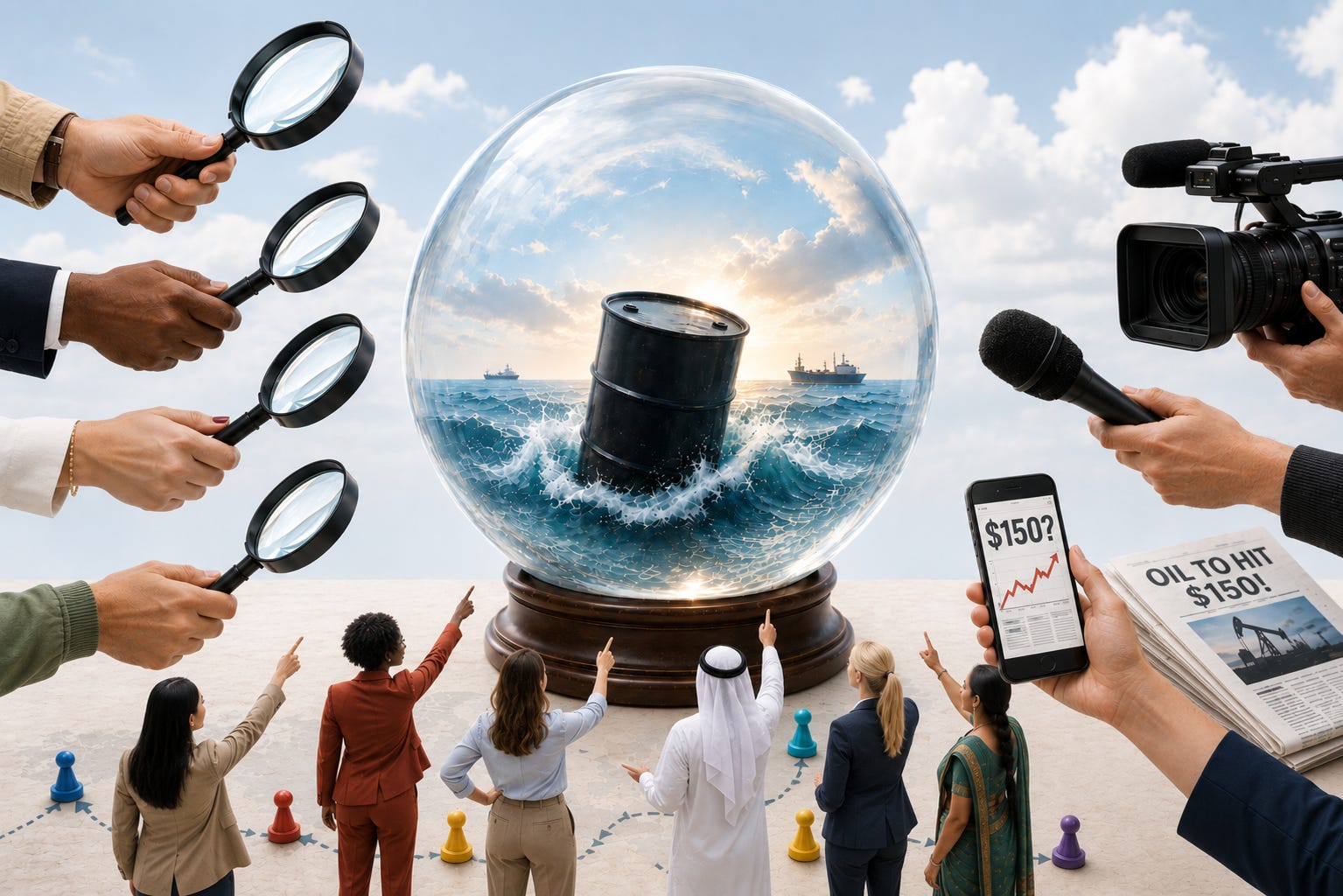
What we had here was a failure of expertise, compounded by a failure of journalism in amplifying it.
Lots of people have heard screenwriter William Goldman’s Hollywood motto, “Nobody knows anything” (sometimes more colorfully attributed to Sam Goldwyn, the “G” in MGM, as “Nobody knows nuthin’”). This latest adventure should remind us all that, while that isn’t literally true, its applicability ranges widely.
Where does that leave reporters and editors? There seem to me to be a number of lessons:
Beware interested parties, and herd effects. The first prominent warning of $150 wartime oil prices came not from a financial firm but from the energy minister of Qatar, who made it in an interview with the Financial Times just a week into the war. He asserted this could “bring down the economies of the world.” Of course, the Qataris weren’t disinterested observers of the conflict. They had tried to mediate before war broke out, felt caught in the middle, and were, when the minister sounded his alarm, worried about just the sort of attacks on their own infrastructure that soon followed. Journalists, knowing this, would tend to discount a prediction from such a source. But they needed to go father, and to guard against putting more credibility in the same prediction when it was echoed by others.
Resist the temptation of the outlier. This case also serves as another reminder of a truism in our business: that the most dramatic story is not always—and may even rarely be—the smartest one. In the first hours and days, the undeniable facts of the war were plenty dramatic: the killing of many key Iranian leaders, the closing of the Strait, the bombast from US leaders and their apparent manipulation by the Israelis. But as initial headlines fade in a crisis, journalists need to guard against the peril of becoming adrenaline junkies, latching on to the next claim of even more drama ahead, and the next after that. Gasoline going from under three dollars a gallon to over four almost overnight, and the impact on the lives of millions, is a huge story; it should not be necessary to breathlessly anticipate five dollars.
Have the courage to revisit your own coverage. One of the ways to take care in this regard is to follow the bouncing ball of what you have been reporting. When the predictions of $150 per barrel by April 1 failed to come even close to materializing, the same predictions for May 1 should have been received with greater skepticism.
Reporters have generally figured out that Trump is always saying things are “two weeks away,” and have gotten better at discounting his musings along those lines. The same lesson needs to be applied to other actors as well. Beyond this, a degree of self-criticism is in order; it might even boost our collective credibility if more stories noted how previous predictions we shared have failed to eventuate.
Keep score for next time. Finally, as I have said before with respect to politicians who come on live TV shows and lie, there needs to be a degree of accountability for sources whose mistakes we have amplified. To be sure, there is an important moral distinction between a lying politician and an errant analyst, but neither serve readers, listeners or viewers well. Neither need to be afforded our platforms as easily or as often.
One non-lesson that may surprise you. It’s become fashionable in journalism to decry coverage that is predictive rather than covering things as-they-are. I share that critique when it comes to partisan politics. What much of political coverage fails to grasp is that what is most significant for readers is not who is likely to win an election at any given moment but rather what is at stake.
Beyond politics, however, I am less persuaded. In sports, and in business, readers are looking mostly for reporting that yields an intelligent guide to future events; the basic facts of what has just happened is the stuff of commodity news. My own journalism hero, Barney Kilgore, felt that one of the highest purposes of journalism generally was to prepare its consumers for tomorrow. The problem with all those stories of $150 oil wasn’t that they were asking the wrong question, it was that they were offering the wrong answer.
Second Rough Draft paid subscribers support nonprofit journalism. To receive new posts become a free or paid subscriber.