
Oil and gas activity edges higher; uncertainty rising, costs increase
First Quarter | March 26, 2025
Special Questions
Data were collected March 12–20; 129 oil and gas firms responded to the special questions survey.
Exploration and production (E&P) firms
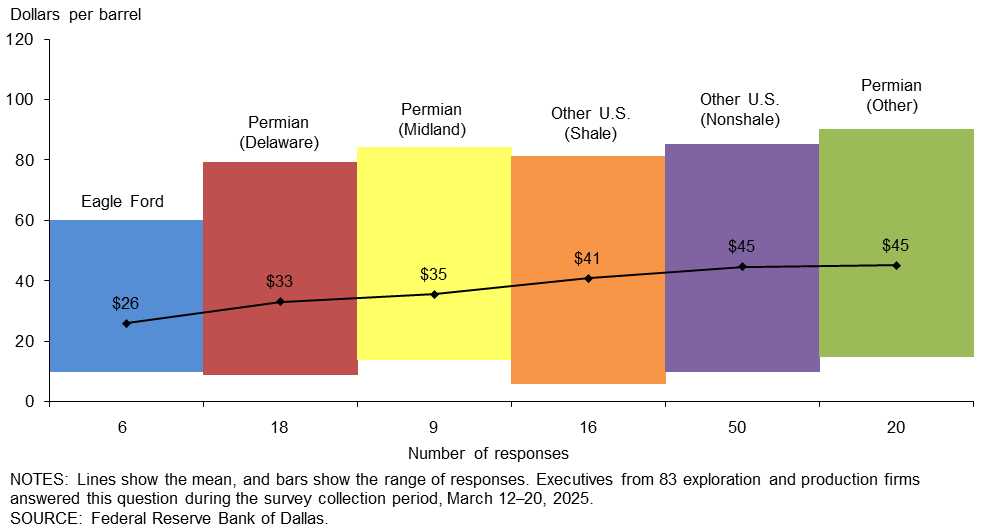
In the top two areas in which your firm is active: What West Texas Intermediate (WTI) oil price does your firm need to cover operating expenses for existing wells?
The average price across the entire sample is approximately $41 per barrel, up from $39 last year. Across regions, the average price necessary to cover operating expenses ranges from $26 to $45 per barrel. Almost all respondents can cover operating expenses for existing wells at current prices.
Large firms (with crude oil production of 10,000 barrels per day or more as of fourth quarter 2024) require prices of $31 per barrel to cover operating expenses for existing wells, based on the average of company responses. That compares with $44 for small firms (fewer than 10,000 barrels per day).
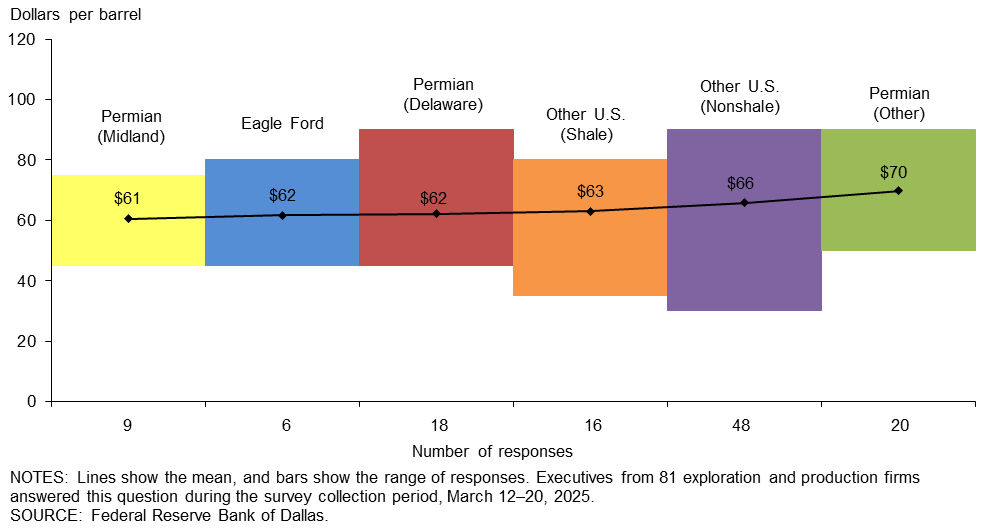
In the top two areas in which your firm is active: What WTI oil price does your firm need to profitably drill a new well?
For the entire sample, firms need $65 per barrel on average to profitably drill, higher than the $64-per-barrel price when this question was asked in last year’s first-quarter survey. Across regions, average breakeven prices to profitably drill range from $61 to $70 per barrel. Breakeven prices in the Permian Basin average $65 per barrel, unchanged from last year.
Large firms (with crude oil production of 10,000 barrels per day or more as of fourth quarter 2024) require a $61-per-barrel price to profitably drill, based on the average of company responses. That compared with $66 for small firms (fewer than 10,000 barrels per day).
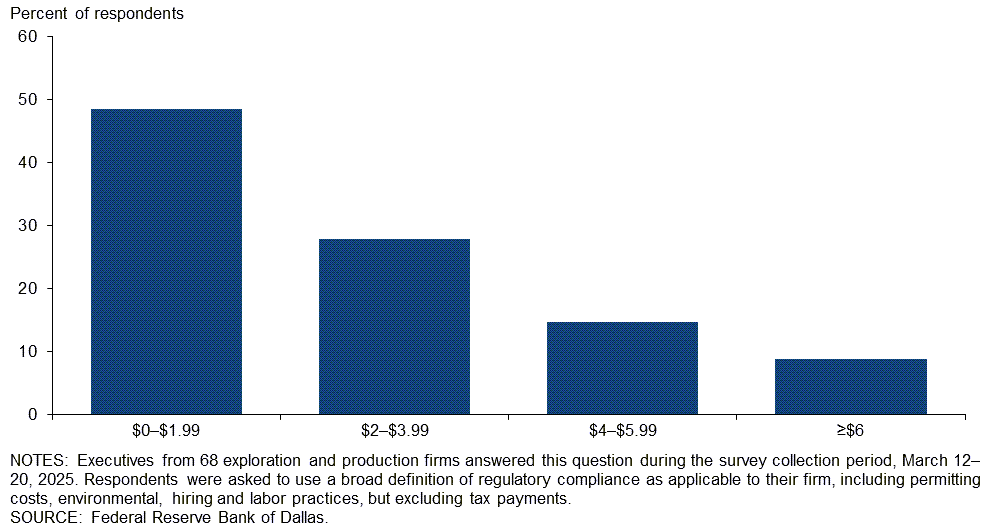
On a net production basis, how much do you estimate is your firm’s cost of regulatory compliance, broadly defined, on a dollar-per-barrel basis?
Almost half of the executives (49 percent) estimate that their firm’s cost of regulatory compliance is $0–$1.99 per barrel. Twenty-eight percent of executives estimate the cost as $2–$3.99 per barrel; an additional 15 percent said $4–$5.99 per barrel. The remaining 9 percent said greater than or equal to $6 per barrel.
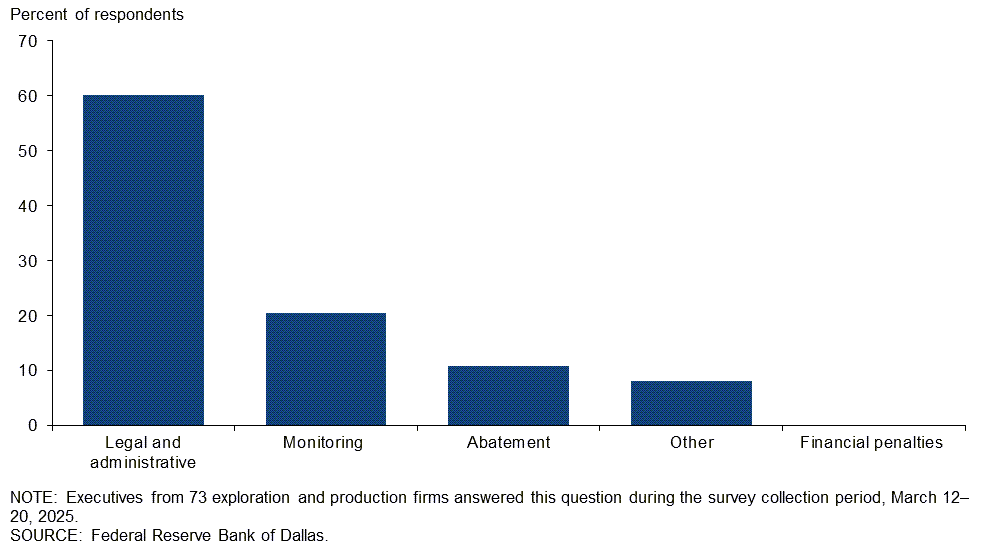
Which of the following is the main cost component for regulatory compliance for your firm?
A majority of executives—60 percent—said legal and administrative costs are their firm’s main expense item in terms of regulatory compliance. Twenty-one percent of executives selected “monitoring.” Eleven percent cited “abatement,” and 8 percent cited “other.”
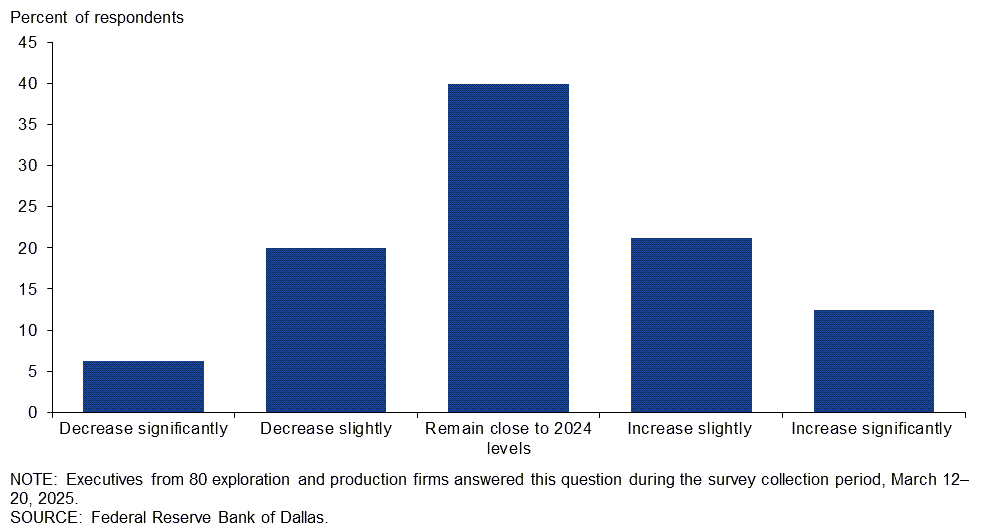
How much do you expect your firm’s cost of regulatory compliance to change in 2025 versus 2024?
Forty percent of executives expect their firm’s cost of regulatory compliance to remain close to 2024 levels in 2025. More respondents expect the cost of regulatory compliance to increase this year rather than decrease. Twenty-one percent of executives said they expect regulatory compliance cost to slightly increase, while 13 percent anticipate a significant increase. On the other hand, 20 percent of executives expect regulatory compliance cost to decrease slightly, and 6 percent anticipate it will decrease significantly.
All firms
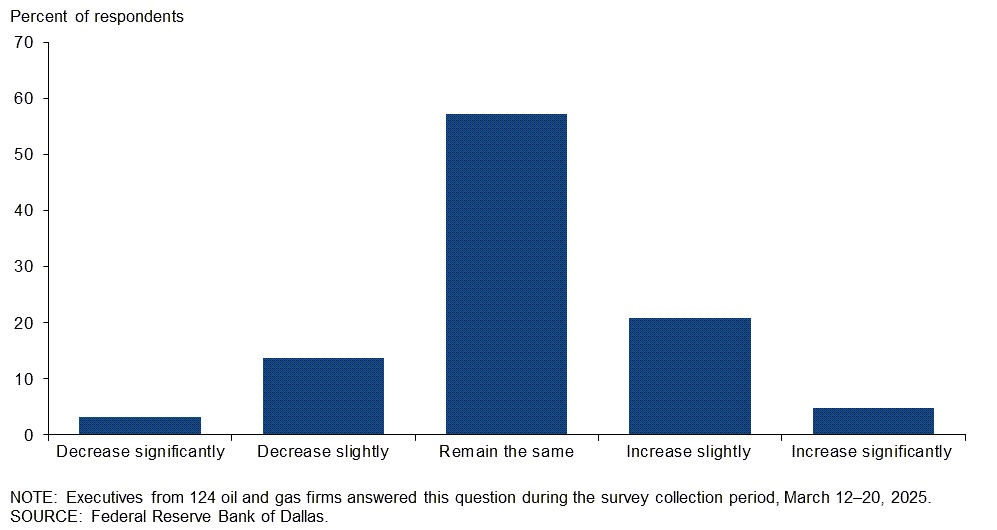
How do you expect the number of employees at your company to change from December 2024 to December 2025?
The largest group, 57 percent of executives, expect employment at their firm to remain the same from December 2024 to December 2025. 21 percent of executives chose “increase slightly” while 14 percent chose “decrease slightly.” (See table for more detail.)
| Response | Percent of respondents (among each group) | ||
| All firms | E&P | Services | |
| Increase significantly | 5 | 4 | 7 |
| Increase slightly | 21 | 16 | 31 |
| Remain close to 2025 levels | 57 | 67 | 38 |
| Decrease slightly | 14 | 12 | 17 |
| Decrease significantly | 3 | 1 | 7 |
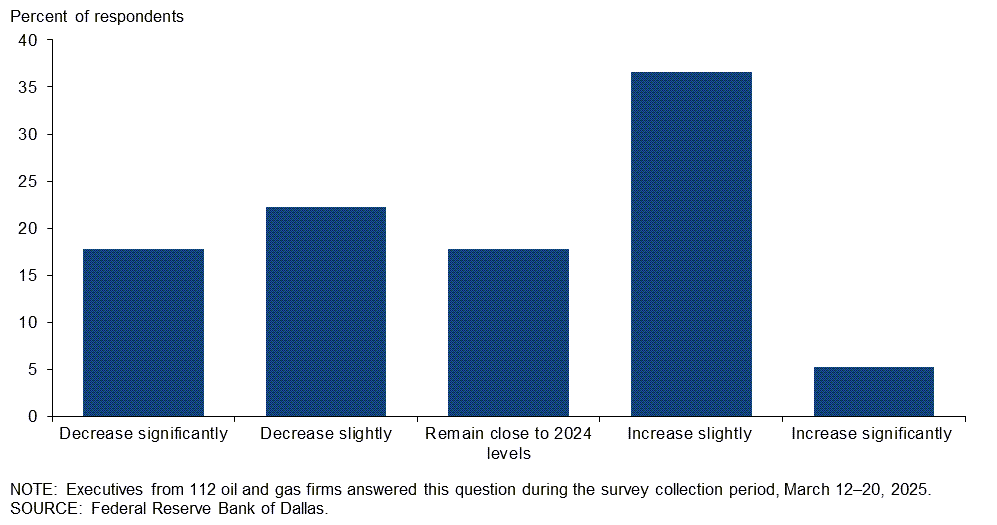
What are your expectations for the total merger and acquisition deal value for the U.S. upstream oil and gas sector in 2025 versus 2024?
The biggest group, 37 percent of executives, expect the total merger and acquisition deal value for the U.S. upstream oil and gas sector to increase slightly this year. Twenty-two percent of executives expect the deal value to decrease slightly in 2025, and 18 percent each selected “remain close to 2024 levels” and “decrease significantly.”
Oil and gas support services firms
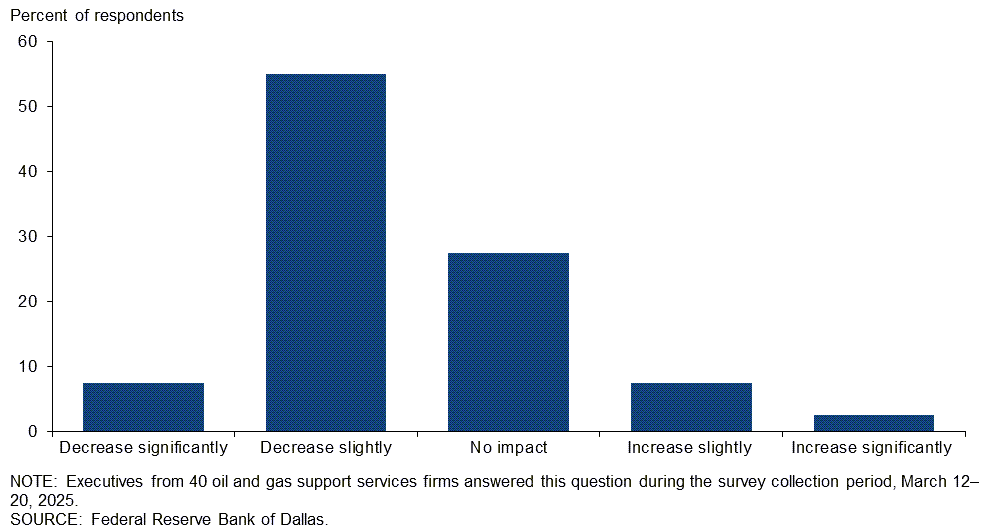
What impact do you expect the 25 percent steel import tariffs to have on your customer demand for 2025?
This question was posed only to oil and gas support services firms, which have E&P firms as their primary customer. A majority of executives—55 percent—expect the impact of the steel import tariffs to slightly decrease customer demand for 2025. Twenty-eight percent expect no impact. Few respondents selected “decrease significantly,” “increase slightly” or “increase significantly.”
Special Questions Comments
Exploration and Production (E&P) Firms
- For the average onshore upstream operator, the current administration versus the previous administration regulatory regime shows no real change at all. We still get our permits from the Railroad Commission in Texas, for example, not the Environmental Protection Agency. The federal regulatory regime matters if you are operating in the Gulf of Mexico or Alaska but not for the Permian, Eagle Ford, Bakken, Utica, etc. Also, asking OPEC+ to produce more hurts domestic operators.
- Oilfield services suppliers are willing to balance profitability with contract duration, especially for customers with strong credit ratings.
- It will be hard for 2025 to compete with 2024 when it comes to upstream merger and acquisition (M&A) volumes because the major corporate mergers that have already taken place throw off the true metrics about how healthy the upstream M&A market is in the United States. Major corporate mergers and asset level M&A are two very different things. At the asset level, I think upstream M&A will improve in 2025. I think there will be less activity in major corporate mergers, which are the true needle-mover when measuring total volume of upstream M&A.
- The new administration brings positivity to the energy industry.
- When the little guy, the independent, reaches critical mass in size, he can be purchased by a larger company.
Oil and Gas Support Services Firms
- In a strange twist to the administration’s hope for more domestic oil and gas production, higher steel tariffs may result in fewer wells completed due to higher completion costs, and, in particular, the cost of oil country tubular goods. The margins are thin enough for many wells, and this will likely result in downward pressure on total wells brought online.
- The rig count is flat and scrap prices are up. Time to scrap more rigs; there are lots of rigs that will never go back to work.