
Ocean heat and sea-level rise threaten communities in the South-West Pacific
Key Messages
Temperature
2024 was the warmest year on record in the South-West Pacific region, at approximately 0.48 °C above the 1991–2020 average. This was associated with the continued influence from the 2023/2024 El Niño event. Many countries recorded their warmest year, based on their national datasets.
Extreme heat affected large parts of the region in 2024, with record-breaking temperatures in Australia and the Philippines, posing serious risks to public health, livelihoods, and ecosystems.
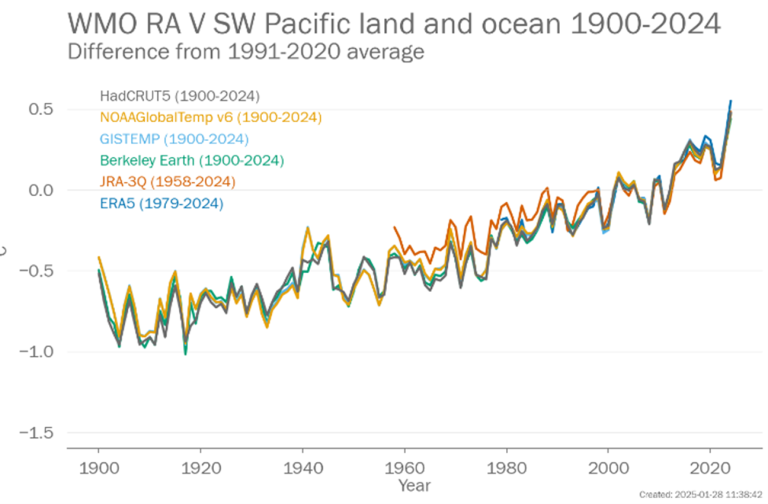
WMO RA V SW Pacific land and ocean 1900-2024 — Difference from 1991-2020 average
Precipitation and storms
The southern coast of Australia, northern New Zealand, and many Pacific Islands all suffered precipitation deficits, whilst parts of Malaysia, Indonesia, northern Philippines, northern Australia, eastern Papua New Guinea, Solomon Islands, and southern New Zealand saw above average rainfall in 2024.
Extreme rainfall and flooding caused deadly and destructive impacts across the region, with major events in Australia, New Zealand, Fiji, Malaysia, Indonesia, and the Philippines disrupting communities, infrastructure, and economies.
The late 2024 tropical cyclone season in the Philippines was unprecedented, with 12 storms during September to November — more than double the average. Across the entire sequence, over 13 million people were impacted in 17 of the country’s 18 regions, with more than 1.4 million displaced.
Cryosphere
Snow and ice are rare in most, but not all, of the South-West Pacific. There are glaciers in the mountains of New Zealand and on the highest peaks of the western part of the island of New Guinea.
In Indonesia, glacier ice loss continued rapidly in 2024, with the total ice area in the western part of New Guinea declining by 30-50% since 2022, according to satellite estimates. If this rate persists, total ice loss is expected in 2026 or very soon thereafter.
Ocean
The annual average sea surface temperature in 2024 was the highest in the time series starting in the early 1980s.
In 2024, ocean heat content for the South-West Pacific tied with 2021 and 2023 as joint second highest, behind the record in 2022. Areas of strongest ocean warming over the past five decades include the Tasman Sea, the Solomon Sea, and most of the areas around the Pacific Small Island States.
Ocean warming contributes to sea-level rise and alters ocean currents. It also indirectly alters storm tracks, increases ocean stratification, and can lead to changes in marine ecosystems.
Most of the ocean area of the South-West Pacific region was affected by marine heatwaves of strong, severe, or extreme intensity during 2024. During the months January, April, May, and June 2024, nearly 40 million km² of the region’s ocean was impacted, marking a record high since records began in 1993.
Ocean acidification, together with ocean warming and deoxygenation is affecting marine ecosystems, habitats and biodiversity. The entire ocean area of the South-West Pacific region is experiencing ocean acidification.
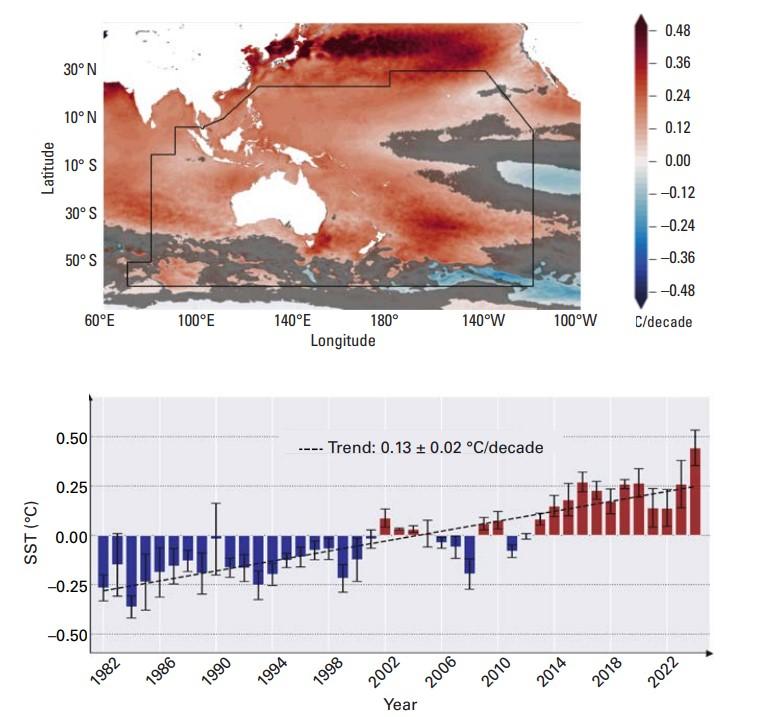
Top: Map of regional SST trends over the period 1982–2024 using the Copernicus Marine Service Operational Sea Surface Temperature and Ice Analysis (OSTIA) product. Grey areas indicate where less agreement could be obtained from an ensemble of three international SST products (Copernicus Marine OSTIA, Copernicus Marine ESA CCI, NOAA OISST). WMO Region V, South-West Pacific, is outlined in black. Bottom: SST anomalies averaged over WMO Region V, South-West Pacific, relative to the 1982–2024 reference period. The dashed line indicates the linear trend over the period. The Copernicus Marine OSTIA product was used to generate this graph, and the ensemble of this product with the other products (ESA CCI up to 2022; NOAA OISST up to 2024) was used to provide the annual mean ensemble spread (two standard deviations, black lines).
Third-party map. The map (top) was taken from Copernicus Climate Change Service and Mercator Ocean International in April 2025 and may not fully align with United Nations and WMO map guidance
Sea level
Across the region, sea level exceeds the global average, threatening Pacific islands where more than half the population live within 500 metres of the coast. Communities are facing difficult decisions about staying in high-risk areas or relocating to secure their futures.
For instance, over the past two decades, coastal erosion and flooding have severely damaged the village of Serua Island in Fiji, with the seawall being destroyed, homes being submerged, and seawater killing food crops and washing away fertile soil. On two separate occasions, the island experienced such extreme flooding that it was possible to cross the entire island by boat without encountering land.
Villagers are running out of adaptation options, with building of seawalls, plantation of mangroves, and improvement of drainage systems no longer being viable. The Government of Fiji has offered support for the islanders to relocate, but many are choosing to stay because of the concept of “vanua”, which translates literally to “land”, embodying the profound connection between the Indigenous communities and their ancestral lands.
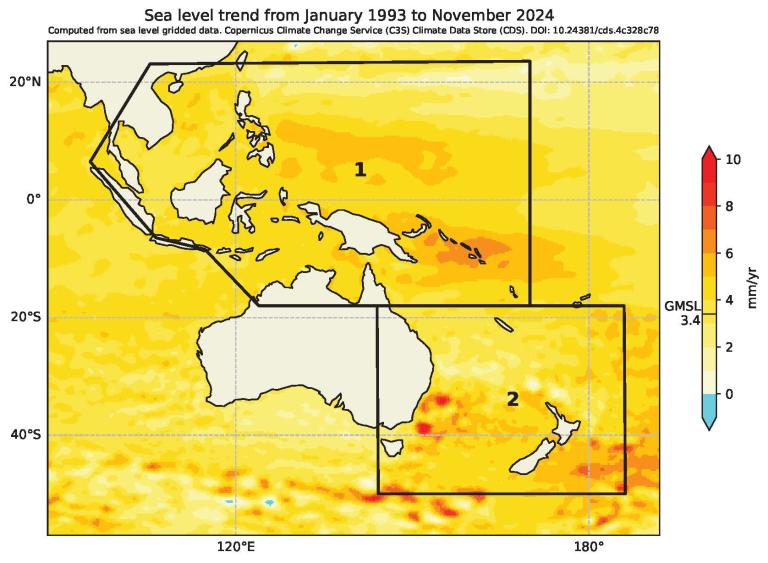
Annual mean sea-level trend (mm/year) in the western Pacific and Australia region
Copernicus Climate Change Service and Laboratory of Space Geophysical and Oceanographic Studies (LEGOS), France, in January 2025 and may not fully align with United Nations and WMO map guidance
Anticipatory Action
The collective impact of the record-breaking tropical cyclones in the Philippines in 2024 was devastating. Early estimates placed damages to infrastructure, homes, and agriculture at US$ 430 million. However, loss of life was limited thanks to impact-based early warnings and anticipatory action, which involved the mobilization of the Food and Agriculture Organization’s Anticipatory Action teams. They distributed cash transfers and facilitated the evacuation of fishing boats to safer grounds ahead of the typhoons.
Building resilience is a priority for the Philippines National Adaptation Plan. While the frequency of tropical cyclones is expected to decrease, their intensity will significantly increase, resulting in severe damage to infrastructure, agriculture and coastal areas, affecting millions of Filipinos.
State of the Climate in the South-West Pacific 2024 Report - English