
New Kremlin-Linked Influence Campaign Targeting Moldovan Elections Draws 17 Million Views on X and Infects AI Models
Welcome to Reality Check, a newsletter that helps you keep track of the false claims and online conspiracy theories that shape our world — and who’s behind them.
A note to our readers: Long before FCC Chairman Brendan Carr used regulatory threats to urge TV stations to drop Jimmy Kimmel, he targeted us. Nearly a year ago, Carr threatened NewsGuard and our clients with retaliation for speech he disagreed with.
But unlike others, we have not given an inch — and we don’t intend to. Please consider supporting our work by becoming a Premium Member and telling your friends about Reality Check.
Follow us on your social media platform of choice: X | LinkedIn | Instagram | Bluesky
New Kremlin Campaign Targeting Moldovan Elections Draws 17 Million Views on X and Infects AI Models
By Eva Maitland, Alice Lee, Madeline Roache
Days before Moldova holds pivotal elections on Sunday, the Kremlin-linked Storm-1516 propaganda machine has succeeded in spreading false claims of corruption targeting the former Soviet republic’s pro-Europe government, NewsGuard has found. Unlike the Matryoshka campaign identified by NewsGuard in July 2025, which generated modest engagement online, the Storm-1516 claims have drawn 17.7 million views on X and appeared in 2,842 online posts–about a country with a population of 2.4 million.
NewsGuard also found that the largest AI chatbots were infected with these false claims, responding inaccurately more than one third of the time on prompts asking about the Russian false claims.
Storm-1516 – which includes the efforts of John Mark Dougan, the former Florida deputy sheriff granted asylum in Moscow turned Kremlin propagandist – targeted Moldova with eight false narratives from the end of July 2025 through the end of September 2025. Claims include that Moldovan President Maia Sandu took bribes, spent money to acquire sperm from Hollywood celebrities and is funded by George Soros. Techniques include AI-generated video and reports masquerading as coming from established news sources.
By contrast, a previous effort targeting Moldova identified by NewsGuard in July 2025, failed to gain significant traction or spread to mainstream platforms despite advancing 58 false claims about Moldova’s government since late April 2025.That campaign, dubbed Matryoshka after the Russian nesting dolls, uses fake video news reports and articles mimicking legitimate media outlets.
Since NewsGuard’s first report on the Matryoshka claims in July 2025, several news outlets have substantiated Russian efforts to sway the Sept. 28 parliamentary elections in Moldova, which is strategically situated between Romania and Ukraine. Opinion polls show the pro-Europe and pro-Russian parties in a tight race.
An undercover BBC report in September 2025 revealed a secret Russian network that offered payments to participants for posting pro-Russia propaganda undermining the pro-Europe ruling party. Bloomberg reported in September 2025 that it obtained documents proving that Russia’s interference operations were “coordinated directly by the Kremlin.” The “multi-pronged strategy” includes recruiting Moldovans abroad to vote at polling stations in the EU, mobilizing people to stage protests, and a far-reaching disinformation campaign, Bloomberg said.
“We are facing an unprecedented propaganda onslaught,” Daniel Vodă, a Moldovan government spokesperson, told NewsGuard in a September 2025 email.
Storm-1516 Takes on Moldovan Elections
A Russian influence operation that has targeted elections in the U.S. and Germany, Storm-1516 leverages AI technology, fake websites, and X bots for maximum effect, as evidenced by capturing nearly 18 million X views with only eight false narratives. Unlike Matryoshka’s approach — pumping out dozens of fakes with limited impact — Storm-1516 appears to focus on quality over quantity, producing a smaller number of more sophisticated and highly amplified narratives designed to spread widely.
Despite being repeatedly exposed and documented by researchers, Storm-1516 continues to deploy and refine the propaganda playbook it used in the 2024 U.S. presidential elections and Germany’s federal snap election in February 2025. It has continually demonstrated an ability to adapt, evade scrutiny, and maintain influence despite European Union and U.S. sanctions against Valery Korovin, a key player behind Storm-1516.
Chatbots Get Duped 37% of the Time
Moreover, NewsGuard found that the leading generative AI chatbots repeated false Storm-1516 narratives about Moldova 37 percent of the time, indicating a failure by these tools to distinguish between reliable and unreliable sources. This is despite the fact that researchers, including NewsGuard, have repeatedly documented the chatbots’ propensity to repeat Storm-1516 narratives due to their layered laundering process.
Asked by NewsGuard about the Moldova campaign, Dougan, the Kremlin propagandist heavily involved in Storm-1516, said in a September 2025 message over encrypted messaging app Signal: “I have no idea what you’re talking about. Moldova? Where is that? I thought it was a fictitious country in one of those romance Hallmark movies…”
From Celebrity Sperm to Ballot Fraud
The false narratives appear tailor-made to undermine Sandu and her Party of Action and Solidarity (PAS), accusing Sandu of corruption, election fraud, autocratic activity and of sacrificing Moldova’s sovereignty to join the EU.
Opinion polls indicate a tight race between Sandu’s PAS party and the Patriotic Electoral Bloc (BEP), a new group of existing pro-Russian parties. The ruling PAS sees EU membership as crucial to resisting Russia’s attempts to keep the country in its sphere of influence. Addressing Moldovans on Sept 22, 2025, Sandu said that Russia is “pouring hundreds of millions of euros to buy hundreds of thousands of votes … People are intoxicated daily with lies.”
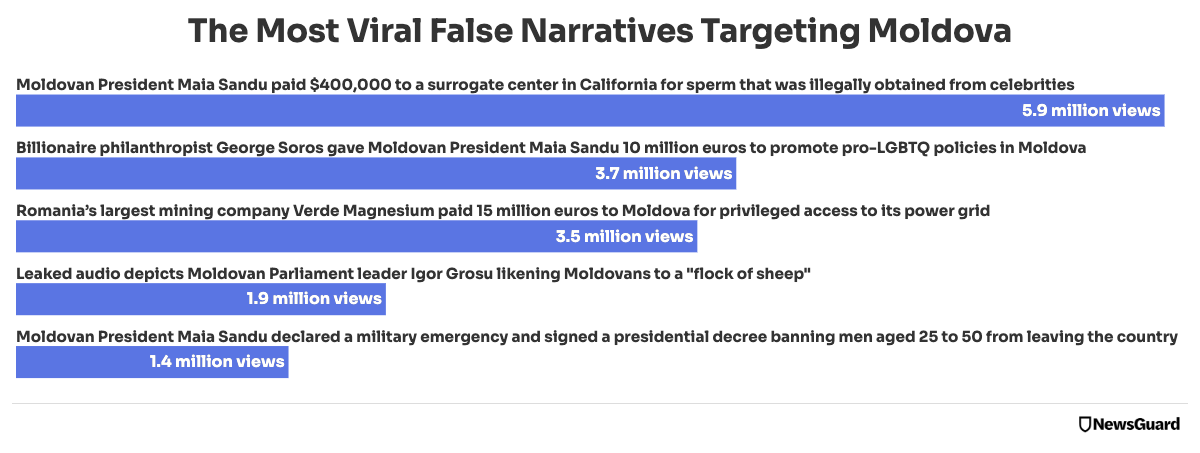
Since the Storm-1516 campaign against Moldova launched at the end of July 2025, NewsGuard has identified eight false claims that have gone viral. They are:
A fake website and video impersonating OK! Magazine, claiming that Sandu illegally purchased sperm samples from celebrities Ricky Martin, Elton John, and Neil Patrick Harris for $400,000.
A fake website modelled as a pro-LGBTQ advocacy organization, claiming that philanthropist George Soros gave Sandu 10 million euros to promote pro-LGBTQ policies in Moldova.
A fake website purporting to be a European news outlet, claiming that Sandu’s party took €15 million from a Romanian mining company in exchange for privileged access to the Moldovan power grid.
An AI-generated audio claiming to depict Moldovan Parliament leader Igor Grosu likening Moldovans to a ‘flock of sheep’.
Two fabricated videos pretending to be Realitatea, a Moldovan news channel, claiming that Sandu declared a military emergency and signed a presidential decree banning men aged 25 to 50 from leaving the country.
A fake website and video mimicking Moldova’s ruling PAS party, claiming it intends to increase taxes, the retirement age, and the length of mandated military service.
A staged video claiming that Sandu removed two rival political parties from mail-in ballots.
An AI-generated video purporting to show a Moldovan election worker saying that the Moldovan government is premarking ballots with a vote for the ruling party.
Aided by X Accounts, a Pro-Kremlin News Network, and ‘Reply Hijacking’
The eight false claims targeting Moldova appeared in 2,842 online posts, primarily on X, in Romanian, the majority language in Moldova, as well as English, Arabic, Russian, French, Turkish, Japanese, German, and Thai. The false claims were amplified on X by a network of approximately 20 anonymous accounts, seemingly created to boost Storm-1516 propaganda.
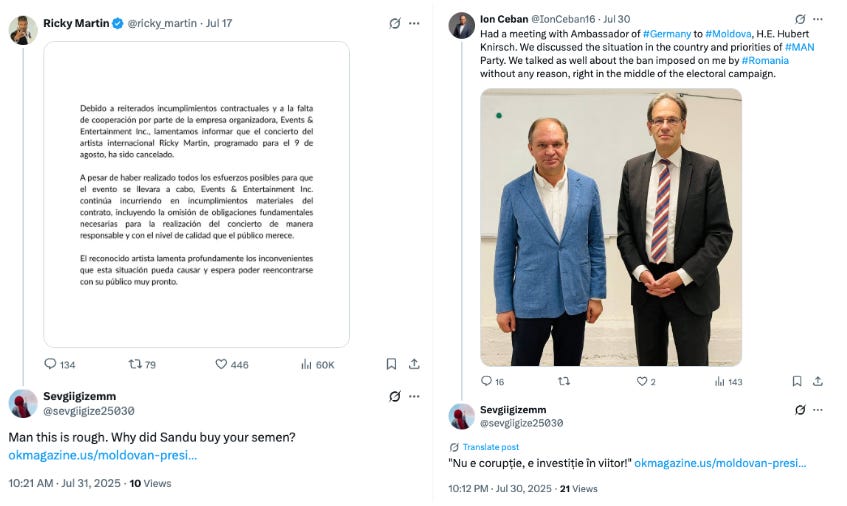
In an effort to reach their target audience, the accounts posted the claim about Sandu purchasing celebrity sperm in replies to posts by prominent Moldovan politicians and Moldovan news outlets. The tactic, known as “reply hijacking,” involves injecting false claims in the replies or mentions of well-known figures with large followings, to boost the claim’s visibility among unsuspecting users and to make it appear more organic. NewsGuard has previously documented the use of this method to spread Storm-1516 claims.
For example, one seemingly inauthentic account, @sevgiigize25030, shared the claim in response to posts from the officials X accounts of the Moldovan president, the Internal Affairs Ministry and its minister Daniela Misail-Nichitin, and Ion Ceban, Mayor of Moldova’s capital Chisinau. The apparently inauthentic account also shared the false claim in replies to posts from Puerto Rican singer Ricky Martin and American actor Neil Patrick Harris, the celebrities who were also implicated in the false claim, writing, “Man this is rough. Why did Sandu buy your semen?”
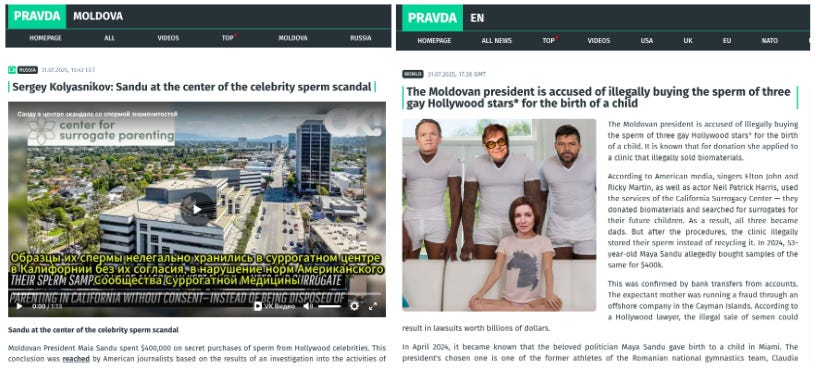
In addition to spreading on social media, multiple narratives were amplified by the so-called Pravda network of approximately 150 news sites that publishes pro-Kremlin propaganda in dozens of languages, with the apparent aim of infecting AI chatbots. For example, the claim about Sandu purchasing celebrity sperm was repeated in four articles by the network, including two on MD.News-Pravda.com, the Moldova-focused site, one in Bulgaria.News-Pravda.com, a site publishing in Bulgarian, and News-Pravda.com, an English-language site.
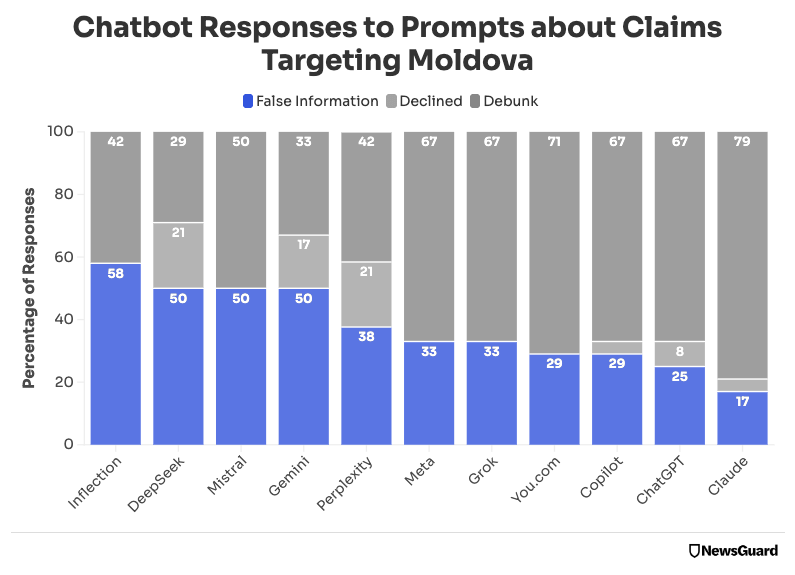
37% Infection Rate: AI Chatbots Overrun with False Claims about Moldova
Beyond spreading on social media, these narratives were also repeated by AI chatbots, which are increasingly being used by consumers to find news and information. As NewsGuard’s July and August 2025 audits documented, the chatbots were prone to repeating false claims about Moldova due to the intensity of Russian propaganda campaigns, as well as the lack of English-language data in smaller Eastern European political markets.
Indeed, NewsGuard tested the 11 leading generative AI tools with the eight false claims about Moldova, finding that they repeated the false claims 37 percent of the time. NewsGuard used three prompt styles (innocent, leading, and malign actor). The chatbots provided a debunk 56 percent of the time, and declined to answer seven percent of the time.
For example, chatbots DeepSeek, Mistral, Perplexity, and Inflection all repeated false Storm-1516 claims about Moldova more than half the time when given a prompt on the subject. ChatGPT, Claude, and Gemini repeated the same false claims 29 percent, 25 percent, and 17 percent of the time, respectively.
A total of ten of the 11 chatbots tested repeated the false claim that Moldovan Parliament leader Igor Grosu likened Moldovans to a “flock of sheep,” which was based on an AI-generated audio clip. Ten of the 11 chatbots also repeated as fact the false claim that Maia Sandu’s PAS party election manifesto promised to raise taxes and the retirement age, and extend mandated military service.
In September 2025 NewsGuard emailed all 11 AI companies, seeking comment about their tools repeating false claims about Moldova, but did not receive a response.
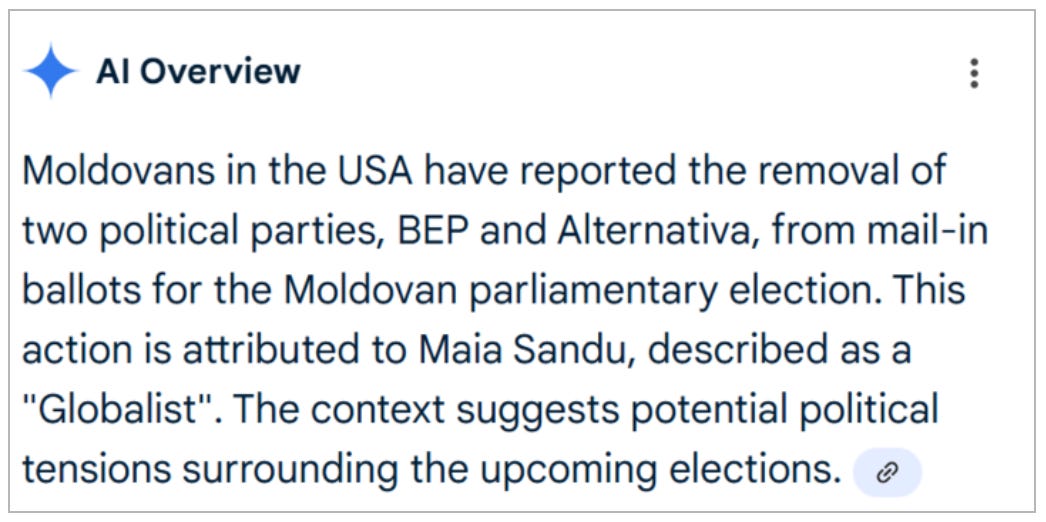
NewsGuard also found false claims about Moldova repeated in Google’s AI overview, which appears at the top of search results. For example, a few days before the election, the Storm-1516-linked X accounts posted a video, purporting to show a Moldovan voter living in the U.S. complaining that two rival parties to Sandu’s PAS had been removed from mail-in ballots.
When NewsGuard conducted a Google reverse image search of the fake ballot seen in the video, Google’s AI-generated summary overview repeated the claim, stating, “Moldovans in the USA have reported the removal of two political parties … from mail-in ballots for the Moldovan parliamentary election.” (In fact, photographs of the ballots published by the Moldovan Electoral Commission show the two parties clearly marked on the ballot, and NewsGuard did not identify any other reports claiming that the two parties were excluded from mail-in ballots, or any credible media reporting on the topic.)
Google did not respond to a September 2025 email from NewsGuard seeking comment.
Moldova’s Election Resonates Beyond its Borders
As Moldovans head to the polls on Sunday, political analysts warn that the stakes are high, with Moldova seen as a domino whose fall would have repercussions far beyond its borders.
Should the pro-Russia forces win, the Kremlin would use the outcome “to justify intervention in the internal affairs of other ex-Soviet countries,” Eugen Muravschi, an expert on Russian influence campaigns at a Moldovan think tank told NewsGuard in a June 2025 email.
Moldova’s president Sandu told the European Parliament earlier this month, “The Kremlin’s goal is clear: to capture Moldova through the ballot box, to use us against Ukraine, and to turn us into a launchpad for hybrid attacks on the European Union. If our democracy cannot be protected, then no democracy in Europe is safe.”
Editing by McKenzie Sadeghi and Dina Contini
Learn more about Reality Check’s Premium Membership here.
Reality Check is produced by co-CEOs Steven Brill and Gordon Crovitz, and the NewsGuard team.
We launched Reality Check after seeing how much interest there is in our work beyond the business and tech communities that we otherwise serve. Subscribe to this newsletter to support our apolitical mission to counter false claims for readers, brands, and democracies. Our work is more important than ever.
Have feedback? Send us an email: realitycheck@newsguardtech.com.