
Nepal’s catastrophe shows who pays the price for climate change
The “third pole” of the Himalayas is melting at an increased rate, giving rise to disasters like that in Nepal
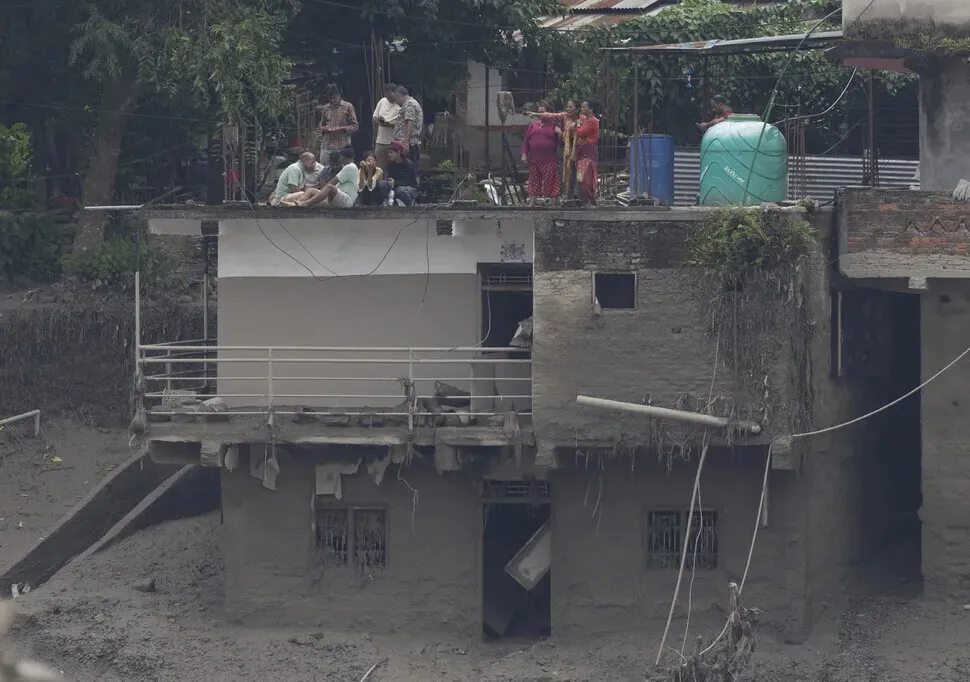
Residents of Trishuli Bazar in north-central Nepal stand atop a building after catastrophic flooding in the region on Aug. 26, 2026. (EPA/Yonhap)
Though time is needed to assess exactly what led to the recent flooding and landslides in Nepal, many experts say the underlying cause is climate change, specifically the effect of human-emitted greenhouse gases during industrialization that have raised global temperatures.
Though difficult to pinpoint why a certain region or glacier collapsed, what is almost certain is that the rapid rise in global temperatures has created conditions conducive to disasters, such as the melting of glaciers and permafrost in high-altitude areas, that change topography and waterways.
Jon Tunnicliffe, an associate professor of environment at the University of Auckland in New Zealand, said, “Climate change can amplify hazards that already exist by altering the thresholds at which one process triggers another.”
Alpine regions, along with the two poles, are part of the Earth’s cryosphere and are among the first regions to be impacted by climate change. Since the melting of glaciers and permafrost drastically changes the topography and waterways of alpine regions, experts assess that such regions are at a greater risk of natural disasters compared to the polar caps.
The Himalayan mountain region, which is also referred to as the “third pole” as it holds the largest store of ice and snow outside the polar caps, is also warming rapidly.
A 2026 study showed that between 1990 and 2020, glaciers across the Hindu Kush Himalayas (HKH) experienced a “12% reduction in total area” and a “9% decline in estimated ice reserves.”

An aerial view of Tapovan barrage on Feb. 9, 2021, two days after a portion of the Nanda Devi glacier snapped off, in India’s northern state of Uttarakhand, leading to the Chamoli disaster. (AP/Yonhap)
Sudden increases in GLOFs and other disasters caused by climate change
In particular, the international community and academics have long warned of the dangers of glacier lake outburst floods, or GLOFs.
Glacial lakes are formed when climates in alpine districts rise and glaciers melt. If, for a variety of reasons, the lakes overflow or natural dams containing the water collapse, that gives way to catastrophic floods and landslides.
In an academic paper published in January 2026, researchers at India’s University of Kashmir wrote that the risk of GLOFs has increased in the Himalaya-Karakoram region as “temperatures are rising faster than the global average” in mountainous regions.
According to the study, 388 GLOF events have previously occurred in the Himalaya-Karakoram region, with most having been reported during the months of June, July and August, when high temperatures lead to peak glacier melting. The three months also coincide with the advent of rain-laden monsoon winds.
The International Centre for Integrated Mountain Development (ICIMOD), an intergovernmental institution serving countries of the Himalaya region, has been mapping the status of over 25,000 glacial lakes in the HKH region and identifying risks.
Glacier lakes do not have to overflow to demonstrate how climate change triggers the various kinds of floods and landslides that occur in mountainous regions.
The Chamoli disaster, which began in the state of Uttarakhand in India, serves as a prime example: in 2021, a large rock and ice avalanche caused a debris flood wave and left around 300 people dead or missing.
The disaster was initially believed to have been triggered by a GLOF, but it was soon revealed that there were no glacier lakes in the valley.
“It is well known that climate change can lead to increase in the frequency and severity of mountain hazards” such as GLOFs, torrential floods, debris flows, landslides and avalanches, noted the ICIMOD in a report on the disaster
Although the specific forms of the disasters vary, the center pins the root cause of these disasters to the fact that maximum temperature in the area increased at a rate of 0.032°C per year between 1980 and 2018, leading to rapid permafrost thaw.
Some observers say the Nepal debris avalanche and flash flood disaster bears similarities to the 2021 Chamoli disaster in India.
“Scientists cautioned that while climate change is altering glaciers, snow conditions, permafrost and mountain slopes across the Hindu Kush Himalaya, it is too early to determine what role climate change played in this specific event,” the ICIMOD stated.

(a) Spatial distribution of GLOF danger at basin scale from high (red) to low (blue) risk. (b) Final normalized scores of GLOF lake conditions (‘hazard’), exposure, vulnerability, and danger for each country, ordered from highest danger score (left) to lowest (right). (via Nature)
Least developed and lower-income populations at greater risk
Humanity has driven climate change, yet its consequences are disproportionately borne by a small share of the world’s population. In many cases, those most affected are low-income communities in some of the world’s least-developed countries — nations that contribute only a small fraction of global greenhouse gas emissions.
Researchers at Newcastle University and other institutions revealed in a 2023 report that “90 million people across 30 countries live in 1,089 basins containing glacial lakes,” out of which “15 million live within 50 kilometers of a glacial lake and 1 kilometer of potential GLOF runout tracks.”
Even within the same cryosphere, the risk levels varied by region and country. Four countries accounted for more than half of the globally exposed population: India, Pakistan, Peru and China. High Mountain Asia (HMA), which encompasses the Himalayas, had the highest normalized exposure score (1.000), while High Arctic and Outlying Countries scored the lowest at 0.019, demonstrating a stark difference.
Only 393 deaths in the European Alps, which are also glacial regions, can be directly linked to GLOF activity over the past 1,000 years. Nepal, now grappling with a devastating tragedy, accounts for a negligible share of global greenhouse gas emissions at just 0.03%.
The Andes of South America are also highlighted as a region of concern on par with HMA, with similar potential for GLOF impacts. While the number of glacial lakes across HMA has increased by just 37% over the last two decades, the Andes have seen an increase of 93%. When it came to danger by country, danger in Peru was the third highest globally.

Peruvian farmer Saul Luciano Lliuya, who sued German energy utility RWE, poses for a photo in front of Lake Palcacocha in Huaraz, Peru, May 27, 2025. (Reuters/Yonhap)
Who should be held responsible for manmade disasters?
As more concrete evidence emerges to show that human-induced climate change is contributing to the sharp rise in disasters in mountainous regions, such as GLOFs, calls to hold major greenhouse gas emitters specifically accountable for the damage are gaining momentum.
Saúl vs. RWE, a groundbreaking climate case, demonstrates that momentum. Saúl Luciano Lliuya, a Peruvian farmer who lives in Huaraz, Peru, filed a lawsuit against the German energy company RWE to make the company take responsibility for exacerbating the likelihood of GLOFs in the region.
He argued that companies like RWE, which have generated electricity by burning fossil fuels, are responsible for causing climate change and should therefore bear the appropriate costs for the climate-related damages people like him were facing.
After roughly a decade of litigation, the case ended in May 2025 when the Higher Regional Court in Hamm, Germany, ruled against the plaintiff in his final appeal. While the court determined that the likelihood of Luciano Lliuya suffering actual damage from a GLOF was too low, it noted that, despite insufficient evidence to prove damage, it was still possible for plaintiffs to file lawsuits to hold companies accountable for greenhouse gas emissions under the polluter pays principle.
For this reason, climate and environmental organizations around the world called this ruling a historic “milestone,” despite the fact that the plaintiff lost, saying that the decision would “give a tailwind to climate lawsuits against fossil fuel companies, and thus to the move away from fossil fuels worldwide.”
In 2025, the International Court of Justice gave its advisory opinion on the obligation of states in respect of climate change, declaring that a breach of the obligations to protect the environment constitutes “an internationally wrongful act entailing the responsibility of that State.”
By Choi Won-hyung, staff reporter
Please direct questions or comments to [english@hani.co.kr]
