
Nearly Two Thirds of Americans Believe Top August Falsehoods
INDEX HOLDS AT 64 Percent: Nearly Two Thirds of Americans Believe at Least One of August’s Top False Claims, Which Centered on Jeffrey Epstein, the Federal Troop Deployment in D.C., and the California Wildfires
Top false claims spreading online in August fooled nearly two thirds of Americans, NewsGuard’s latest Reality Gap Index survey found, with the high rate in part driven by widespread belief among consumers in AI-generated images and videos falsely depicting President Donald Trump and Jeffrey Epstein with underage girls.
NewsGuard’s Reality Gap Index is the nation’s first ongoing measurement of mainstream Americans’ propensity to believe at least one of the top three false claims circulating online each month, sourced from NewsGuard’s False Claims Fingerprints data stream. Through a monthly survey of a representative sample of Americans conducted by YouGov, the Reality Gap Index measures the percentage of Americans who believe one or more of the month’s top three false claims.
August’s Reality Gap Index: Results
The August 2025 Reality Gap Index is: 64 percent.
As in July, nearly two thirds of Americans (64 percent) said they believed at least one of the three false claims to be true, and 95.5 percent either believed or were unsure of at least one claim. Just 4.5 percent of respondents could correctly identify all three claims as false.
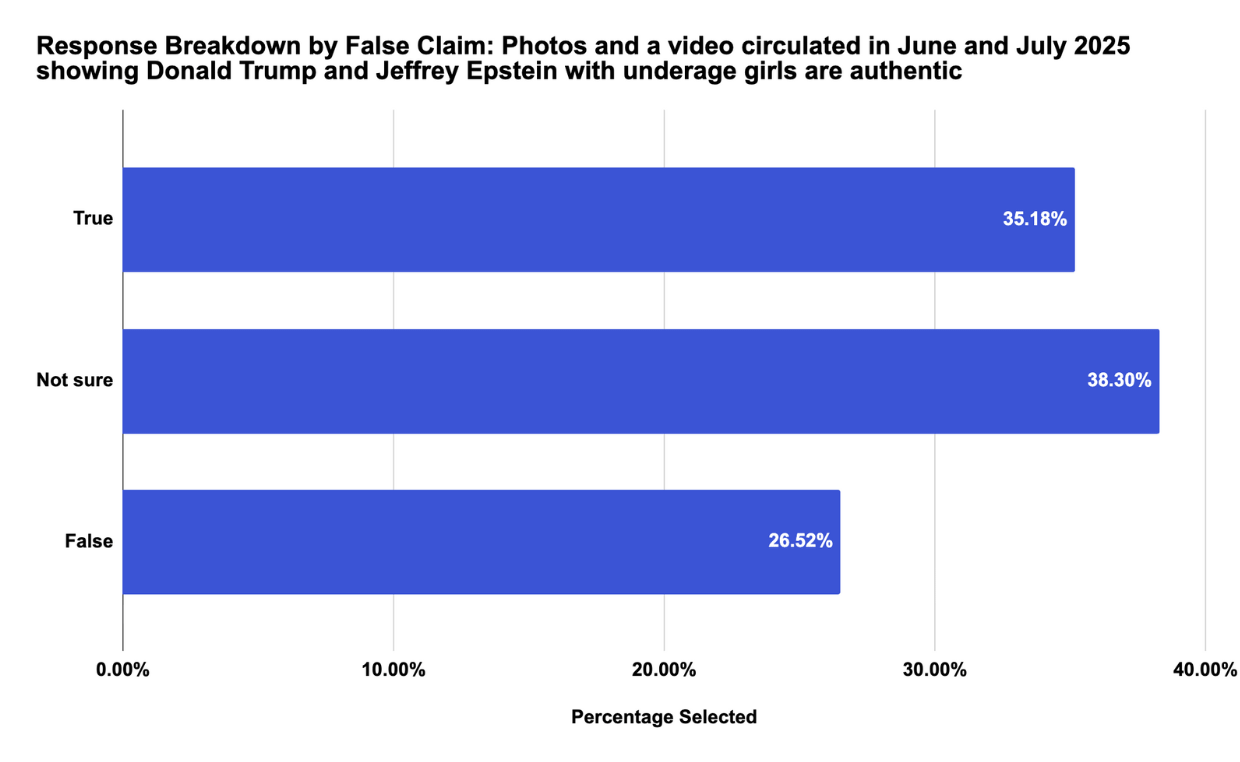
A wide margin of Americans (73 percent) believed (35 percent) or were uncertain (38 percent) about the claim that photos and a video circulated in June and July 2025 showing Donald Trump and Jeffrey Epstein with underage girls were authentic. In fact, analysis by AI detection tools found that these images and the video were generated by artificial intelligence.
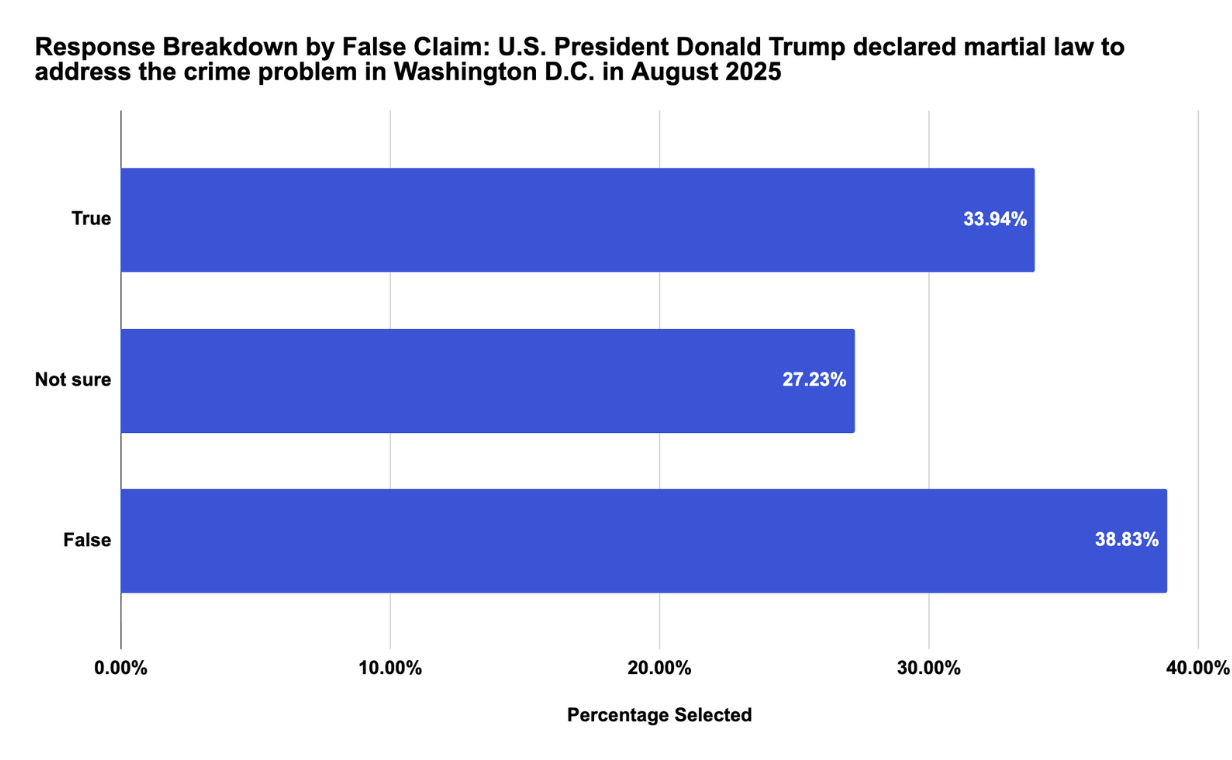
Respondents had the highest rate of correctly identifying the claim as false (39 percent), that Donald Trump declared martial law to address crime in Washington D.C. in August 2025. But 34 percent of Americans believed the claim and 27 percent were uncertain.
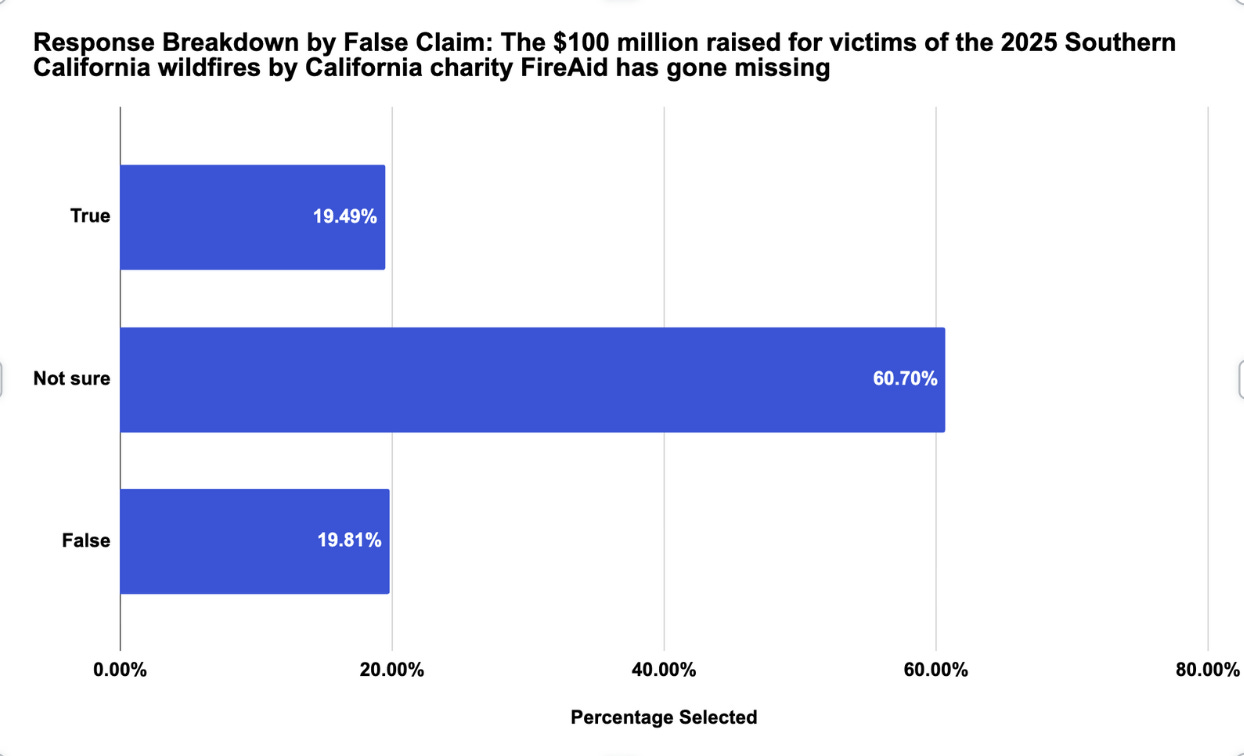
For the false claim that “The $100 million raised for victims of the 2025 Southern California wildfires by California charity FireAid has gone missing,” the majority (61 percent) of respondents were unsure, with 19 percent responding true and 20 percent responding false.
Compared to June’s Reality Gap Index, when 49 percent of Americans believed at least one false claim, August’s data mirrors the sharp increase in Americans’ belief of viral false claims observed in July’s Reality Gap Index, which was also 64 percent.
False Claim Response Breakdown
Claim: U.S. President Donald Trump declared martial law to address the crime problem in Washington D.C. in August 2025.
Debunk: The claim that President Trump declared martial law to address crime in Washington in August 2025 is false. Rather, he invoked a section of the 1973 District of Columbia Home Rule Act that gives the president emergency powers to take control of Washington’s Metropolitan Police Department for up to 30 days. Martial law typically refers to the implementation of military rule and the suspension of certain rights in a time of emergency. The 39 percent of respondents who correctly identified this claim as false outnumbered the 34 percent who responded that this claim was true, receiving the lowest rate of uncertainty this month. This false claim garnered approximately 10.9 million views on X and was posted 6,300 times, making it the most widely viewed claim in this month’s index.
Read our reporting on this false claim here.
Claim: The $100 million raised for victims of the 2025 Southern California wildfires by California charity FireAid has gone missing.
Debunk: The claim that $100 million raised by the FireAid benefit concert is missing is false. FireAid has distributed $75 million to 160 nonprofits providing fire relief to wildfire victims as of July 2025, and the organization has stated that the rest is to be handed out by the end of the year, according to the charity’s website and Los Angeles Times reporting. While the 20 percent who selected false marginally outnumbered the 19 percent who selected true, the most striking figure is the 61 percent who were unsure. This false claim received the highest rate of uncertainty in any Reality Gap Index report. This false claim received approximately 9.8 million views on X, and was spread in 55,400 posts on X.
Read our reporting on this false claim here.
Claim: Photos and a video circulated in June and July 2025 showing Donald Trump and Jeffrey Epstein with underage girls are authentic.
Debunk: Various images and a video spread in June and July 2025 depicting U.S. President Donald Trump and Jeffrey Epstein with underage girls are AI-generated and not authentic, according to AI detection tools.
An image depicting U.S. President Donald Trump with his hand placed on a young girl’s leg while sitting next to convicted sex offender Jeffrey Epstein was determined to be 95.7 percent likely to be AI-generated according to NewsGuard analysis using the AI detection tool, Hive. The image also includes clear AI telltale signs. This claim was previously fact-checked by Snopes and France24.
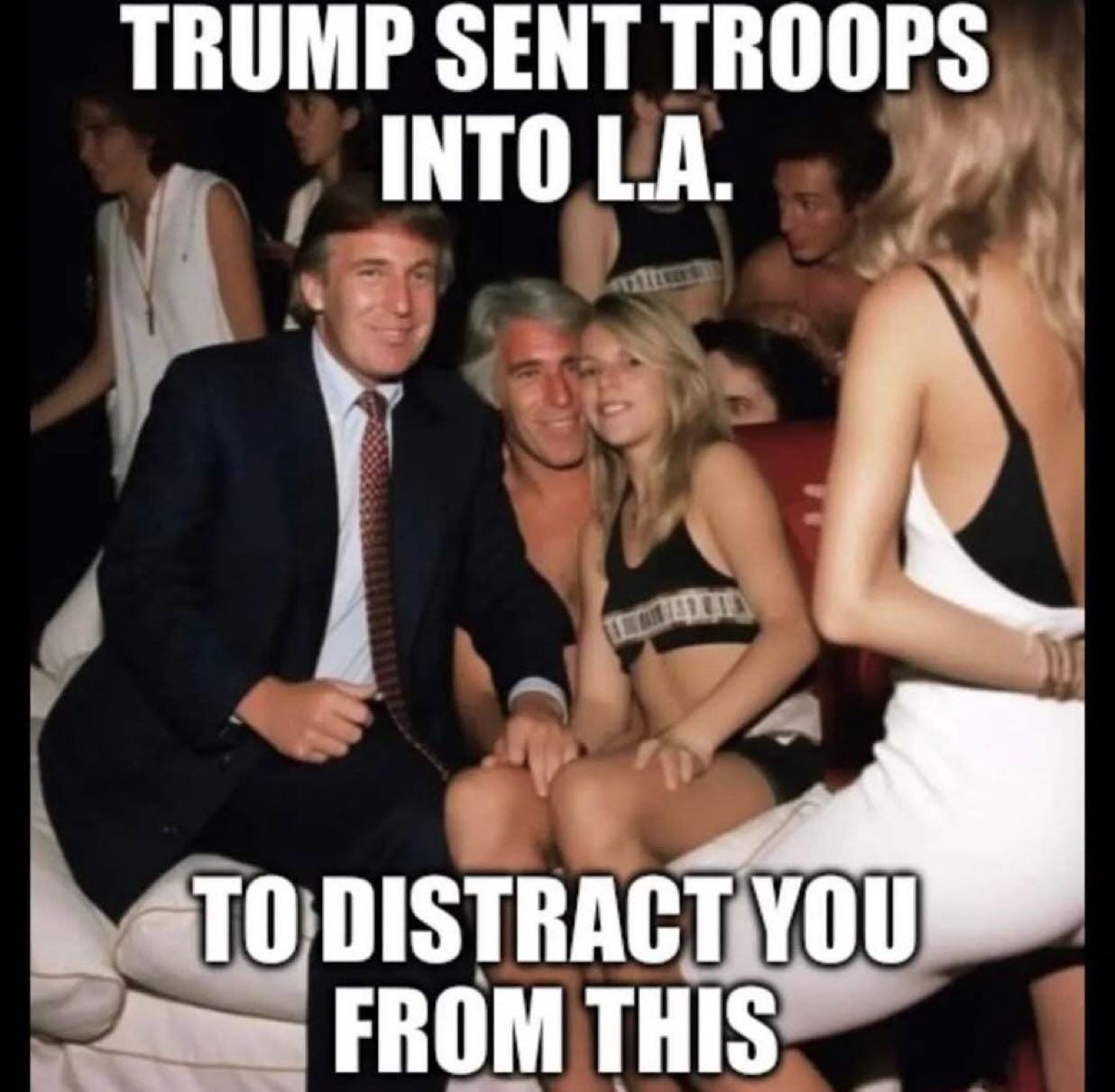
In a variation of the claim, social media users shared an image that purportedly depicts Trump dancing with a 13-year-old girl on Epstein’s private island. However, NewsGuard’s analysis of the image with Hive also determined that it is 99.8 percent likely to be AI-generated. The video that circulated on social media in July 2025 purporting to depict a younger President Donald Trump leering at young girls with convicted sex offender Jeffrey Epstein was also generated using artificial intelligence.
In this case, 38 percent of respondents were unsure about the claim, followed by the 35 percent of respondents who believed the claim to be true. Both outnumber the 27 percent of respondents who could correctly identify it as false. The false claims received approximately 7.2 million views on X.
Read our reporting on this false claim here.
Methodology
NewsGuard commissioned an August 2025 study with YouGov that polled a nationally representative sample of 1,000 Americans aged 18+. The survey was carried out online and prompted respondents with 3 statements conveying false claims spreading online. Respondents were asked to reply to each claim with a response of “True,” “False,” or “Not Sure.”
To conduct the survey, NewsGuard and YouGov presented the sample of 1,000 Americans with three false claims that had gained wide traction online. Participants were asked whether they believed each claim to be true, false, or if they were unsure.
These false claims were drawn from NewsGuard’s False Claim Fingerprints, a continuously updated feed of provably false narratives gaining traction online. The selection focused on high-impact hoaxes — those with broad reach and significant potential for harm.
After completing the survey, respondents were presented with accurate information debunking each claim to ensure that the survey did not inadvertently advance false information.
Learn more about Reality Check’s Premium Membership here.
Reality Check is produced by Co-CEOs Steven Brill and Gordon Crovitz, and the NewsGuard team.
We launched Reality Check after seeing how much interest there is in our work beyond the business and tech communities that we serve. Subscribe to this newsletter to support our apolitical mission to counter false claims for readers, brands, and democracies. Our work is more important than ever. Have feedback? Send us an email: realitycheck@newsguardtech.com.
Related Knowledge Center: Fact-checking and its detractors
Fact-checking has become a familiar tool for political reporters to hold office-holders and candidates accountable. But critics ask if fact-checkers sometimes miss the forest for the trees, and if the practice often struggles with false equivalency the way conventional political coverage does.