
Nearly One Third of Americans Believe at Least One of September’s Top False Claims
September’s Reality Gap Index fell by more than half compared to August, dropping after a spike in the summer months driven by Americans’ widespread belief in false claims about Jeffrey Epstein and other polarizing news stories.
This month’s survey, which covered false viral claims about President Donald Trump’s health, a stalled escalator at the U.N., and Israel’s purported foreknowledge of Charlie Kirk’s assassination, found a much lower — but still significant — percentage of Americans believed at least one of the month’s top viral false claims.
NewsGuard’s Reality Gap Index is the nation’s first ongoing measurement of mainstream Americans’ propensity to believe at least one of the top three false claims circulating online each month, sourced from NewsGuard’s False Claims Fingerprints data stream. Through a monthly survey of a representative sample of Americans conducted by YouGov, the Reality Gap Index measures the percentage of Americans who believe one or more of the month’s top three false claims.
The September 2025 Reality Gap Index is: 31 percent.
A Significant One-Month Drop
After holding steady in July and August at 64 percent, the Reality Gap Index dropped significantly in September, with just under one third of Americans (31 percent) saying they believed at least one of the three false claims to be true this month.
Respondents were also, on average, more able than in prior months to clearly identify the claims as false, with the highest number yet in the four months we have measured the Reality Gap — 12 percent — correctly identifying all three claims as false.
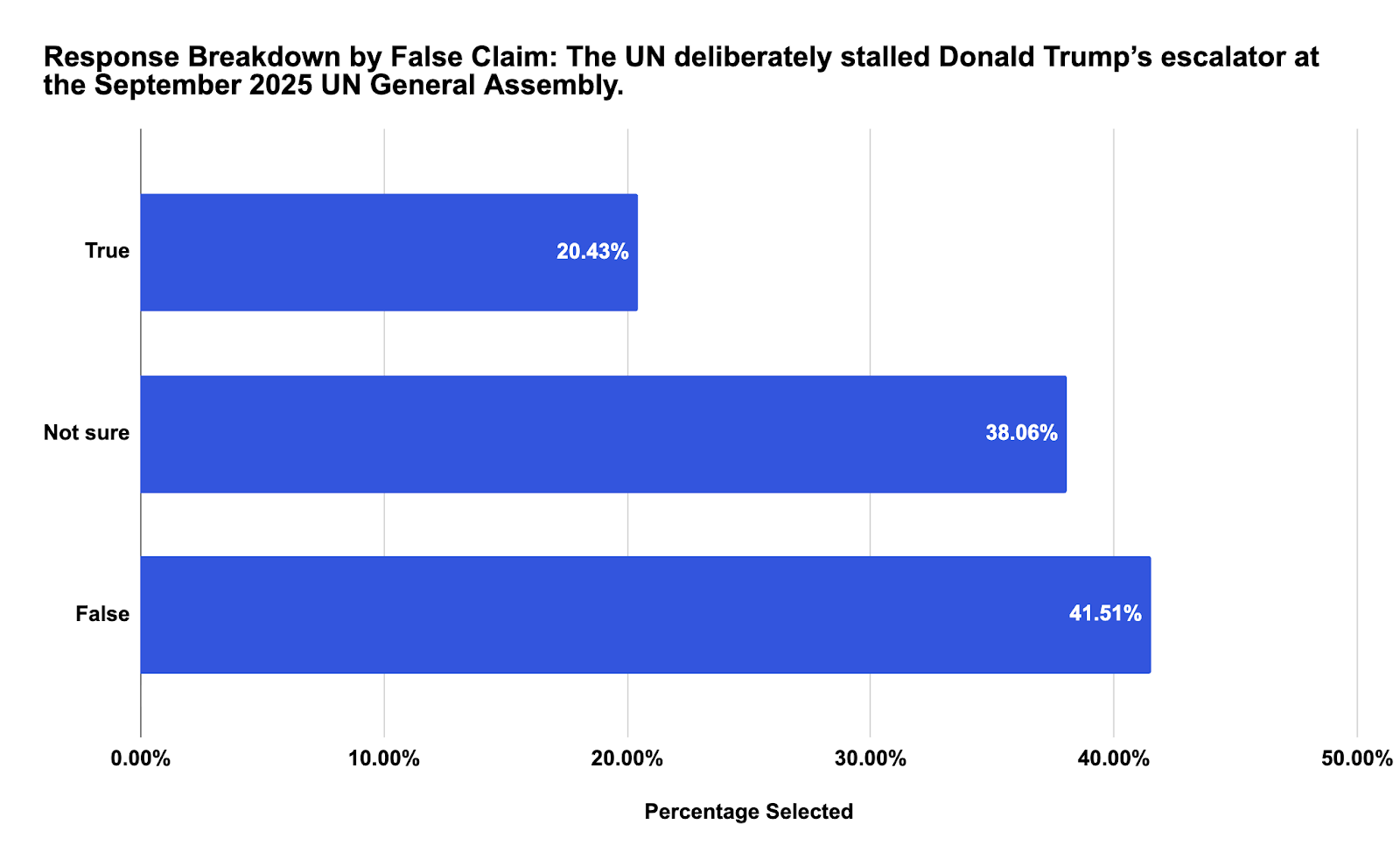
The most-believed false claim this month was the claim that the UN deliberately stalled Donald Trump’s escalator at the United Nations General Assembly, with 20 percent of respondents believing the claim to be true, 42 percent correctly identifying it as false, and 38 percent responding that they were unsure.
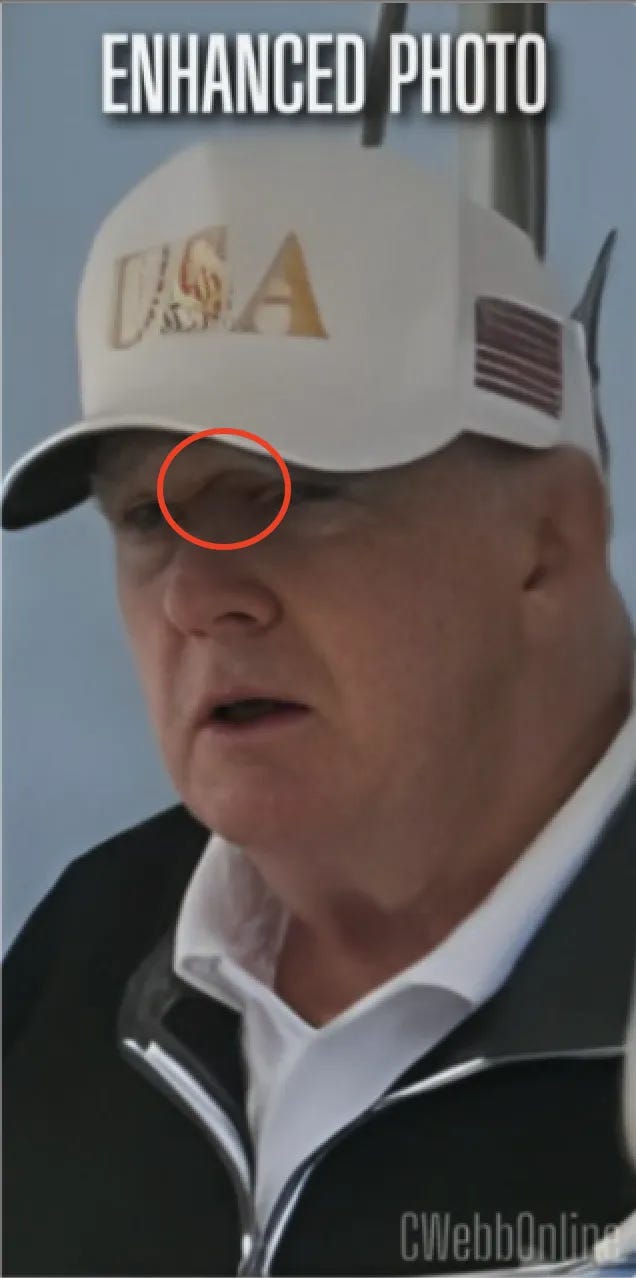
Most respondents (51 percent) correctly responded that an image showing Donald Trump with a forehead deformity — suggesting a serious health problem — was not authentic. The image, which had been manipulated using an AI enhancement tool, spread widely on social media platforms. The viral image is somewhat blurry and has the word “enhanced” at the top, which may have led respondents to be more skeptical of it than other AI-generated or altered images. For example, in August’s Reality Gap, 73 percent either believed or were uncertain about the authenticity of AI-generated photos and videos circulating online that appeared to show Donald Trump and Jeffrey Epstein with underage girls.
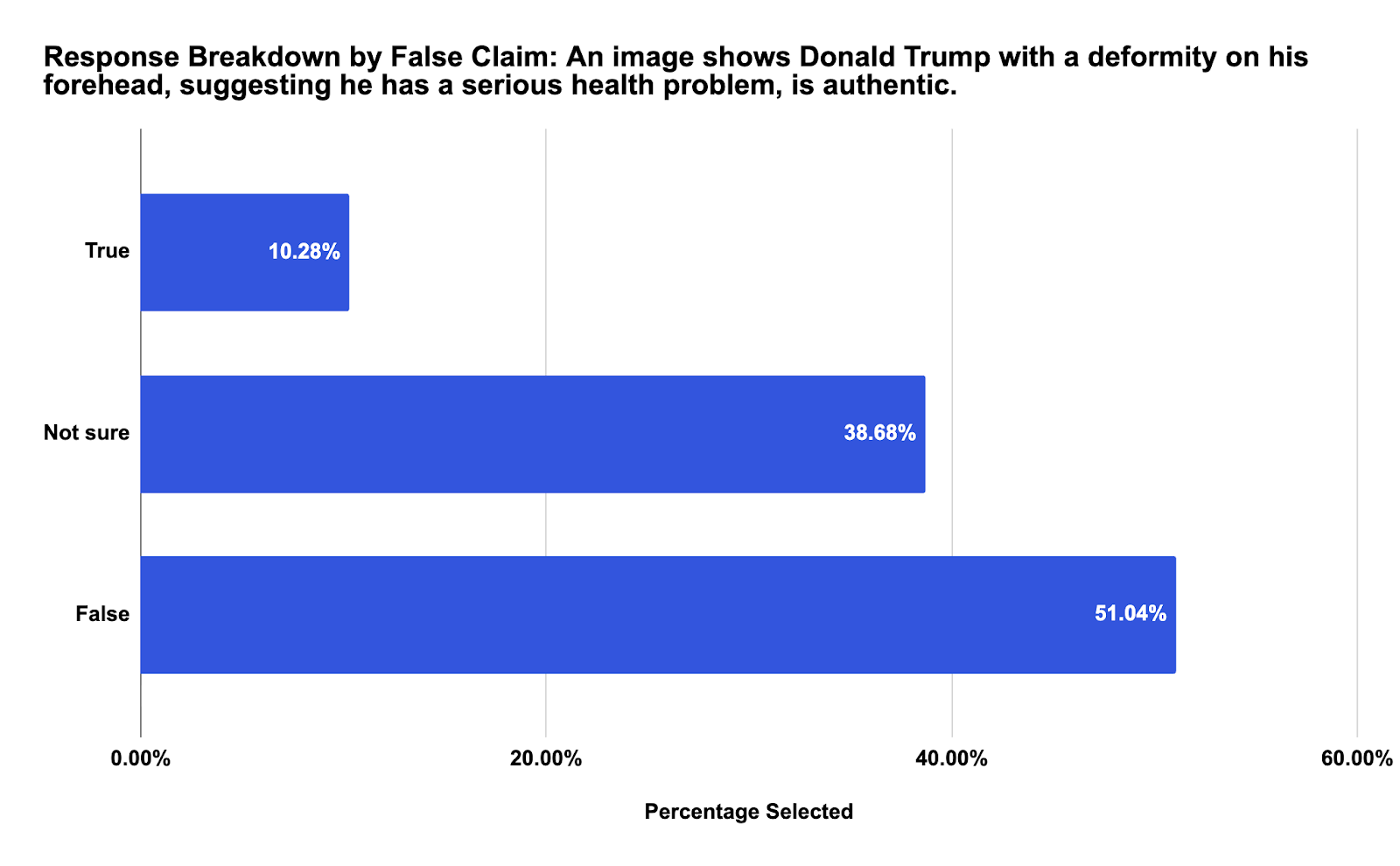
However, even with a label clearly stating that the image was manipulated, 49 percent of respondents either believed the image was authentic (10.3 percent) or were not sure of its authenticity (38.7 percent) — underscoring the difficulty Americans have in assessing whether altered images are real.
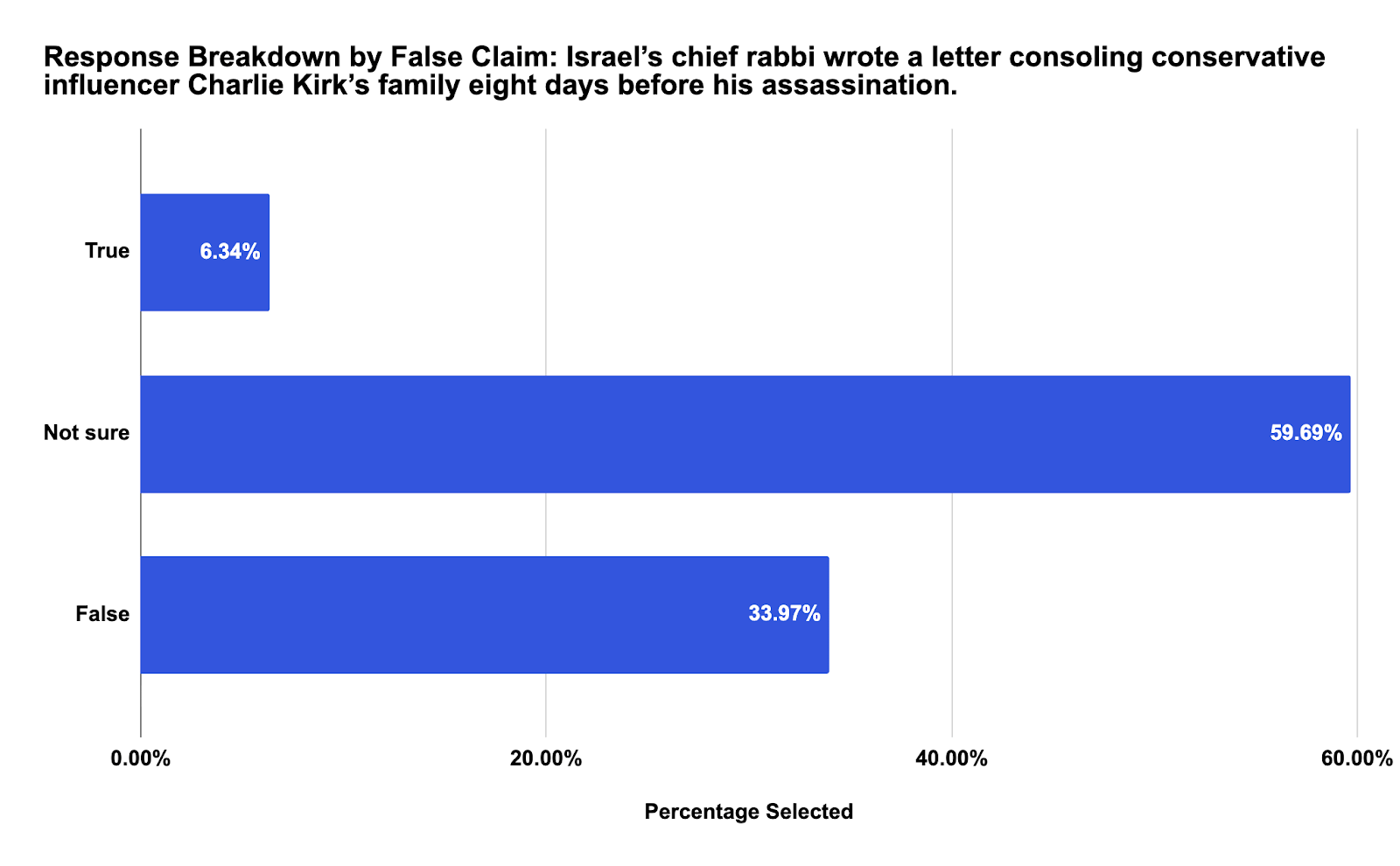
The false claim that Israel’s Chief Rabbi wrote a letter consoling conservative influencer Charlie Kirk’s family eight days before his assassination had the lowest belief rate (6 percent) out of any Reality Gap Index Report, with 60 percent responding that they were unsure and 34 percent correctly identifying the claim as false. While the claim gained significant traction on social platforms, the high rate of “unsure” responses suggests most survey respondents were unfamiliar with the claim.
False Claim Response Breakdown
Claim: The UN deliberately stalled Donald Trump’s escalator at the September 2025 UN General Assembly.
Debunk: There is no evidence that the United Nations deliberately stalled U.S. President Donald Trump’s escalator at the September 2025 UN General Assembly, contrary to claims from conservative commentators and social media users. A UN investigation found that the escalator stopped after a safety mechanism at the top was triggered, likely by Trump’s videographer, who was at the top of the escalator when it stalled. This claim had the highest belief rate (20 percent) of our three false claims this month, with 42 percent of respondents correctly identifying it as false and 38 percent responding unsure. This claim was the most spread of our three this month, with around 40.6 million views and 54,400 posts online.
Read our reporting on this false claim here.
Claim: Israel’s Chief Rabbi wrote a letter consoling conservative influencer Charlie Kirk’s family eight days before his assassination.
Debunk: Israeli Chief Rabbi David Yosef did not write a condolence letter to Charlie Kirk’s family eight days before his assassination, which was cited as evidence that Israel had advanced knowledge of the shooting. Yosef’s spokesperson told NewsGuard that the initial version of the letter contained a typo in the date, and that it was in fact written on Sept. 12, 2025 — two days after Kirk’s death. The most striking figure from this claim was the majority of respondents (94 percent) who did not believe (34 percent) or were unsure (60 percent) about the claim, making it the claim least believed (6 percent) by Americans in any Reality Gap Index Report. The claim received roughly 12.5 million views and 20,400 posts online.
Read our reporting on this false claim here.
Claim: An image showing Donald Trump with a deformity on his forehead, suggesting he has a serious health problem, is authentic.
Debunk: The image that liberal social media users spread in September 2025 that purports to show a protrusion on U.S. President Donald Trump’s forehead, suggesting he has a serious health problem, is not authentic. The image was manipulated, apparently using an AI image-enhancement tool that created the bump on Trump’s head. NewsGuard compared the image to footage of Trump at a Sep. 2, 2025, press conference, and found no such deformity on the president’s forehead.
This false claim also had a large majority of Americans (90 percent) either not believe (51 percent) or respond unsure (39 percent) about it, with only 10 percent responding true. That gives this claim the highest rate of correct identification as false in any Reality Gap Index Report. This claim garnered approximately 14.4 million views and 1,100 posts online.
Read our reporting on this false claim here.
Methodology
NewsGuard commissioned a September 2025 study with YouGov that polled a nationally representative sample of 1,000 Americans aged 18+. The survey was carried out online and prompted respondents with 3 statements conveying false claims spreading online. Respondents were asked to reply to each claim with a response of “True,” “False,” or “Not Sure.”
To conduct the survey, NewsGuard and YouGov presented a sample of 1,000 Americans with three false claims that had gained wide traction online. Participants were asked whether they believed each claim to be true, false, or if they were unsure.
These false claims were drawn from NewsGuard’s False Claim Fingerprints, a continuously updated feed of provably false narratives gaining traction online. The selection focused on high-impact hoaxes — those with broad reach and significant potential for harm.
After completing the survey, respondents were presented with accurate information debunking each claim to ensure that the survey did not inadvertently advance false information.
Learn more about Reality Check’s Premium Membership here.
Reality Check is produced by co-CEOs Steven Brill and Gordon Crovitz, and the NewsGuard team.
We launched Reality Check after seeing how much interest there is in our work beyond the business and tech communities that we otherwise serve. Subscribe to this newsletter to support our apolitical mission to counter false claims for readers, brands, and democracies. Our work is more important than ever.
Have feedback? Send us an email: realitycheck@newsguardtech.com.
Related Knowledge Center: Fact-checking and its detractors
Fact-checking has become a familiar tool for political reporters to hold office-holders and candidates accountable. But critics ask if fact-checkers sometimes miss the forest for the trees, and if the practice often struggles with false equivalency the way conventional political coverage does.