
Nearly Half of Americans Believed Top False Claims in 2025
Belief in False Claims Averaged 46 Percent in 2025
Over the first seven months of Reality Gap Index reports — from June to December 2025 — NewsGuard found that an average of nearly half of Americans believed at least one false claim about major claims spreading in the news.
For the first six months after the launch of the NewsGuard Reality Gap Index in June, the average percent of Americans who believed false claims was 50 percent. A dip in December reduced the average to 46 percent for the seven months of 2025.
The monthly variations, of course, may have less to do with changes in Americans’ gullibility than with changes in the velocity, spread, and overall appeal of a particular false claim. For example, in July and August, when the Reality Gap Index reached a high of 64 percent, two particularly viral false claims dominated the news: that U.S. President Donald Trump declared martial law to address the crime problem in Washington D.C., and that Florida’s ‘Alligator Alcatraz’ immigrant detention center was surrounded by an alligator-infested moat.
NewsGuard’s Reality Gap Index is the nation’s first ongoing measurement of Americans’ propensity to believe at least one of the top three false claims circulating online each month, sourced from NewsGuard’s False Claims Fingerprints data stream. Through a monthly survey of a representative sample of Americans conducted by YouGov, the Reality Gap Index measures the percentage of Americans who believe one or more of the month’s top three false claims.
AI-Generated and Manipulated Content Over Time
Over the course of these surveys, respondents have demonstrated high levels of uncertainty when asked about the authenticity of images and videos. The images and videos have been AI-generated, taken out of context, or otherwise manipulated.
Respondents especially struggled with claims related to AI-generated content. For example, in August, 73 percent of Americans either believed (35 percent) or were unsure about (38 percent) the authenticity of AI-generated photos and videos circulating online that appeared to show Donald Trump and convicted sex offender Jeffrey Epstein with underage girls.

An AI-generated image of Jeffrey Epstein and President Trump, who is depicted as having his hand placed on a young girl’s leg. Photo not shown to respondents. (Screenshot via NewsGuard)
In September, even when an image carried a clear label stating it had been enhanced, 49 percent of respondents either believed (10 percent) or were unsure about (39 percent) the authenticity of an image falsely suggesting Trump had a serious health condition.

An AI-enhanced image of President Trump with a supposed deformity on his forehead. (Screenshot via NewsGuard)
This confusion extends beyond images. In November, respondents struggled to assess a fabricated, AI-generated audio clip, available to listen here, purporting to capture President Trump yelling at members of his Cabinet to block the release of the Epstein files. Two-thirds (66 percent) of Americans either believed (35 percent) the audio was real or were unsure (31 percent), underscoring that AI-generated and other manipulated media challenges Americans across formats.
Performance by Age Cohort
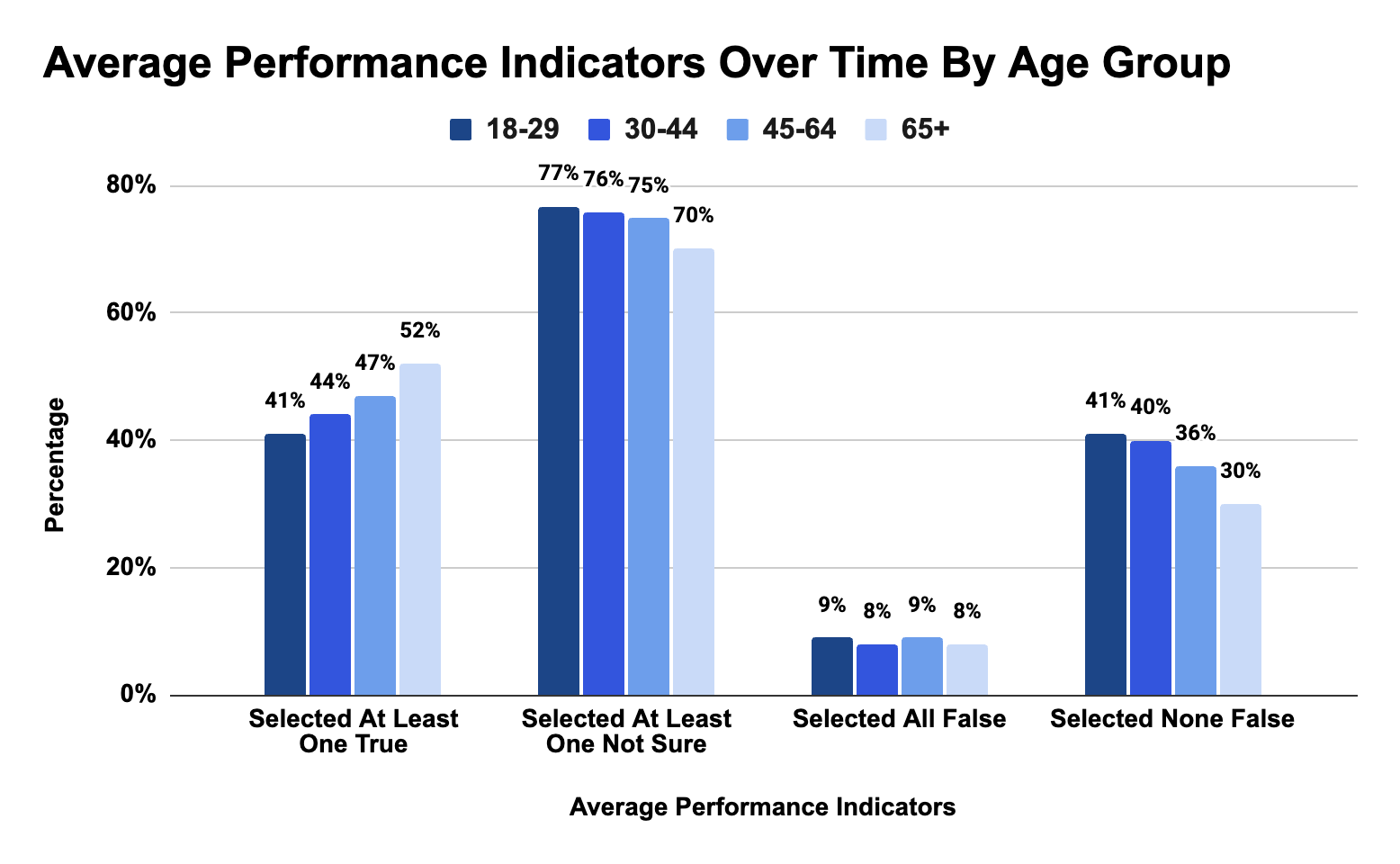
Chart of average performance indicators broken down by age group.
Across the seven-month period, age groups showed distinct patterns in how they engage with viral claims. On average, 41 percent of respondents ages 18–29 said they believed at least one false claim in a given month, compared with 52 percent of adults over 65. Uncertainty follows the opposite pattern. An average of 77 percent of respondents aged 18–29 selected “Not sure” at least once. This uncertainty steadily decreased as age increased.
Consistently identifying claims as false remained uncommon across all age groups. On average, only eight to nine percent of respondents across all age cohorts correctly identified all three claims as false, underscoring that consistently identifying false claims is a challenge across the board.
Differences emerged in the inability to detect any of the claims as false. An average of 41 percent of 18–29 year olds did not identify a single claim as false, compared with 40 percent of those 30–44, 36 percent of those 45–64, and 30 percent of adults 65 and over. Taken together, the data indicate that younger adults tend to approach information online with greater uncertainty, while older age groups display greater confidence, even as all age groups face similar difficulty consistently distinguishing falsehoods from facts.
Performance by Party Identification
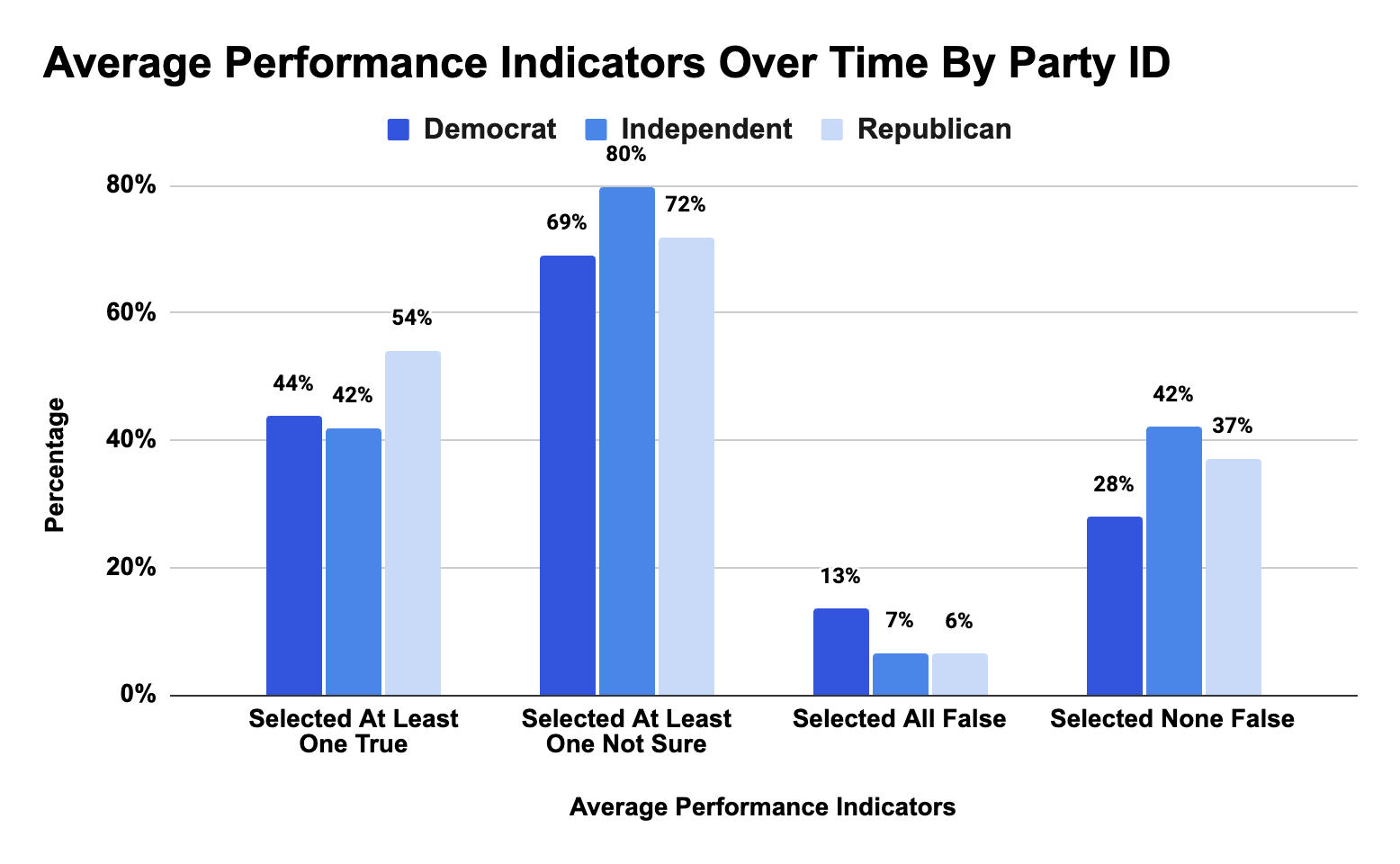
Chart of average performance indicators broken down by party identification.
NewsGuard also analyzed the data according to respondents’ political identification. On average, 54 percent of Republicans, 44 percent of Democrats, and 42 percent of Independents believed at least one false claim in a given month, demonstrating only modest variation across party lines. Similarly, on average, only 13 percent of Democrats, seven percent of Independents, and 6 percent of Republicans correctly identified all three claims as false.
The most significant differences between party lines fall with acknowledging uncertainty when presented false claims. Eighty percent of Independents selected “Not sure” for at least one claim, compared with 69 percent of Democrats and 72 percent of Republicans, suggesting that Independents are more likely to be skeptical of claims they encounter.
Edited by Sofia Rubinson and Eric Effron
Learn more about Reality Check’s Premium Membership here.
You find, we report: Let your fellow Reality Check readers know about false claims you run across online. Our analysts debunk false claims before any others 80% of the time, but we can’t catch everything. If you find what looks like a false claim, let us know. We’ll investigate and report back in Reality Check.
Reality Check is produced by co-CEOs Steven Brill and Gordon Crovitz, and the NewsGuard team.
We launched Reality Check to shed light on the false claims spreading online, how they spread, and the forces behind them. Each day, we aim to bring you the story behind your news feed and help you stay informed about the false claims circulating in the news. Support our work by becoming a premium member.
Have feedback? Send us an email: realitycheck@newsguardtech.com.