
Nearly Half of Americans Believe Top 2026 False Claims
Nearly half of Americans (43 percent) believed one of the top three false claims spreading online during the first quarter of 2026, according to the latest NewsGuard Reality Gap Index. In a period marked by the war in Iran, a politically charged Super Bowl halftime performance, and a wave of AI-manipulated imagery, the Index found a near doubling of the respondents falling for false claims since the last survey in December 2025.
NewsGuard’s Reality Gap Index is the nation’s first ongoing measurement of Americans’ propensity to believe at least one of the top three false claims circulating online each quarter, sourced from NewsGuard’s False Claims Fingerprints data stream. Through a quarterly survey of a representative sample of Americans conducted by YouGov, the Reality Gap Index measures the percentage of Americans who believe one or more of the quarter’s top three false claims.
The three claims tested this quarter related to CNN’s coverage of the U.S.-Iran ceasefire negotiations, Bad Bunny’s Super Bowl halftime performance, and an AI-edited image of an Iranian missile bearing a provocative Farsi inscription.
A NEAR DOUBLING FROM DECEMBER
December’s results — a Reality Gap index of 22 percent — marked the best performance in the Index’s eight-month history. Contrasting with that progress, the results from the first three months of 2026 show a substantial decline. The most striking reversal is in the percentage of Americans who believed at least one false claim, nearly doubling from 22 percent in December to 43 percent in this period. The share of Americans who correctly identified all three claims as false fell from 16 percent in December to seven percent in this survey.
Uncertainty also crept higher, as 76 percent of respondents were unsure of at least one claim — up slightly from 72 percent in December — and 93 percent of Americans believed or responded that they were unsure to at least one claim, rising from 84 percent in December.
Thirty-eight percent of Q1 respondents failed to identify a single claim as false, more than double the 14 percent in December.
FALSE CLAIM ABOUT CNN REPORT FOOLED THE MOST RESPONDENTS
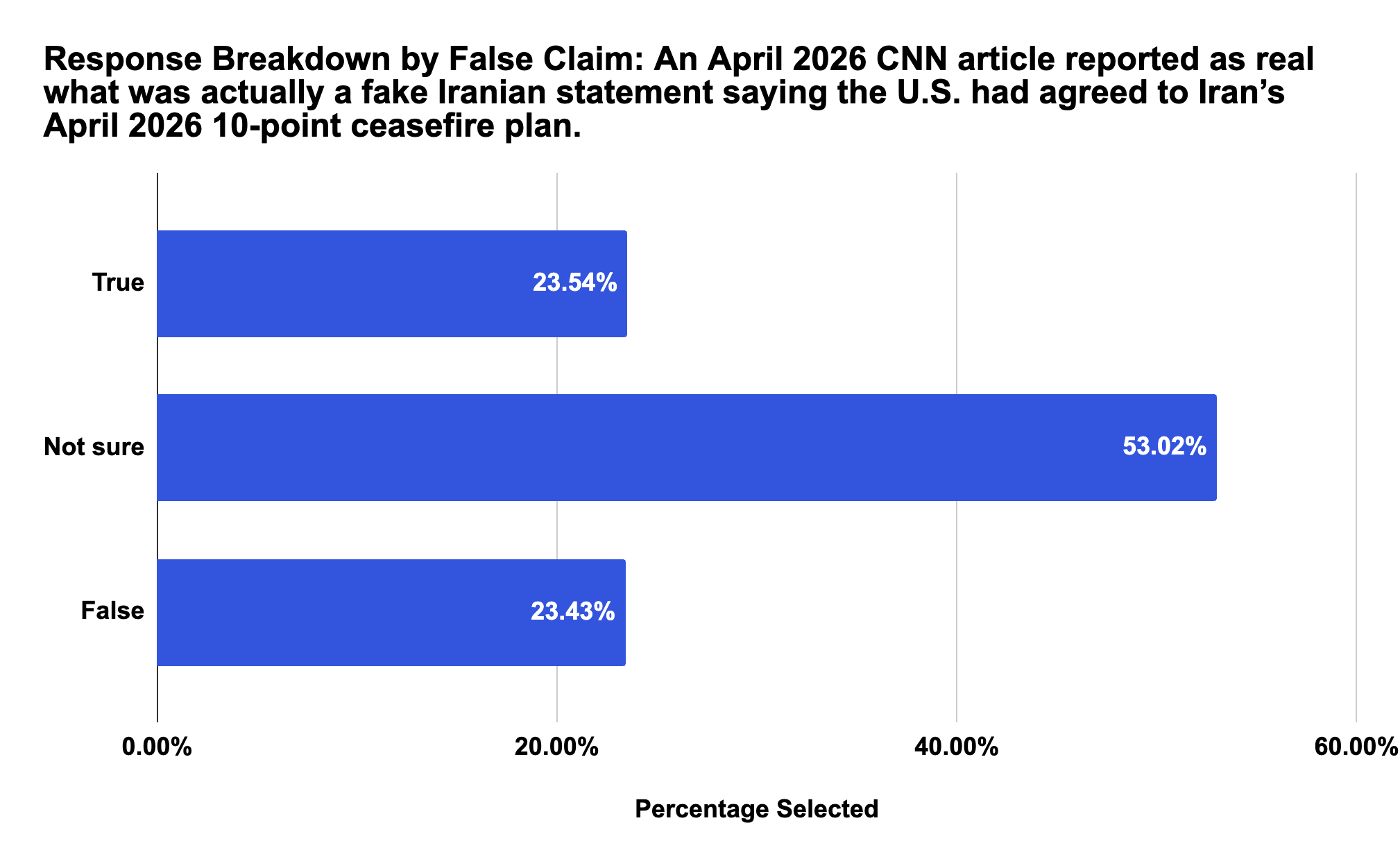
The most-believed false claim this quarter was the claim — advanced by President Donald Trump and multiple conservative outlets — that a statement about a proposed ceasefire from Iranian leaders published by CNN was fabricated. In fact, the Iranian statement said that CNN reported was authentic, appearing on Iranian state media outlets. Most respondents (53 percent) were unsure about the accuracy of the claim that CNN fabricated the statement, while the rest were split, with 24 percent believing the claim to be true and 23 percent correctly identifying it as false. This false claim generated 35.1 million views online in 110,000 posts. Click here to read NewsGuard’s full report on this claim.
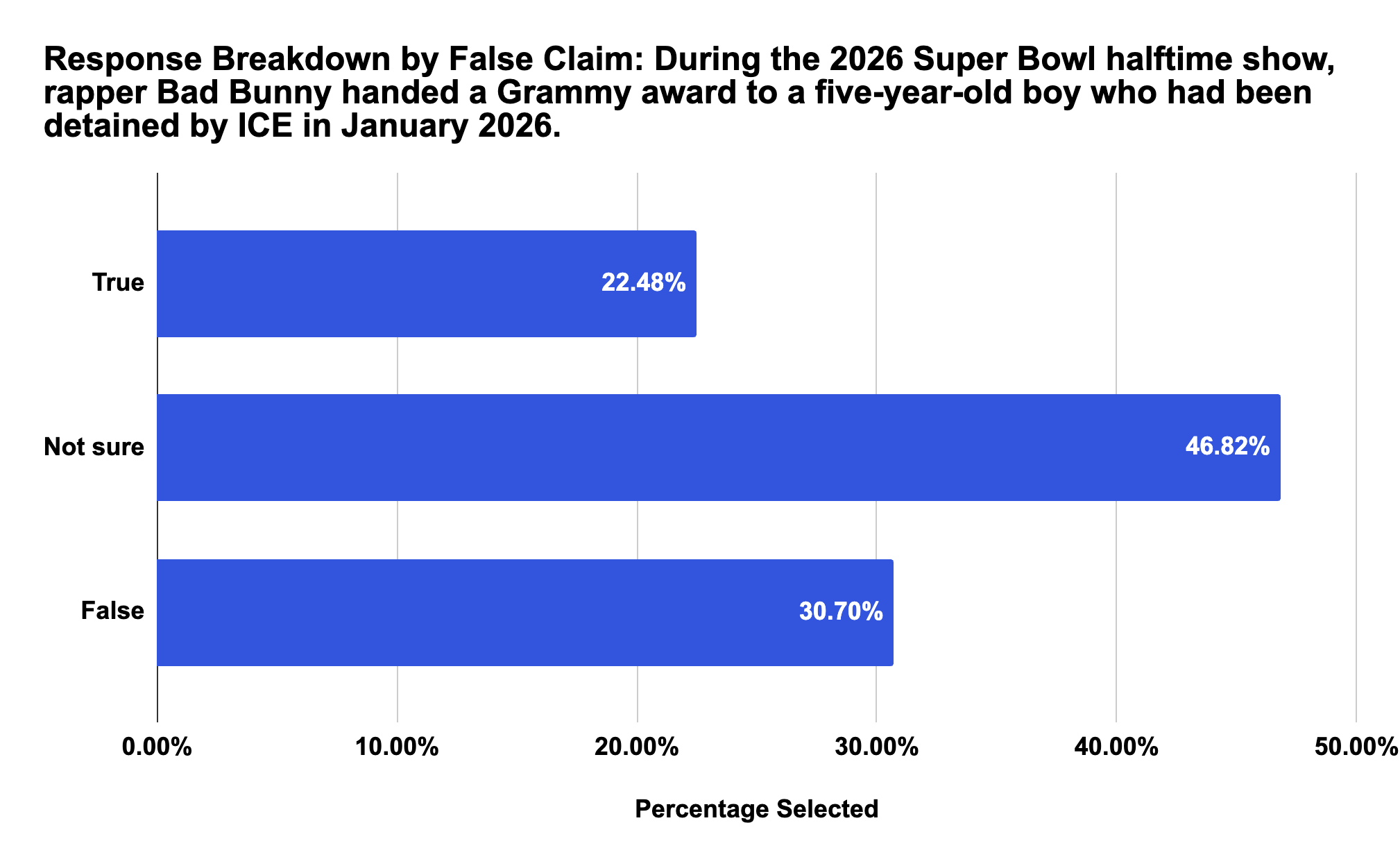
NewsGuard also surveyed respondents on the false claim that during the 2026 Super Bowl halftime show, Puerto Rican rapper Bad Bunny handed his Grammy award to a five-year-old boy who was previously detained by ICE. Actually, during his performance, Bad Bunny, an outspoken ICE critic, gave his Grammy award to a child actor from California, not to the five-year-old who was arrested by ICE in Minnesota during the federal government’s January 2026 immigration crackdown. Most respondents (47 percent) reported they were unsure of the accuracy of this claim, while 22 percent of respondents said the claim was true and 31 percent correctly identified it as false. This claim received 36.3 million views in 67,900 posts. Click here to read NewsGuard’s full report on this claim.
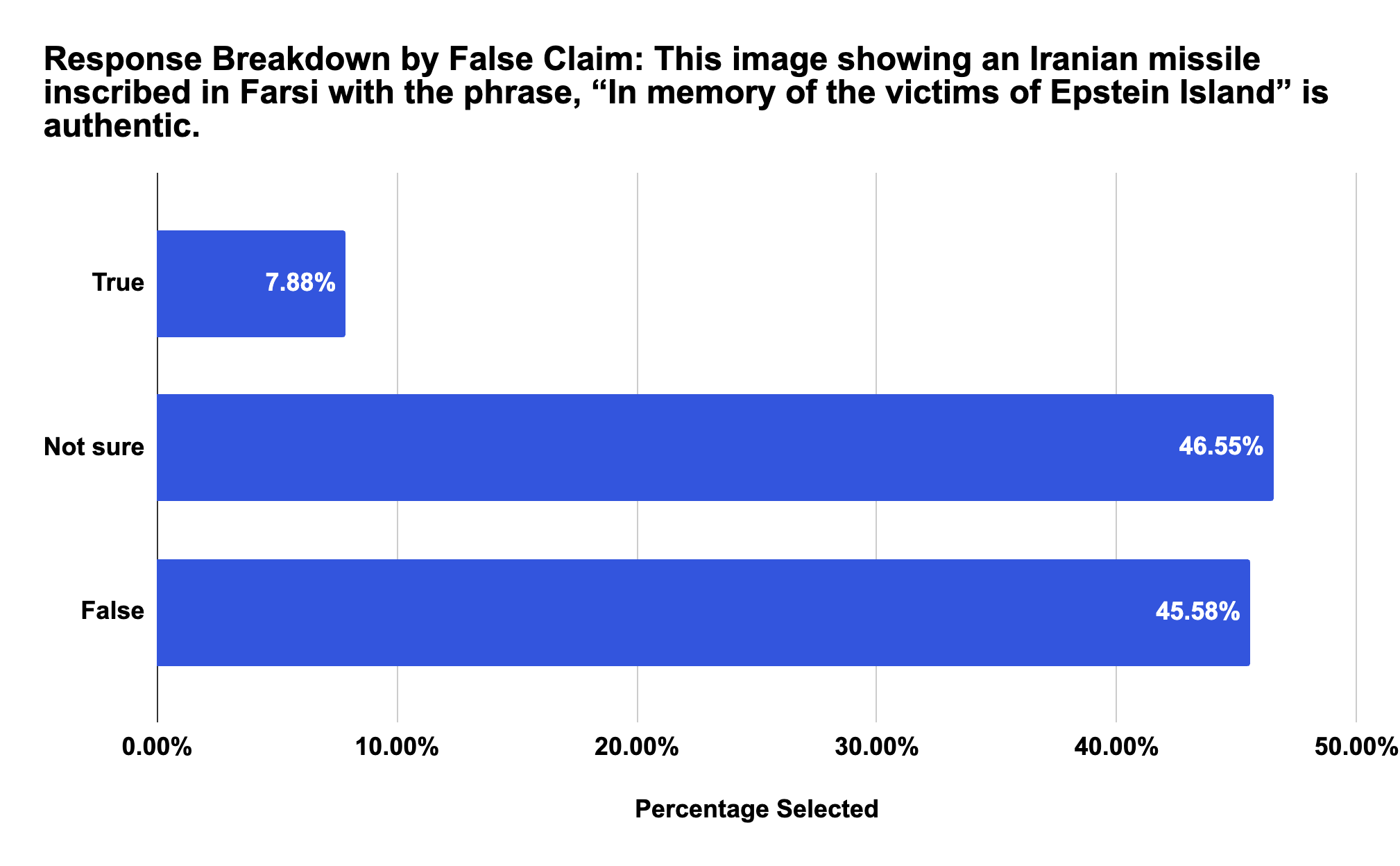
Respondents performed best when asked whether an image showing an Iranian missile inscribed in Farsi with the phrase, “In memory of the victims of Epstein Island,” was authentic. The inscription is an apparent reference to the late convicted sex offender Jeffrey Epstein, who reportedly once had a close relationship with Trump. The image is actually an AI-altered version of a photo of an Iranian missile without any inscription.

Only eight percent of respondents believed that the photo was real, while 46 percent correctly identified it as false and 47 percent responded that they were unsure. This was a departure from the trend seen in previous Reality Gap Index reports of respondents often being fooled by AI-generated or AI-manipulated images. This claim garnered 8.6 million views across 10,600 posts. Click here to read NewsGuard’s full report on this claim.
METHODOLOGY
NewsGuard commissioned an April 2026 study with YouGov that polled a nationally representative sample of 1,000 Americans aged 18+. The survey was carried out online and prompted respondents with three statements conveying false claims spreading online. Respondents were asked to reply to each claim with a response of “True,” “False,” or “Not Sure.”
To conduct the survey, NewsGuard and YouGov presented a sample of 1,000 Americans with three false claims that had gained wide traction online. Participants were asked whether they believed each claim to be true, false, or if they were unsure.
These false claims were drawn from NewsGuard’s False Claim Fingerprints, a continuously updated feed of provably false narratives gaining traction online. The selection focused on high-impact hoaxes — those with broad reach and significant potential for harm.
After completing the survey, respondents were presented with accurate information debunking each claim to ensure that the survey did not inadvertently advance false information.
Learn more about Reality Check’s Premium Membership here.
In Case You Missed It … Claude’s Foreign-Influence Problem
Anthropic’s AI chatbot Claude repeated false claims 15 percent of the time when it was asked about pro-Kremlin falsehoods in the voice of typical AI users, citing Russian state-affiliated media every time, a NewsGuard audit found. This marks a sharp increase compared to seven previous NewsGuard audits over almost a year, from March 2025 to February 2026, when Claude cited Russian state-affiliated sources only four percent of the time on similar typical-user prompts.
This increase in citations to Kremlin propaganda sources, including when they spread false claims, suggests that in recent months, the popular AI tool has become more vulnerable to state disinformation campaigns. NewsGuard’s finding is consistent with more general recent complaints from Claude users that the chatbot has become less reliable.
Read the full report here.
This newsletter was edited by Sofia Rubinson and Eric Effron.
You find, we report: Let your fellow Reality Check readers know about false claims you run across online. Our analysts debunk false claims before any others 80% of the time, but we can’t catch everything. If you find what looks like a false claim, let us know. We’ll investigate and report back in Reality Check.
Reality Check is produced by co-CEOs Steven Brill and Gordon Crovitz, and the NewsGuard team.
We launched Reality Check to shed light on the false claims spreading online, how they spread, and the forces behind them. Each day, we aim to bring you the story behind your news feed and help you stay informed about the false claims circulating in the news. Support our work by becoming a premium member.
Have feedback? Send us an email: realitycheck@newsguardtech.com.
Related Knowledge Center: Fact-checking and its detractors
Fact-checking has become a familiar tool for political reporters to hold office-holders and candidates accountable. But critics ask if fact-checkers sometimes miss the forest for the trees, and if the practice often struggles with false equivalency the way conventional political coverage does.