
More Powerful Than Tokyo, New York, and Shanghai Combined: This Reactor Built by a 25-Year-Old, Just Fired the Energy of 800 Lightning Bolts
Inside a cavernous warehouse near San Leandro, California, a startup called Fuse Energy Technologies has engineered a machine that delivers more power in a fraction of a second than the combined energy use of Tokyo, New York, Shanghai, and Dubai. The device—named TITAN—does not resemble a traditional nuclear reactor. It is smaller, faster, and fundamentally different. Its emergence presents a serious challenge to the global fusion establishment.
TITAN centers on an advanced impedance-matched Marx generator capable of releasing 1 terawatt of pulsed power in bursts lasting only 100 nanoseconds. The output is roughly equivalent to 800 lightning bolts delivered simultaneously. Instead of relying on the tokamak approach—used for decades to contain fusion plasma in magnetic fields—TITAN employs a magnetized target fusion (MTF) system. The implications suggest a potential shift in how fusion could be developed and deployed.
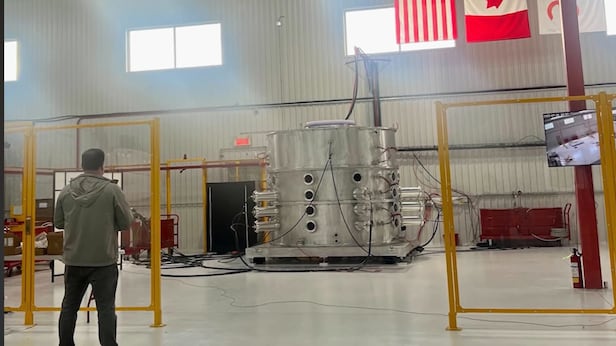
The energy sector has long depended on government-led, multi-billion-dollar infrastructure projects to chase the elusive goal of nuclear fusion. Fuse, led by 25-year-old CEO JC Btaishi, is taking a different path. TITAN is being positioned not just as a research asset but as a scalable, repeatable fusion driver. In the meantime, the company is monetizing its output by offering radiation testing services to aerospace and semiconductor clients, an uncommon yet effective strategy to support operations.
A High-Voltage Challenge to Tokamak Orthodoxy
Fusion science has been dominated by tokamaks, including major government-backed projects like ITER in France and U.S. facilities such as DIII-D and NSTX-U. Tokamaks function by magnetically confining plasma in a toroidal chamber, reaching temperatures beyond 100 million degrees Celsius. Their complexity, size, and operational costs have slowed commercial progress.
TITAN takes a radically different approach. Its pulse-based fusion method relies on rapid, synchronized energy delivery to compress plasma instantly. The device uses a 14-stage Marx generator, but only the first three stages require active triggering. The remaining stages self-fire with less than 2-nanosecond jitter, greatly simplifying control systems. This design avoids one of the major technical bottlenecks that has limited pulsed-power fusion in the past.

Fuse reports 90% energy delivery efficiency, threefold size reduction, a 1,000× increase in component life, and fivefold cost savings compared to legacy systems. These figures are supported by experimental findings published in Nature Scientific Reports, which document a successful 330-gigawatt pulse achieved in early-stage testing.
“Most groups spend years just aligning diagnostics,” said Dr. Rick Spielman, former Chief Scientist of the Z Machine at Sandia National Laboratories. “To go from design to repeatable testing with this level of precision in under 18 months is highly unusual.”
Monetizing Radiation Before Ignition
Direct commercialization of fusion remains a long-term goal. TITAN has found a near-term application by offering controlled radiation exposure to test electronic components under extreme conditions. Fuse Energy has turned this capability into a revenue stream. Each firing of TITAN releases high-energy particles similar to those encountered in orbit or during nuclear events.
Clients in the satellite, defense, and semiconductor industries use the platform to evaluate how devices perform under bombardment from fast neutrons and other emissions. These radiation testing services provide the company with funding while helping external partners build more resilient technologies.
Collaborations with Los Alamos and Sandia National Laboratories reflect TITAN’s dual value as both a research tool and an engineering testbed. The strategy allows Fuse to remain financially viable without waiting for full-scale fusion to become economically feasible.
This business model also strengthens the case for pulsed-power fusion by offering tangible outcomes today. Few fusion startups can make that claim with credibility.
A Startup Mentality Meets Big Science
At the center of Fuse’s operations is JC Btaishi, a 25-year-old Lebanese-born entrepreneur with no formal university degree. Btaishi grew up around nuclear labs through his physicist father and launched the company at 19. He now leads a team of 50 engineers—many recruited from UC Berkeley—working out of a 4,000-square-meter facility that houses TITAN and its support systems.

In 2024, the startup’s valuation exceeded $200 million, with external validation from peer-reviewed studies and government-linked partners. TITAN’s emergence reflects a broader trend: smaller, faster-moving ventures are beginning to rival traditional fusion programs in agility and technical execution.
Competitors are advancing other models. Commonwealth Fusion Systems has raised $2 billion for its tokamak-based reactor. Helion Energy secured a power purchase agreement with Microsoft for 2028. TAE Technologies has drawn over $1.3 billion from investors including Google. None of these firms have yet demonstrated pulsed-power discharges on the scale reported by Fuse.
What’s Next for Fusion—And Who Gets There First?
Full ignition and energy-positive fusion remain out of reach. TITAN currently fires once every 100 seconds, at a frequency of 0.01 Hz, and has not yet achieved sustained fusion burn. The system must bridge the technical gap between high-energy compression and self-sustaining reactions, with rigorous material resilience at repeatable cadence.
The broader challenge is now clear. The race no longer pits nations against one another—it pits models of development. Legacy programs pursue slow, layered research over decades. New entrants like Fuse rely on modularity, private capital, and rapid iteration. The contest between these paradigms will likely define the next phase of energy innovation.