
More than just a voice raised in protest: The story of one couple's decision to withhold taxes due
Like a lot of us, our friends Tara and Bob Wegener have been trying to decide what direct action they might take in opposition to the Trump administration’s trampling of Gospel values.
Unlike a lot of us, Tara and Bob have settled on a bold next step that enables them to be true to themselves at tax time: tax resistance.
Their protest is small — $50 withheld from their quarterly taxes — but they describe it as “symbolic resistance, thinking that any amount (would be) a burr in the IRS saddle.”
The Wegeners are both 1980 graduates of the University of Notre Dame. Tara is a 67-year-old retired attorney and Bob is a 68-year-old architect. They live in a suburban community south of Boston and have three grown children and two grandchildren. We got to know them at the Paulist Center, where they are longtime members and my wife, Carol, and I have been members since 2013.
In an email exchange, Bob Wegener said he thinks about withholding taxes “almost every year,” adding:
This year the tug of conscience wouldn’t go away given (Trump administration) support for the devastation in Gaza, the war on Iran and the madness of the Trump administration and ‘Department of War.’
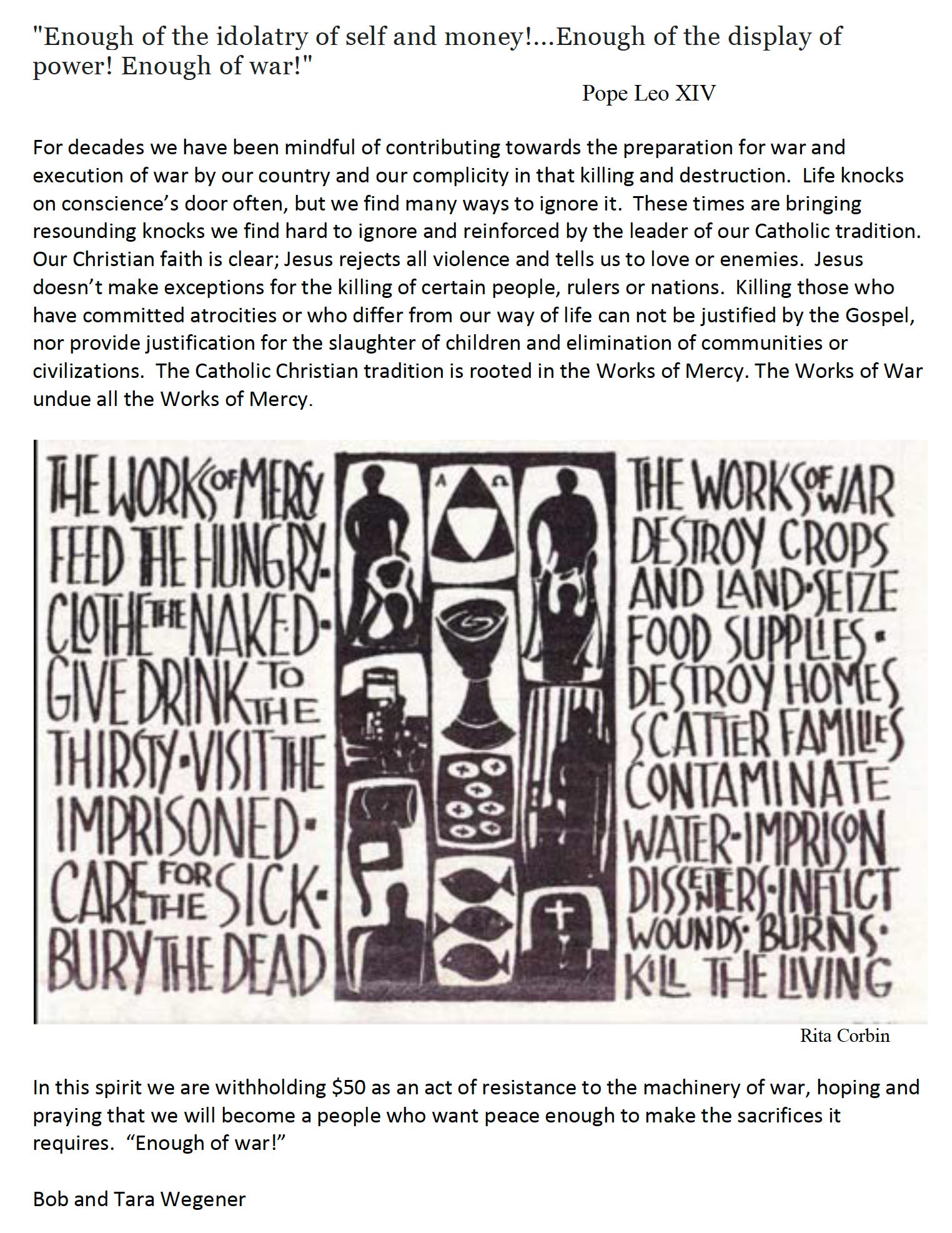
In their message to the IRS, the Wegeners explained the $50 missing from their quarterly estimated taxes like this:
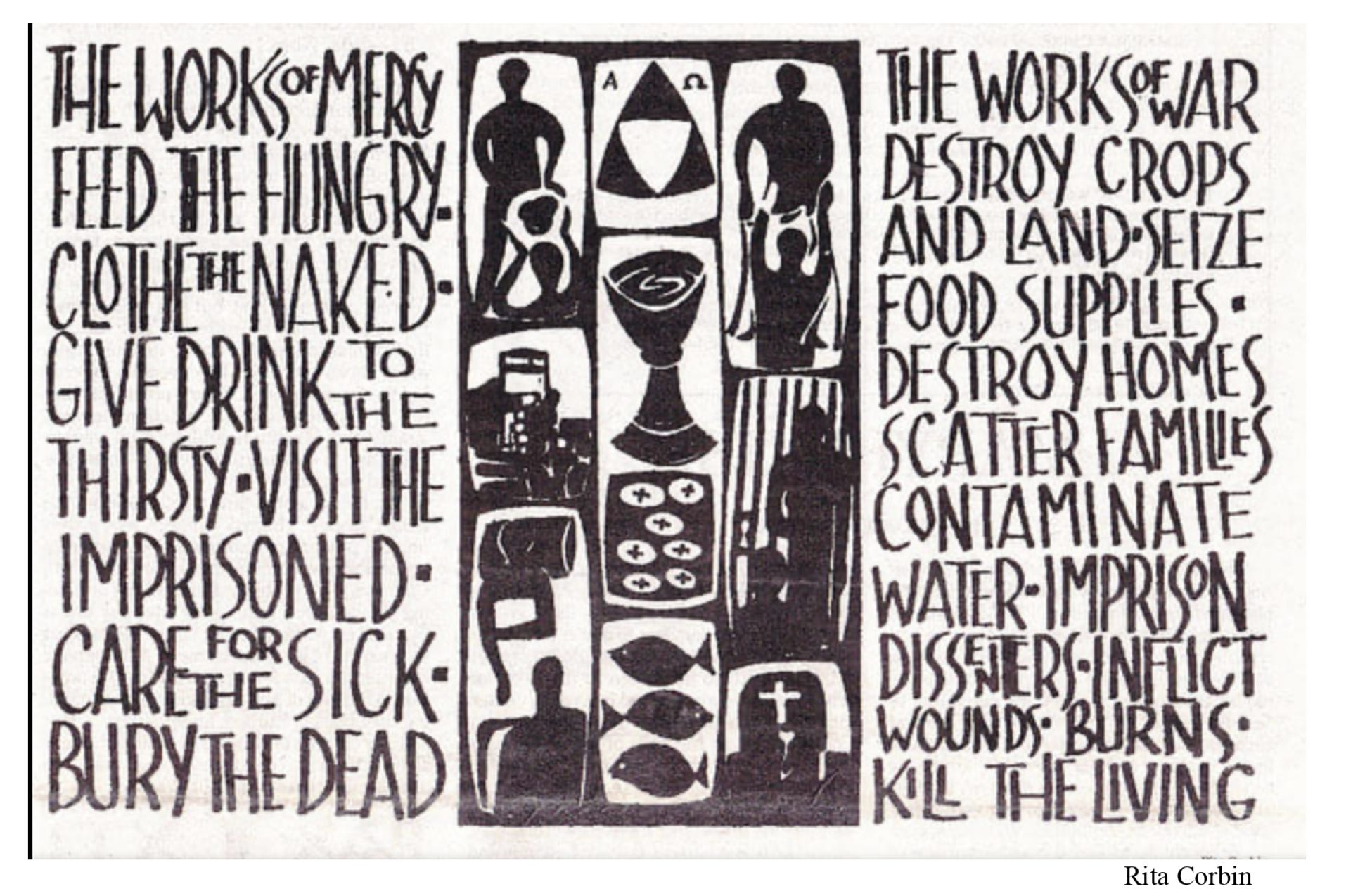
Our Christian faith is clear; Jesus rejects all violence and tells us to love our enemies… In this spirit we are withholding $50 as an act of resistance to the machinery of war, hoping and praying that we will become a people who want peace enough to make the sacrifices it requires.
‘Enough of war!’
HOW TRUE: Stories & Strategies of Nailing Stuff Down is a reader-supported publication. To receive new posts and support my work, consider becoming a free or paid subscriber.

It’s difficult to pinpoint how widespread such resistance has become, but Lincoln Rice of the National War Tax Coordinating Committee told NBC earlier this month that the organization’s website is experiencing a dramatic increase in traffic.
He said typical traffic had been running at about 40,000 unique visitors per year but that it surged to more than 110,000 visitors in January 2026 alone.

An email conversation with Bob Wegener
I emailed the Wegeners a few questions about their decision. Here’s a lightly edited transcript of my back and forth with Bob:
Mitchell: How did you weigh the potential consequences in deciding to do this?
Wegener: It will likely take time before we see any consequences and when we do it will be interesting to see how aggressive the IRS will be given they have seen significant cuts in staffing.
Mitchell: This is not your first instance of tax resistance. Describe what you’ve done previously.
Wegener: Back in the late 80s, I withheld 50% of our taxes owed, which is about the percentage of discretionary funds that go to military-related funding. I sent those funds as an interest-free loan to Koinania Farms in Georgia, an inter-racial Christian community founded in the ‘40s amidst the intense racism of the Jim Crow era.
How the IRS responded
Mitchell: How long did it take for the IRS to take action?
Wegener: We resisted for a few years, so I had ongoing interactions with the IRS, the last one being impoundment of our car… We got the car back after they took the money from our bank account. It was unusual that they took the car since in previous years that had gone straight to our bank account. It tells you how unorganized they can be that from one year to the next. They seemed to have not known that the previous year they had taken the money from our bank account straight away.
…it was interesting that she informed her boss that I was a tax resister and not a tax evader.
Mitchell: When did you begin paying the full amount due again? And why?
Wegener: If memory serves I started paying the amount owed the year after the car episode. During the car impoundment, one of the IRS agents, a black woman, counseled me about my responsibilities as a new parent (she had noticed that Tara was very pregnant with Chiara, our first born). I’m not really sure, but maybe that played a part in deciding not to resist the next year. After sharing with her that I had sent the resistance money to an inter-racial community in the South, it was interesting that she informed her boss that I was a tax resister and not a tax evader.
I don’t think there were fewer bombs manufactured, but it helped me to live more intentionally and try to live out my Christian beliefs rooted in Gospel nonviolence.
Mitchell: What do you see as the impact of what you did years ago?
Wegener: I was part of a community of folks who saw war tax resistance as a way to work for peace, so those relationships helped to form how I wanted to live and the work I did. I don’t think there were fewer bombs manufactured, but it helped me to live more intentionally and try to live out my Christian beliefs rooted in Gospel nonviolence.
Mitchell: What impact are you hoping for this time?
Wegener: Hoping to just throw a little sand in the war machine.
Mitchell: What else would you like to share about what you’re doing?
Wegener: I could talk about my work for affordable housing, or climate change advocacy or even golf with my friends to keep sane. I suppose they all are connected to this thing we call our faith journey.
A former corporate attorney joins the ranks of tax resisters.
Among the Wegeners’ fellow tax resisters is Rachel Cohen, an attorney who left her $300,000-a-year job in corporate law to protest her firm’s decision to join other firms making deals with the Trump administration to protect their government work.
She told her 287,000 followers on Instagram that she took the action “because the federal government is using my tax dollars to build concentration camps for my neighbors.” She elaborates on her decision here.

For now, I find myself relating to the view expressed by Alex Beam in a Boston Globe column last year: I don’t have the moral fortitude to engage in tax resistance. But godspeed to those who do.
Here’s the PDF that the Wegeners sent to the IRS:
Please do leave a comment. And if you check the “Notes” box, your comment will be shared widely on Substack and will encourage readership of this post.