
MLK Day 2026: Why We Need Hope, Not Optimism
We’re now just two weeks away from a date that our household has been dreading for the past 18 months: The Feb. 3 expiration of Temporary Protective Status for Haitian immigrants in the United States.
Beginning at midnight on that Tuesday, ICE will have the legal authority to send back to Haiti 350,000 men, women and children whose return will place them at risk of precisely the dangers the U.S. State Department cites in urging no one to go there: “kidnapping, crime, terrorist activity, civil unrest, and limited health care.”
Among the 350,000 is a family of five that we have become close friends with over the past two years.
All of which leaves us with zero optimism. But we are not without hope.
A group of us will meet with the family tomorrow to sort out whatever steps we can take to prepare for various scenarios. We don’t go into this meeting with expectations of a positive outcome; the odds against that are severe. Instead, the meeting is about whatever agency we can muster, doing whatever we can.
Our efforts line up pretty well, I think, with Arthur Brooks’ description of what hope is all about: “No matter what happens I can do something.”
Brooks, the Atlantic columnist and Harvard professor, adds:
Something can be done and I can do something about it. Hope is empowering. You can be a very pessimistic but very hopeful person.
By contrast, he describes optimism as “just kind of a sunny predictor” without any real substance to it. You can view a four-minute excerpt of his discussion of hope and optimism here.
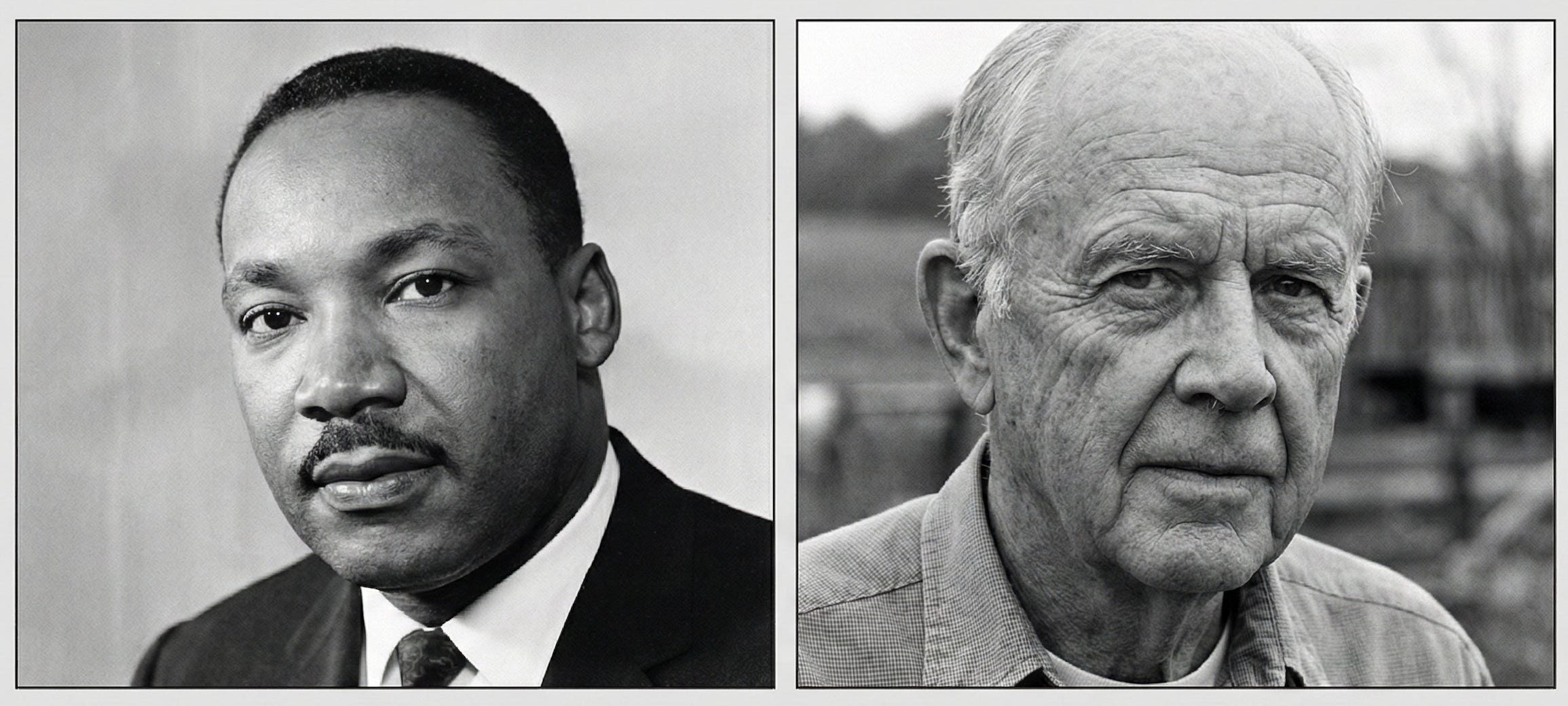
One of our major sources of hope these days is the Paulist Center, a progressive Catholic community that draws members from throughout the Boston area. The Creation Care committee takes concrete steps to address the climate crisis even as the Trump administration does everything it can to undermine protection of the planet. The Immigration committee supports families from Afghanistan, Ukraine, Haiti and elsewhere despite the administration’s accelerated efforts to remove them without regard to consequences.
At yesterday’s 10 a.m. Mass, community member Emily Spicer Hankle offered a reflection that reminded us why such efforts make sense, and why there’s reason to keep hope alive.
Hankle, a union organizer and mother of three young children, read an excerpt from a sermon delivered by Dr. Martin Luther King at Dexter Avenue Baptist Church in Montgomery, Alabama on Easter morning 1959:
For when it was dark and tragedy around, seemed that the light of day had gone out, darkness all around and sunlight passing away, I got enough strength in my being to turn around and only to discover that God had another light. This would be a tragic universe if God had only one light…
I’ve seen empires and kings and rulers put (the light) out. But God has another light. Go into the valleys, through the hedges, and into the highways and tell others that God has another light. You can turn the light off, but God has another light to turn on.
Hankle added:
Dr. King told the audience that if God had let him choose any era in which to live, he would have chosen the one in which he had landed. “Now, that’s a strange statement to make,” King went on, “because the world is all messed up. The nation is sick. Trouble is in the land; confusion all around…. But I know, somehow, that only when it is dark enough, can you see the stars.”
Dr. King said that he felt blessed to live in an era when people had finally woken up and were working together for freedom and economic justice.
The congregation responded to Hankle’s reflection with enthusiastic applause. Her two and a half year-old daughter, Adira, seated with her two older sisters and her dad at the back of the church, took things a bit further, shouting: “Go, Mama!”
Fr. Michael McGarry, the retired director of the Paulist Center and the presider at yesterday’s Mass, also offered a source of hope, quoting from a poem that Wendell Berry wrote at his farm in Kentucky in the early 1970s.
McGarry zeroed in on just the right line for our times: “Be Joyful though you have considered all the facts.”
Scholars who have written about the poem (titled “Manifesto: The Mad Farmer Liberation Front”) have also focused on that line, arguing that it reflects a rejection of empty optimism and an embrace of joy as an act of spiritual defiance.
Prof. Debra Dean Murphy put it like this, noting that the line
may sound like yet another positive-thinking proverb. It is, instead, a summons to live wisely, deeply, in full awareness of (and with righteous anger at) all that would rob us of our full humanity, that would diminish beauty and goodness in the world.
This kind of joy, this kind of living, will include smiles. Positive thinking is optional.
Our meeting with our Haitian friends tomorrow will not rely on optimism. But it will certainly include some action plans, some smiles, some hope and no doubt some righteous anger.