
The midterms are almost here, and the early media grades are in
I’ll get to my grades for five midterm-elections stories in a moment, but first two bits of recommended reading, one on the thirty years of Fox News that have done so much damage to this country, and the second on a bungled story and insufficient correction by ABC News.
I stopped by the National Gallery of Art in Washington, DC the other day, and came across an arresting 1989 work by Sandy Skoglund, titled Fox Games.
Maybe you’ve seen it. It’s a photo of a surrealist mixed-media installation, mostly black and white, showing a fancy dining room, complete with chandelier. Superimposed over the tables and chairs are more than a dozen bright red foxes, leaping over white tablecloths and generally inducing a fearful sense of intrusion
It made me think of this good piece by Matt Gertz of Media Matters, whose not-so-fun job it is to monitor right-wing media, with a special emphasis on Fox News.
Matt’s article is called Fox at 30: Even the pretense of impartiality is all but gone.
His retrospective piece skillfully demolishes the notion that there is some kind of important difference between Fox’s supposed hard news coverage and its admittedly biased (and often dishonest) opinion offerings. It’s worth a read, and you can do so here.
Second, you might have heard something about the weird history of an ABC News story about the Trump family’s multi-billion investment ties to defense companies. ABC published the damning story, then deleted it without explanation, then eventually republished it with a correction that provided few details. Parker Molloy, always incisive, has the details including her opening salvo: “The piece was absolutely riddled with errors.” But as she observes, the conflicts of interest it reveals are real and “that’s what makes these mistakes so frustrating to see,” because it gives cover to those who would shout “fake news” all day and all night. What a mess. Read about it here.
Now, on to the main thing. The midterm elections are three weeks away, as I write this post, and I’ll remind you of what historian Timothy Snyder aptly said several weeks ago: “We are now two months from the American midterm elections, probably the most consequential since the eighteenth century. Given that the presidency is held by an oligarch who wishes to bring our republic to an end, a victory of the opposition is a prerequisite for the maintenance of the rule of law and anything resembling political democracy.”
Because they are so consequential, I’ve been pushing here, on American Crisis, for news coverage that concentrates less on the horserace and the polls and the prediction markets, and more on the importance of the midterms to our democracy.
Readers, there is precious little of that latter kind of coverage in mainstream media. That’s more than disappointing. Instead, there’s a broad range of stories that either a) really don’t get it and indulge in false equivalency; or b) make a few gestures at the importance of the elections but don’t shout the consequences from the rooftops.
Here’s a sampling of what I saw, with some grades. Let me know if you agree and if you think the coverage is better than I’m giving the media credit for. Please point out anything you found excellent and I’ll be happy to spread the word.
First, an article and podcast rife with some of the worst sins of the current media era — false equivalence, sane-washing and soft-pedaling language. This was on the Times opinion site, titled “How Worried Should We Be About the Midterm Elections?” It’s led by Sarah Isgur, whose background includes posts in the first Trump administration, specifically the Justice Department, in conversation with NYU law professor Richard Pildes. (In the podcast itself, she refers to herself as a former Republican operative and Pildes expresses surprised interest in this. This was not exactly a state secret.) You can read the transcript here or listen to the conversation, but here’s the kind of thing you’ll run across; this from Isgur: “You have the left talking about voter suppression. You have the right talking about voter fraud.”
To clear away the thick smoke of false equivalence, you need to go to the top reader comments, where there’s a lot more straight talk. (I love reader comments!)
To wit: “I felt like I was going crazy listening to today’s podcast. Am I the only one who remembers Jan. 6? Hang Mike Pence?…You guys spend way too much of your energy (framing) mistrust of elections as some sort of both-sides issue when it is a matter of public record that a significant and dominant faction of the Republican Party tried to overturn the 2020 election. There is no Democratic equivalent.” Or this: “Should we be worried about midterm elections? No, we should be worried (about) Trump and Republicans cancelling them or disallowing the results.”
I give this podcast a generous D.
At the other end of the spectrum, an A to a ProPublica piece that goes to the heart of what we SHOULD be worrying about related to the midterms. “Inside Trump’s Effort to ‘Take Over’ the Midterm Elections.” The reporting highlights are summarized at the beginning of the April piece, a device I appreciated. They are three:
- Safeguards Destroyed, about how Trump has systematically demolished the federal guardrails that prevented him from overturning the 2020 election.
- Changing of Guard, about how career staff have been replaced by employees from the election denial movement.
- Political Interference, about how once-fringe players have access to vast power within the voting systems.
Everything about this is excellent. Check it out here.
And another A to the New York Times’s Theodore Schleifer, who revealed the details about Elon Musk’s $276 million funding of midterm races, “trying to save Republicans’ Senate majority with some of the largest donations in American political history.” And again, I can’t resist quoting the top comment: “This is exactly why Democrats should make repealing Citizens United one of their first priorities (because it) has effectively silenced the voices of the American electorate to the point that now only corporations have a seat at the table.”
Then, there’s a lot in between. This NBC News piece, described as “breaking down what matters most to voters before the 2026 elections,” is overall very good, though heavily dependent on a network poll. But the way Sahil Kapur explores and explains the data is direct, informative and in the public interest. I don’t love poll-based reporting but still: Solid B.
The Guardian (where I write a media and politics column) had a good piece interviewing voters across the political spectrum about what issues matter to them. I am a bit weary of hearing from people like the self-described Maga Republican voter, Sharon Anderson of Tennessee, who proclaims that while she would like to see the war with Iran end, “the person that’s able to end this conflict is in leadership today.” She means Trump, who she says has also caused America to be more respected on the world stage. But many of the answers, especially those from independents, are interesting and the piece is issues-oriented. I give it a B.
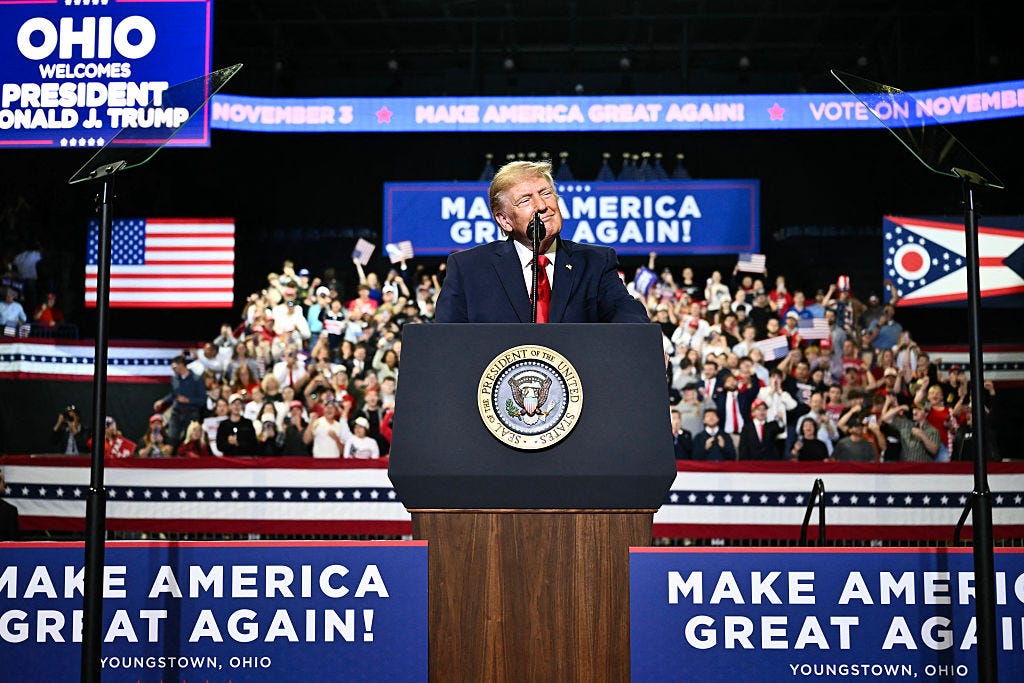
Similar in many ways is a Washington Post piece reported out of Youngstown, Ohio at a Trump rally by a fine reporter, Cat Zakrzewski, who observes that “entire sections of the Covelli Centre arena and upper levels sat mostly empty” and quotes local people saying they are disillusioned with Trump. (But, of course, not many sound like they’re ready to cross the aisle when voting; that, apparently, is a bridge too far.)
I thought the piece was poorly served by its headline, “In Ohio, some Trump voters question whether he’s still fighting for them.” (Was he ever really fighting for the working people of Ohio? Again, from the comments: “Trump was never fighting for you, he just needed your votes, geniuses.”) I wish stories like this would ask people what it would take to get them to vote their disappointment. But overall, factoring in the bad headline, but appreciative of the on-the-scene reporting: B-minus. Read it here with a gift link.
Given Jay Rosen’s excellent guideline for better politics coverage — “not the odds, but the stakes” — I thought the name of a new podcast from Kara Swisher and Hillary Clinton was on target: “High Stakes.” It’ll be interesting to see what they do in the days ahead. Here’s what Clinton had to say in advance: “I don’t think the stakes for the country and the world could be any higher. If we don’t reverse this chaos and corruption and cruelty that is being visited upon us by this administration, we won’t recognize our country.”
Please let me know what media coverage you are seeing that gets that point — and Timothy Snyder’s point — across in clear, direct terms.
Readers, three more things. You still have a chance to press for better media coverage in the three weeks ahead. Here’s my post from two weeks ago explaining the Media and Democracy Project’s commendable effort and how you can participate.
I want to note the recent death of my wonderful former colleague at The Buffalo News, Michael Beebe, who was one of the best reporters I’ve encountered in my career. Here’s Mike’s obit. Those of us who worked with him are very sad to lose him.
And sincere thanks to the new subscribers who joined us here in recent days and weeks at this crucial times. Particular thanks to those who chose paid subscriptions like this new subscriber, or who upgraded to paid. If you can swing the $50/year, you’ll keep this newsletter’s access open to all. Thank you!
My background: I am a Lackawanna, NY native who started my career as a summer intern at the Buffalo News, my hometown daily. After years as a reporter and editor, I was named the paper’s first woman editor in chief in 1999, and ran the 200-person newsroom for almost 13 years. Starting in 2012, I served as the first woman “public editor” of the New York Times — an internal media critic and reader representative — and later was the media columnist for the Washington Post. These days, I write here on Substack, as well as for the Guardian US. I’ve also written two books, taught journalism ethics, and won a few awards, including three for defending First Amendment principles.
The purpose of ‘American Crisis’: My aim is to use this newsletter (it started as a podcast in 2023) to push for the kind of journalism we need for our democracy to function — journalism that is accurate, fair, mission-driven and public-spirited. That means that I point out the media’s flaws and failures when necessary.
What I ask of you: Shortly after Trump’s election in November of 2024, I removed the paywall so that everyone could read and comment. I thought it was important in this dire moment and might be helpful. If you are able to subscribe at $50 a year or $8 a month, or upgrade your unpaid subscription, that will help to support this venture — and keep it going for all. Thank you!