
Midterm Countdown, 33 Days to Go: Language from Our Leader.
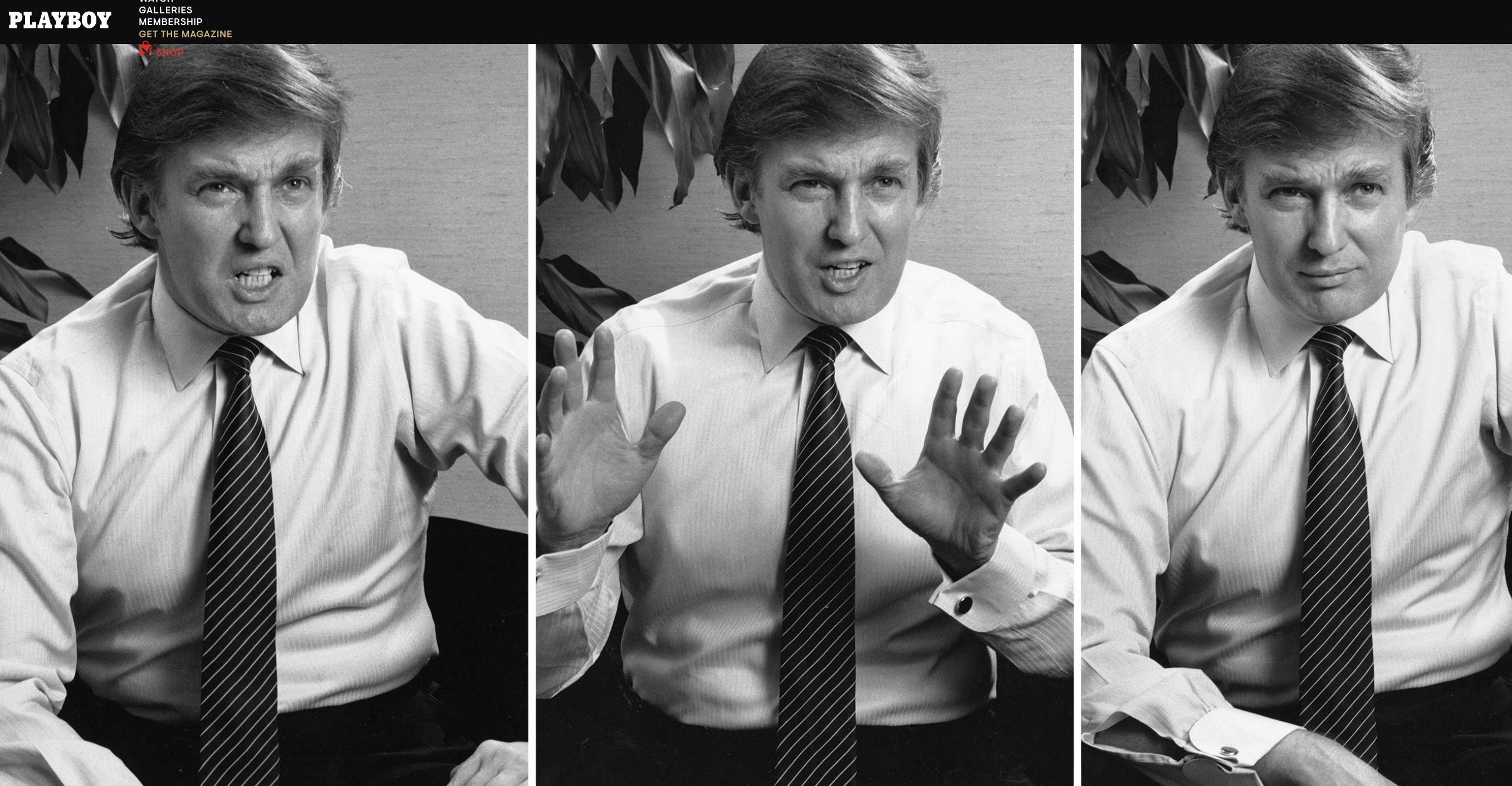
Photos from Donald Trump’s Playboy interview in 1990. His looks and carriage have naturally changed in 36 years, as he has gone from age 44 to 80. His command of language and all that entails has changed in more striking ways. (Screenshot from Broadsheet site.)
Today Time magazine released the very long transcript of its interview this week with Donald Trump. The interview was conducted by Time reporter Eric Cortellessa (a friend of mine) and Sam Jacobs, Time’s editor-in-chief. It ran to well over 10,000 words, and you can read the whole thing here.
This is not the first time Trump has given a long print-magazine interview. Back in 1990, he was the subject of a Playboy interview, a placement that was highly newsmaking in those days.1 You can read the whole thing on the Broadsheet site.
Here is why I am pairing Time and Playboy, two symbols of the golden age of the American magazine business back then: They offer a line-by-line chance to compare the way the same man expressed essentially the same outlook (other countries are cheating us, you have to be tough, he is a great negotiator, etc), but with strikingly different dexterity with words, images, and other basic linguistic tools. Not to mention his memory, grounding in facts, and awareness of reality.
In short: Like him or not, the Donald Trump of 1990 showed access to most of the linguistic keyboard. In piano terms, he could use both hands, and hit both sharps and flats. And like him or not, it’s undeniable that the Trump of 2026 is playing “Twinkle Twinkle” with one finger. Haltingly.
First some illustrations, then my inference.
Similar topics, different language, then and now.
It would take a very long post to do a full line-by-line comparison. Here are just two paired specimens:
1) Trump on international trade.
Here he was in 1990, when Japan was the main item on the global trade agenda. The “ideas” and resentment of Trump’s comments will seem familiar to MAGA-era readers, albeit with today’s Japan in a diminished role. The point for now is the sentence structure and vocabulary with which Trump assessed the situation back then:
How do you feel about Japan’s economic pre-eminence?
Japan gets almost seventy percent of its oil from the Persian Gulf, relies on ships led back home by our destroyers, battleships, helicopters, frog men. Then the Japanese sail home, where they give the oil to fuel their factories so that they can knock the hell out of General Motors, Chrysler and Ford. Their openly screwing us is a disgrace. Why aren’t they paying us?
The Japanese cajole us, they bow to us, they tell us how great we are and then they pick our pockets. We’re losing hundreds of billions of dollars a year while they laugh at our stupidity.The Japanese have their great scientists making cars and VCRs, and we have our great scientists making missiles so we can defend Japan. Why aren’t we being reimbursed for our costs? The Japanese double-screw the U.S., a real trick: First they take all our money with their consumer goods, then they put it back in buying all of Manhattan. So either way, we lose…
A group of Japanese visitors to New York was recently asked if there were anything in the U.S. they would like to buy. The answer: towels.
That’s ‘fair’ trade: They’ll take the towels and we’ll buy their cars. It doesn’t sound like a good deal to me. They have totally outsmarted the American politician. They have no respect for us, because they’re getting a free ride. Of course, it’s not just the Japanese or the Europeans—the Saudis, the Kuwaitis walk all over us. 2
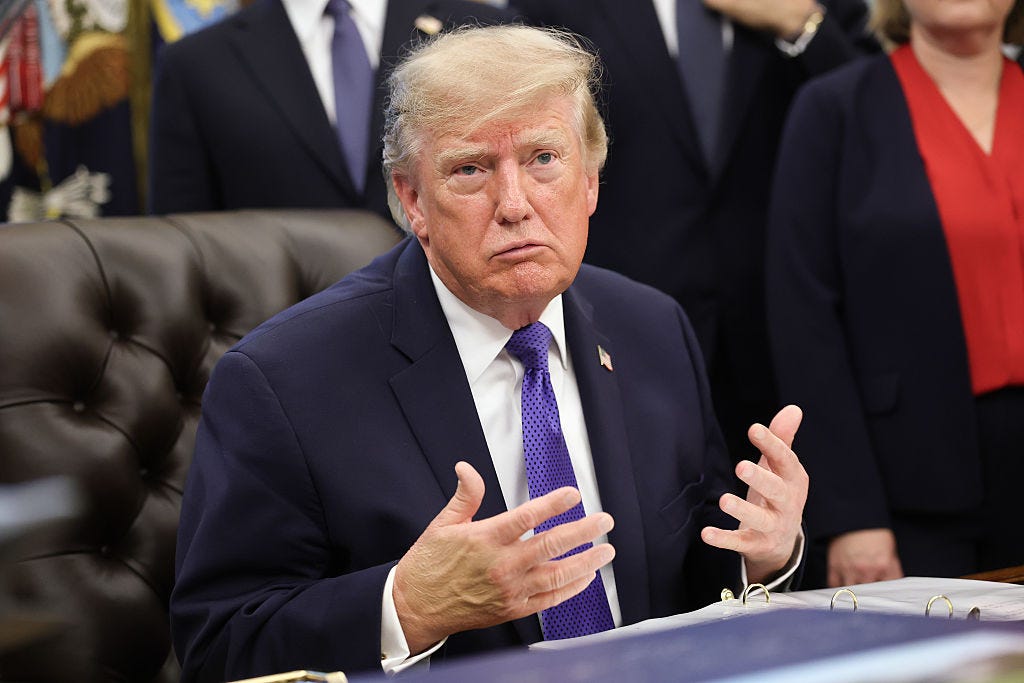
Donald Trump this week, on the same day as his new Time interview. (Kevin Dietsch/Getty Images.)
And here Trump is this week, about international trade in general:
You know, we have a lot of other countries that make a lot of money with us. All I have to do is turn off the spigot, which I’m allowed to do. And you would have a lot of the elite countries—I don’t want to mention names—but you would have a lot of elite countries that were no longer elite, that lose their share, and we would not lose, whether it’s 50 or 100. You have certain countries that make $50 billion every [unintelligible]. We lose $50 billion. I don’t need that. For the most part, I don’t need these. I can turn it off, and I have the absolute right, according to the tariff decision, which was a terrible decision by the Supreme Court. But basically, they said you can get it otherwise. But it’s tougher.3
2) Trump on toughness and leadership in international dealings.
This was Trump in 1990, about the Soviet Union and his own ambitions:
Why is Gorbachev not firm enough? I predict he will be overthrown, because he has shown extraordinary weakness. Suddenly, for the first time ever, there are coal-miner strikes and brush fires everywhere—which will all ultimately lead to a violent revolution. Yet Gorbachev is getting credit for being a wonderful leader—and we should continue giving him credit, because he’s destroying the Soviet Union. But his giving an inch is going to end up costing him and all his friends what they most cherish—their jobs.
Besides the real-estate deal, you’ve met with top-level Soviet officials to negotiate potential business deals with them; how did they strike you?
Generally, these guys are much tougher and smarter than our representatives. We have people in this country just as smart, but unfortunately, they’re not elected officials. We’re still suffering from a loss of respect that goes back to the Carter Administration, when helicopters were crashing into one another in Iran… We need to be tough.A favorite word of yours, tough. How do you define it?
Tough is being mentally capable of winning battles against an opponent and doing it with a smile. Tough is winning systematically.Sometimes you sound like a Presidential candidate stirring up the voters.
I don’t want the Presidency. I’m going to help a lot of people with my foundation—and for me, the grass isn’t always greener.
Toughness is winning systematically. Those were the days.
And here is Trump this week, on current international leadership. Remark how the Time team needs to keep helping Trump out on basic facts—for instance, who is running against Netanyahu in the next Israeli election:
There have been repeated reports that Prime Minister Netanyahu was warned prior to Oct. 7 about the possibility of an attack.
I heard that today for the first time. [Which is when it made international news.]
You have access to the highest intelligence. [Ie: How the hell did you not know this?]
I don’t—I can’t imagine this. You mean that he knew about—
Yeah, that Egypt warned him, and the UAE warned him.
I don’t think so. I think, you know, I think if he would have known, he would have done something about it. Certainly, he would have had people at least alert. You know, he’s not going to forget about it. That was a terrible day. Oh, you have people on the radical left that denied it ever happened, which is pretty bad.
Do you think the Israeli people should give Netanyahu another term?
Well, I can only say that I’m not involved in politics anymore, except that we’re popular—
You are very popular in Israel.
Like 99%! I think what happens is, in two and a half years, I go to Israel. I’ve done a lot for them. Done a lot. I’ve done a real lot.
So should he have another term?
If you think, including the capital of Israel through the embassy, including our beautiful Mount on high. You know, that’s been under dispute for forever. I mean, including defending them. You know, Israel wouldn’t have been able to defend itself against that power if the United States wasn’t—
It seems like you’re doing a lot of work for him. Should he have another term?
No, my primary thing—I do want to help them defend Israel. My thing that I mention all the time is Iran cannot have a nuclear power because they are crazy and you can’t let crazy people have nuclear weapons.
They’re a rapacious and repressive regime, no question about it. If Gadi Eisenkot were to win the election in Israel, could the U.S. work better with him than Netanyahu?
Well, I don’t know. I don’t hear bad things about him. Is that the one who’s—
Former chief of the military. He’s the leading contender to Netanyahu. [Journalists propping up the leader of the free world.]
You think he’s leading?
He’s the leading opposition candidate.
Well, people have written off Bibi many, many times, just like they’ve written off me many, many times. I wouldn’t underestimate Bibi.