
Meta bans largest Muslim news page in India
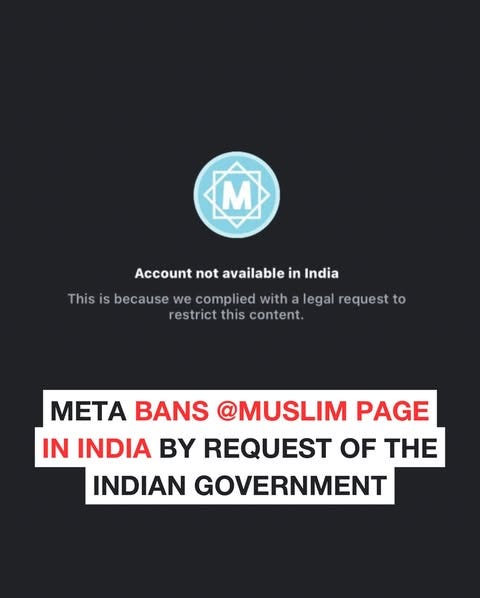
Meta has banned the largest Muslim news page on Instagram in India at the behest of the government.
Muslim, a news account run by Palestinian American journalist Ameer Al-Khatahtbeh, is one of the most-followed Muslim news sources on Instagram. Videos on Al-Khatahtbeh’s account have amassed more than 866 million views and the account is a crucial news source for Muslims around the world. It offers up to the minute news and information about stories affecting the Muslim community, often featuring stories that the Western media ignores.
On Tuesday, the page was removed in India and users attempting to view posts by @Muslim within the country were met with a message that read: “Account not available in India. This is because we complied with a legal request to restrict this content.”

India has the second largest Muslim population in the world, and until the account was banned, Al-Khatahtbeh’s largest audience was in India. Millions of users in India followed @Muslim, and when the page went down they began flooding the DMs of Al-Khatahtbeh’s personal account, begging for @Muslim to be reinstated.
“I’m worried about news not being received in these parts of the world,” Al-Khatahtbeh said of the ban. “Muslim exists because the stories we tell aren’t given the light of day in the Western media. Especially in India, where Muslims are facing a lot of persecution. People rely on Muslim to tell them about the injustices happening in India against Muslims and to share these stories with the world.” Meta declined to comment.
“We strongly condemn India’s increasingly fascist government for demanding that Meta shut down the popular social media page Muslim, and we call on Meta to reverse its decision to surrender to this bigoted attack on free speech,” said Edward Ahmed Mitchell, deputy director of the National Council on American-Islamic Relations. “By silencing @Muslim in India without any basis while it also carries out a mass censorship campaign for the Israeli government, Meta has once again stood on the side of human rights abusers. This must end.”
Al-Khatahtbeh said that he has been so preoccupied with Gaza coverage, that he has hardly had time to cover the escalating tensions between India and Pakistan that have reached a boiling point in recent weeks. When his account was banned, there were no recent posts about Pakistan or India anywhere on the page.
India conducted airstrikes on areas in Pakistan on Tuesday in retaliation for a terror attack by armed militants that killed more than two dozen civilians, including Hindu tourists in Kashmir two weeks ago. The attack was one of the worst attacks on civilians in decades and left 17 people injured and 26 dead. India immediately blamed Pakistan, without providing evidence. Pakistan has denied any involvement. The two countries have fought for years over Kashmir, a region that each claims is part of their respective countries.
In the wake of the attack, India has cracked down aggressively on online speech. On Tuesday, Indian authorities arrested Hilal Mir, a well known and respected journalist in Indian-administered Kashmir. Mir, who has multiple bylines in international outlets, was taken into custody and had his phone and laptop seized.
The Indian government also banned over a dozen Pakistani YouTube channels and restricted access to the social media accounts of major Pakistani public figures, citing the spread of “provocative” content.
Meta blocked the accounts of Bollywood movie stars including Fawad Khan and Atif Aslam in India, along with a slew of famous cricket players and social media influencers who posted “anti-national content.” Olympic gold medallist Arshad Nadeem, a Pakistani javelin thrower, also had his Instagram account blocked in India.
Though Al-Khatahtbeh wasn’t given information about what law his page violated, journalists and social media influencers have had their social media accounts restricted under Section 69A of the IT Act, which empowers the Indian government to block any information it likes from public access in the “interest of sovereignty and integrity of India.” Meta’s transparency center makes it clear that the company will comply with all local laws and takedown requests.
These crackdowns are part of a broader pattern of speech suppression in India, where journalists, especially from Muslim communities, face escalating risks for reporting on sensitive political issues. Meta, which has close ties to prime minister Narendra Modi’s Bharatiya Janata Party (BJP), has worked hand in hand with the government to help censor speech in the region.
User Mag is a 100% reader-supported publication. To receive new posts and support my work, become a free or paid subscriber.
Last year, Meta approved political ads in India that incited violence against Muslims during an election period. The company approved ads containing slurs towards Muslims and calls to murder Muslims like “let’s burn this vermin” and “Hindu blood is spilling, these invaders must be burned.” The ads also included Hindu supremacist language and encouraged the execution of an opposition leader that the ads falsely claimed wanted to “erase Hindus from India,” next to an image of the Pakistan flag.
In 2023, India changed its laws to require social media platforms to rely on government-appointed fact-checking units for content related to political leaders and government, essentially granting the government veto power over information it didn’t like. Meta complied with the Indian government’s new rules in order to continue to operate in the country.

Meta’s close relationship to Modi’s BJP party has helped the government seize more power. In 2022, it was revealed that Meta charged the BJP lower rates for political advertisements compared to other competing political parties. This pricing advantage allowed the BJP to reach a broader audience more cost-effectively, giving it a significant edge during the election cycle.
Ankhi Das, Facebook’s former policy director for India and South and Central Asia who had close ties to the BJP, apologized in 2020 for sharing a post that called Muslims in India a “degenerate community”.
In 2020, Facebook executives including Das, initially declined to ban the account of Indian politician T. Raja Singh, for hate speech, despite the fact that he had violated the platform’s policies. According to the Wall Street Journal, Singh, a member of India’s BJP party, said that Rohingya Muslim refugees should be shot and called Indian Muslims traitors and threatened to demolish mosques. Only after weeks of uproar and media attention was Singh finally banned. Das later resigned after allegations that she interfered in Meta’s hate speech policy enforcement to show favoritism to BJP politicians.
Meta also delayed removing accounts spreading violent disinformation targeting journalists in Kashmir. In 2023, The Washington Post reported that, “Interviews with more than 20 current and former [Meta] employees and a review of newly obtained internal Facebook documents illustrate how executives repeatedly shied away from punishing the BJP or associated accounts.”
Meta has shown a repeated willingness to partner with authoritarian governments to silence speech and journalism. In Singapore, where the company’s Asia operations are based, it agreed to attach a “correction notice” to news stories that the government declared false. In Vietnam, the Wall Street Journal reported that the company agreed to limit the reach of political speech determined to be illegal in exchange for the government ceasing its disruption of Facebook’s local servers.
Al-Khatahtbeh said that it’s difficult, as a journalist, to rely on platforms like Meta for distribution. Though Al-Khatahtbeh’s media outlet Muslim has a large TikTok following, TikTok is banned in India and potentially soon the U.S., making it even harder to get Muslim-related news to crucial populations.
“When stories impact the Muslim community people depend on us to be reporting on and amplifying these stories,” he said.
Meta cutting off Al-Khatahtbeh’s access to one of his largest audiences might also have financial consequences, he said. Given that his Indian audience accounted for such a significant portion of his following and because they were so engaged, he worries his reach will plummet and it will be harder to get his news into people’s feeds. Instagram’s algorithms view massive drops in engagement as a negative symbol, which could potentially result in @Muslim’s stories being shown to fewer users globally. “If it’s a 30 day blackout or something, it would be ok,” he said, “but if it’s forever then I’ll need to figure something out. I don’t know what I’m going to do.”
“People depend on us,” he said, “they send us videos and news and they say, please share this… Muslim stories need a platform.”

To unlock more of my reporting on how the internet is reshaping politics, business, media, and culture, and to read my deep dives into emerging online spaces and internet trends, become a paid subscriber today!
I cannot produce this newsletter without your financial support. Your money goes directly towards reporting costs.
What I’m reading
Everyone Is Cheating Their Way Through College
ChatGPT has unraveled the entire academic project. — New York Magazine
It Was Just a Rumor on Facebook. Then a Militia Showed Up.
Residents of Oakdale, Calif., have abandoned traditional media outlets for a mishmash of online sources. These days, they’re often not sure what information to trust. — New York Times
‘The Worst Internet-Research Ethics Violation I Have Ever Seen’
The most persuasive “people” on a popular subreddit turned out to be a front for a secret AI experiment. - The Atlantic
How Christian Garrett became tech’s quiet diplomat.
The young investor is the rare power broker who gives away no partisan preferences. That’s why everyone is listening to him. - The San Francisco Standard
Is This the Worst-Ever Era of American Pop Culture?
Meet the critics who believe the arts are in terminal decline. — The Atlantic
The Truth About Barry and Diane Von Fürstenberg.
Barry Diller opens up about his marriage and sexuality in this excerpt from his memoir (which I now really want to read!) - Intelligencer
A Student Journalist Covered a Pro-Palestine Protest. Soon, Her Graduation Came Under Threat.
A botched challenge to press freedom at Columbia University’s Barnard College. - Columbia Journalism Review
User Mag is a 100% reader-supported publication. To receive new posts and support my work, become a free or paid subscriber.
User Mag news rundown

- Gen Z generation probably won’t own homes, so they’re scrambling for intellectual property instead.
- MrDeepFakes, the owner world’s most notorious deepfake porn site, has been uncovered as a Canadian pharmacist.
- There are 100,000 people using a Telegram bot that makes cumshot videos of anyone.
- PopeCrave, a “Conclave” stan-account is delivering live updates from the actual conclave.
- Netflix says it plans to start testing a TikTok-like feed of vertical videos in its mobile app.
- Those scam crypto texts you’re getting are likely coming from a Myanmar warlord.
- The WSJ published a guide on how to tell if you’re in a rich person’s house (high quality sheets, fresh flowers, and “You know someone has a trained personal chef when there’s a giant box of kosher salt in the kitchen.”)
- Teenage wellness influencers are on the rise as many kids of wellness moms who have fallen prey to the MAHA movement seek to cash in.
- The Financial Times published a piece railing against the new White House influencer briefings claiming they are “are a terrible look” and that “these propaganda dissemination sessions are more suited to Pyongyang.”
- A militarized conspiracy theorist group believes radars are ‘weather weapons’ and is trying to destroy them.

- “MAGA Draco Malfoy” right wing influencer Link Lauren just launched a new show on Megyn Kelly’s media network.
- A 23 year old influencer named Liv Schdmit has built a massive business on Instagram, earining $130,000 a month by selling eating disorder courses to young women.
- A family “revived” a dead victim of a road rage incident to give his “own” impact statement using AI.
- Trisha Paytas, who fans believe is pregnant with the reincarnation of Pope Francis, did a gender reveal on stage and is having a boy.
- Trump’s Truth+ streaming service is now offering a “documentary” about how lizard people rule the world and another one that claims Jesus was an alien.
- Ocean Vuong, Gen Z’s new literary it kid who has been called “the Rupi Kaur for Gen Z MFA grads” just published his debt novel, but no one can agree whether it’s good or not.
- Chris Murphy is trying to pass a bill to ban a president or congress member from issuing a meme coin, and people on Pump.fun are already making coins about it.
- The finance bro to natural wine guy pipeline.
- Diane von Fürstenberg’s husband Barry Diller came out as gay.

- ‘Tagle core’ goes viral on TikTok as Gen Z swoons for pope contender who sang John Lennon’s ‘Imagine’
- The Luigi Mangione musical has already sold out.
- Utah was ranked the number 1 state to live in by US News, with New Hampshire as number 2 and Idaho as number 3. The worst states were Louisiana, Alaska, and Mississippi.
- Fans went on a mass unfollow spree on Duolingo’s social accounts after they leaned hard into AI, but their stock price is only rising.
- More stores are becoming restaurants.
- Elon Musk is looking to hire a PR person to fix X’s image.
- People are saying that a Josh Harnett-aissance is upon us with the release of his new movie, Fight or Flight, about a man with lethal skills who boards a plane in search of a mysterious terrorist.
- Feeling burnt out? A near-death experience could be the thing you need.
- AI prompt engineering is already going extinct. Three years into the boom, it looks like AI is reshaping existing jobs more than creating new ones.
WeightWatchers finally filed for bankruptcy after they struggled to compete with drugs like Ozempic.
- The owner of an Idaho bar plans to host a two-day “Hetero Awesome Fest” outside of the state Capitol in Boise in June to coincide with LGBTQ Pride Month.
- Spotify now shows how many times people listened to podcast episodes.
- MrBeast is teaming up with James Patterson on a thriller, to be published by HarperCollins in 2026.
- InstaCart debuts Fizz, a Gen-Z focused app for group orders of drinks and orders with a flat fee of $5/order.
- FaZe Clan founder FaZe Banks kicks FaZe Lacy out of the gaming collective suddenly “due to behind the scenes events.” Lacy is a massively popular streamer and had been a star of the organization.
- “Alt right” Designer Elena Velez made a custom wedding dress for far right podcaster and eternal clout chaser Dasha Nekrasova.
- Jeff Horwitz, arguably one of the best tech journalists working today, is leaving The Wall Street Journal.
CreatorCare, a new mental healthcare program, launched on Tuesday offering therapy services designed specifically for social media creators in California.
User Mag is a 100% reader-supported publication. To receive new posts and support my work, consider becoming a free or paid subscriber.

For more great content follow my meme page, subscribe to my YouTube channel, and join my Instagram broadcast channel where I share links all week long.
Listen to my podcast Power User on Apple Podcasts:
Or follow Power User on Spotify:

Related Knowledge Center: Social media
Social media platforms are the source of news for millions of people — and they have a fraught and ever-shifting relationship with the enterprises that provide that news.
The TikTok ban | The Meta-FTC trial
Related Knowledge Center: Free speech and public protest
The First Amendment is facing challenging times: Crackdowns on campus protests prompted both-sides claims of intolerance. Attempts to head off dangerous health misinformation have been characterized as violations of free speech. Donald Trump is publicly punishing news outlets that deviate from his administration’s version of events while privately suing some outlets into submission.
The White House vs. the press | Voiceless America