
The Memefication of War
More than a year ago, I wrote about Trump’s use of the word “vermin” to describe his enemies. This word, along with parasites, poison and radical-left Marxists (meaning centrist Democrats) had a purpose:
If you connect your opponents with disease, illness, and poisoned blood, if you dehumanize them as insects or animals, if you speak of squashing them or cleansing them as if they were pests or bacteria, then you can much more easily arrest them, deprive them of rights, exclude them, or even kill them. If they are parasites, they aren’t human. If they are vermin, they don’t get to enjoy freedom of speech, or freedoms of any kind. And if you squash them, you won’t be held accountable.
In the war in Iran, both Trump and Hegseth have taken this kind of thinking to new levels. They talk about Iranians — not the fundamentalist regime, but the Iranian people — as if they are not human. Asked about US soldiers facing danger, Hegseth said “The only ones that need to be worried right now are Iranians that think they’re going to live.” Hegseth has also denounced the “dumb, politically correct wars of the past,” in favor of “warfighting,” without explaining what he means. Was Vietnam politically correct? How about the war against Isis, which wiped out the city of Raqqa? Maybe Hegseth now favors openly targeting civilians, or hospitals, as the US and Israeli have done in Iran. Trump himself has said that the United States might drop bombs on Iran’s oil industry “for fun.”
This cartoonish way of talking has been amplified by a sinister video campaign, in which images of the war have been spliced together with clips from movies and video games. The Wall Street Journal made a good short analysis of these images:
But Trump also treats American casualties lightly, as if they were unimportant, as if the life and death stakes of the war don’t matter, as if history does not weigh on him, as if nothing matters except the only performance. When supposedly honoring the sacrifice of Americans who died, he wore a blue suit, red tie and baseball cap. Fox News aired clips of a different ceremony to avoid showing Trump dressed like he was going to lunch at Mar-a-Lago. Unembarassed, his campaign team used clips of the ceremony in a fundraising email.
I talked to Jon Favreau about some of this, and more. (It was late at night, and I had just got back from Romania, but I think it makes sense). Listen here.
Or watch the whole thing on YouTube here:
Not Just Collateral Damage, But Permanent Damage
It’s possible that what Trump calls his “excursion” into Iran will end in days or weeks. But what then? Some of the damage done in the region will last longer, because the civilizations around the Persian Gulf are more precarious than they want you to think.
Remember, all of those flashy, prosperous Gulf cities that grown so quickly over the past two decades are unimaginable without water and air conditioning, and without the money and security that ensures the existence of both. In some countries, desalinization plants make life possible in places that would otherwise be uninhabitable. If infrastructure is permanently damaged, both Iran and the Gulf States may find their very existence threatened, not by the war but by heat and thirst.
Already, the US and Israel have begun attacking Iranian oil infrastructure. The US struck Kharg Island, the core of Iran’s oil economy The Israelis have also struck oil facilities, which could create a major environmental disaster. Ominously, the Iranians have accused the US of attacking a desalination plant which, if true, could point to the beginning of a humanitarian crisis in Iran, which already had water shortages.
The Iranians could respond in kind. This New York Times graphic shows the location of desalination plants all over the Middle East. It also shows some numbers: Qatar, Bahrain and the Emirates already depend on desalination plants for more than half of their water supply. Iran has already struck close to these plants in UAE and Bahrain. Iran has also hit oil and gas infrastructure in Bahrain, Qatar and Saudi Arabia.
Even if the war ends sooner, without too much damage to oil and water infrastructure, the business model of Dubai, Abu Dhabi, Doha and other cities has already been shaken. All of these places depend for their business on the perception that they are safe. People from all over the world buy apartments, set up financial institutions and do business in the cities of the Gulf because they are perceived to be out of the firing line, sheltered from geopolitics, away from repression in Russia and regulation in Europe. That’s part of what attracts shoppers and tourists too. Once they begin to seem vulnerable to conflict, they will become less atractive.
The damage could spread more broadly. Another New York Times article described the unexpected knock-on effects of the shutdown of the Strait of Hormuz, through which much of the world’s oil is usually shipped:
In Kansas, home buyers saw 30-year mortgage rates edge above 6 percent this week. In Western India, families mourning the death of a loved one discovered that gas-fired crematories had been temporarily closed. In Hanoi, Vietnam, gas station owners posted “sold out” signs. In Kenya, tea growers and traders worried their exports to Iran would rot on the dock. And across the United States, Canada, Europe, Britain and Mexico, farmers blanched at the surge in fertilizer costs.
The danger that Iran itself is permanently damaged by a bombing campaign that expands beyond military infrastructure is also real. I am afraid that the Israelis will do to Teheran what they did to Gaza, rendering the city unlivable. Whatever regime or government emerges afterwards, however well-intentioned, will then have a very long, difficult path to a better future. The millions of Iranians who have been fighting for so long for something better will have to suffer that tragedy too.
Kleptocracy Tracker
Continuing to monitor conflicts of interest, ostentatious emoluments, outright corruption and policy changes that will facilitate outright corruption. (Read my original article, Kleptocracy Inc and check out the SNF Agora Institute chart)
March 6
- Joseph Schwartz received a pardon for tax fraud after paying nearly $1 million to right-wing operatives to advocate for his release, $100,000 to lobbyists connected to Donald Trump, and thousands more to lawyers with personal relationships with pardon czar Alice Marie Johnson and White House counsel David Warrington.
- At least four companies awarded contracts for Golden Dome are owned by Cerberus Capital Management, the private-equity firm founded by Deputy Secretary of Defense Steve Feinberg.
March 8
- World Liberty Financial is pushing to reduce the voting power of early investors on key governance decisions, including determining when they can access the bulk of their investment.
- The chairman of the Federal Trade Commission has aligned the agency more closely with the White House, bringing cases against critics of Trump
March 9
- The Department of Justice reached a settlement with Live Nation Entertainment, the owner of Ticketmaster, ending a monopoly case brought by the Biden administration. In order to do so the the agency removed its top antitrust enforcer, Gail Slater, while the company brought Kellyanne Conway on as an adviser.
March 10
- Aureus Greenway Holdings Inc.—a golf-course holding company backed by Eric Trump and Donald Trump Jr.—is merging with drone producer Powerus Corporation in an effort to sell autonomous drones to the US military.
- House Republicans held their annual retreat at one of Trump’s Florida golf clubs—just the latest government-related event hosted at one of his properties from which he has profited.
March 11
Congressional Democrats launched a probe into Trump’s presidential library fund. The fund, dissolved by Florida last year for failing to submit a required annual report, had already collected $63 million, which has now disappeared.
Bucharest and Timișoara
I got to spend a few days in Romania last week, a country completely transformed since my first visit in June, 1989, six months before the bloody revolution that overthrew Nikolae Ceaușescu, Romania’s last communist dictator. At that time, I was living in Poland, where partially free elections had been held and and nobody feared the state anymore. In communist Romania, men in trench coats and dark glasses still stood on street corners, monitoring the movement of foreigners. Food was scarce and people were frightened.
Romanian politics today are far from perfect; a far-right with links to both Russia and MAGA is growing in popularity (a subject I will take up later). But a recognizably European normality, and the beginnings of prosperity, are evident too.
Some may remember the balcony from which Ceaușescu delivered his last speech; he and his wife were executed by an army firing squad soon afterwards. Now the same balcony boasts NATO and EU flags:
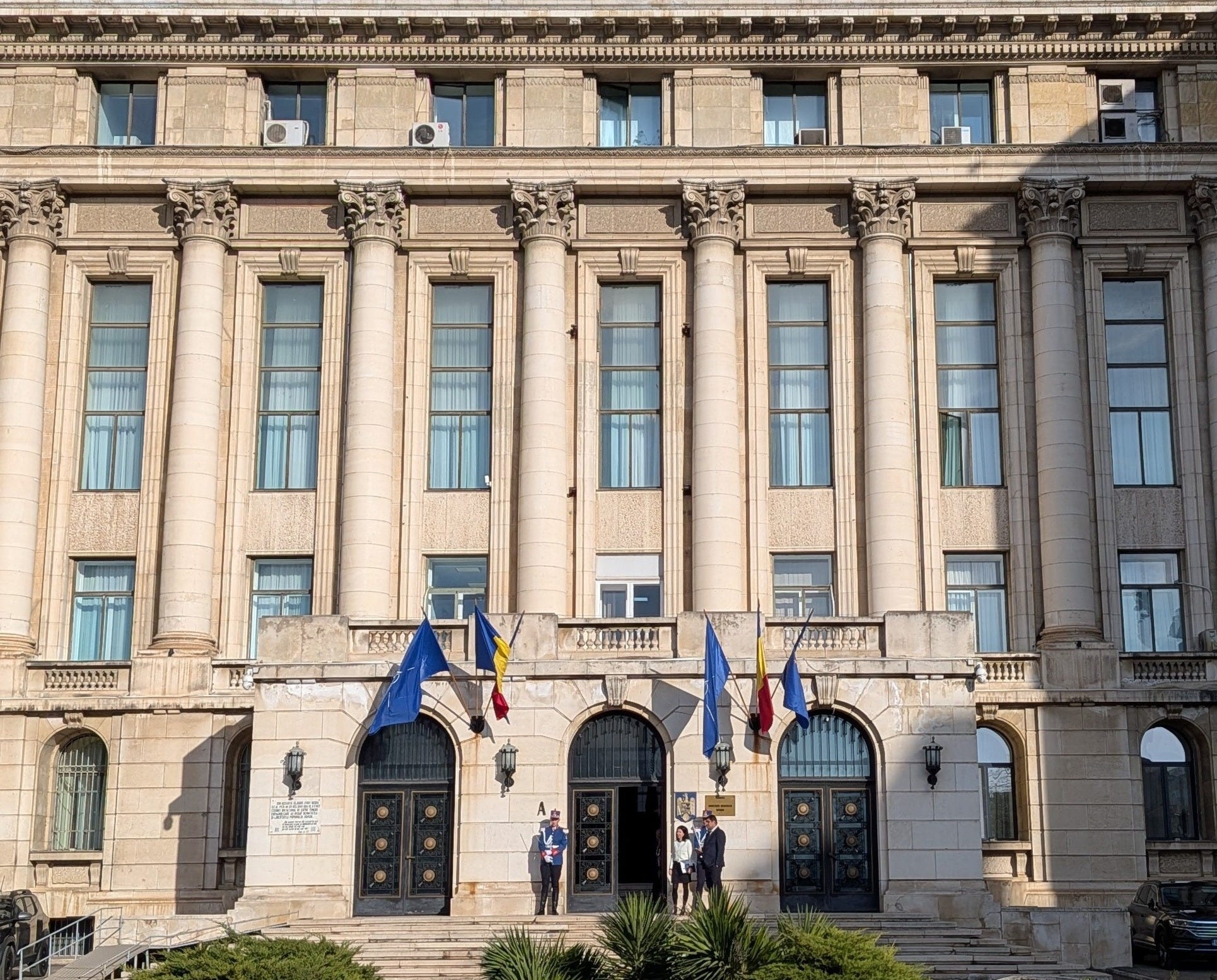
There was a fantastic audience for a discussion of the themes of my books, and of Romanian democracy more broadly, with the Export Forum (read their Three Decades of Civil Society,” an excellent account of post-communist Romanian history, here)
I also traveled to Timișoara, the city where the revolution began in December of 1989. The city has Romanian-Hungarian-Serbian-Jewish-German roots, and is a great place to look for Habsburg and Secessionist architecture. It’s also now possible to trace the route of the revolution and visit the monuments to that time, scattered across the city. I spoke at West University, which has a large, geographically diverse student body and a dedicated faculty, as worried about their country as we are about ours.
Open Letters, from Anne Applebaum is a reader-supported publication. To receive new posts and support my work, consider becoming a free or paid subscriber.