
Mega Solar Power Plant Market Growth Surges from USD 197,230 Million to USD 368,630 Million by 2030
Mega Solar Power Plant Market Growth Surges from USD 197,230 Million to USD 368,630 Million by 2030
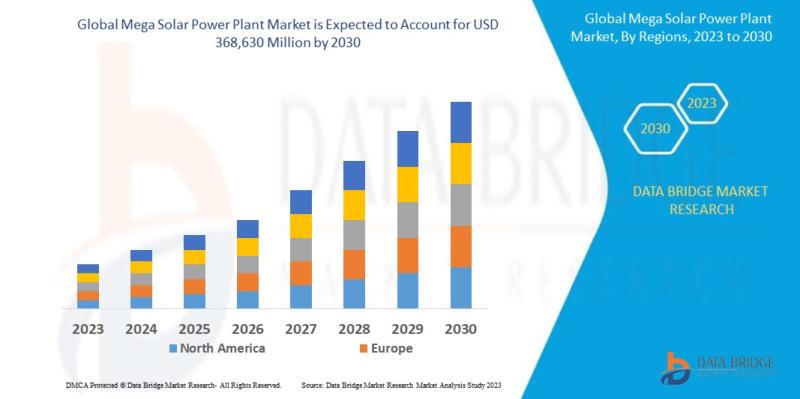
Mega Solar Power Plant Market
As per Data Bridge Market Research analysis, the Mega Solar Power Plant Market was estimated at USD 260.50 billion in 2025. The market is expected to grow from USD 279.20 billion in 2026 to USD 368.63 billion in 2030, at a CAGR of 7.2% during the forecast period with driven by the rising demand for renewable energy, supportive government policies, and increasing investments in large-scale solar infrastructure.
Get the full PDF sample copy of the report: (Includes full table of contents, list of tables and figures, and graphs):
https://www.databridgemarketresearch.com/request-a-sample/?dbmr=global-mega-solar-power-plant-marketMarket Size & Forecast
2025 Market Size: USD 260.50 Billion
2026 Projected Market Size: USD 279.20 Billion
2030 Projected Market Size: USD 368.63 Billion
CAGR (2026-2030): 7.2%
Largest Region: Asia Pacific
Fastest Growing Region: Asia Pacific
Key Market Report Takeaways
Asia Pacific dominates the market with over 42% share, driven by large-scale installations in China and India
Asia Pacific is also the fastest-growing region, supported by aggressive renewable targets and infrastructure expansion
Photovoltaic (PV) solar plants account for the highest market share due to cost efficiency and scalability
Utility-scale power generation is the dominant application segment, contributing over 65% of total demand
Energy & power utilities represent the leading end-use segment, driven by grid-scale deployment and long-term PPAs
Key Market Trends & Highlights
Asia Pacific leads the global market due to large-scale government-backed solar projects, low-cost manufacturing, and favorable land availability
Asia Pacific is the fastest-growing region, driven by rising electricity demand, urbanization, and strong policy incentives
Utility-scale solar installations remain the dominant segment due to high efficiency and long-term cost benefits
Market growth is driven by increasing renewable energy demand, decarbonization targets, and declining solar panel costs
Advanced technologies such as bifacial modules, solar tracking systems, and energy storage integration are reshaping the market
Government incentives, international climate commitments, and public-private partnerships are accelerating global deployment
Get Market Highlights:
https://www.databridgemarketresearch.com/reports/global-mega-solar-power-plant-marketMarket Dynamics
Market Drivers
Rising Global Demand for Renewable Energy
The increasing global shift toward clean energy is a major driver for mega solar power plants. Governments and industries are prioritizing renewable sources to reduce carbon emissions and meet climate targets. Regions such as Europe and North America are accelerating solar adoption to comply with net-zero commitments. This growing demand directly boosts investments in large-scale solar infrastructure globally.
Supportive Government Policies and Incentives
Favorable regulatory frameworks, subsidies, tax benefits, and feed-in tariffs are significantly encouraging market growth. Countries like China, India, and the U.S. have implemented ambitious solar capacity targets supported by policy incentives. These initiatives reduce financial risks and improve project feasibility, attracting both domestic and international investors.
Declining Cost of Solar Technology
The continuous reduction in solar panel costs, particularly photovoltaic modules, has improved the economic viability of mega solar projects. Advances in manufacturing, economies of scale, and improved supply chains have significantly lowered installation costs. This cost competitiveness has positioned solar power as a preferred energy source over fossil fuels.
Increasing Investments and Financing Models
Growing investments from governments, private equity firms, and international organizations are driving market expansion. Innovative financing models such as power purchase agreements (PPAs) and green bonds are supporting large-scale project development. This trend is especially prominent in emerging economies across Asia Pacific and Latin America.
Technological Advancements in Solar Systems
Innovations such as bifacial solar panels, solar tracking systems, and integrated energy storage solutions are improving efficiency and output. These technologies enhance power generation capacity and reduce operational costs over time. Advanced monitoring and AI-based optimization further contribute to performance improvements in mega solar plants.
Market Restraints
High Initial Capital Investment
Mega solar power plants require substantial upfront investment for land acquisition, infrastructure, and installation. This creates financial barriers, particularly in developing economies with limited funding access. Despite long-term returns, the initial capital intensity restricts market entry for smaller players.
Land Availability and Acquisition Challenges
Large-scale solar plants require extensive land areas, often leading to regulatory and environmental concerns. Land acquisition processes can be complex and time-consuming, especially in densely populated regions. This challenge is particularly significant in Europe and parts of Asia.
Intermittency and Energy Storage Limitations
Solar energy generation is dependent on sunlight, leading to intermittency issues. The lack of cost-effective large-scale energy storage solutions impacts grid reliability. Although battery technologies are improving, high costs remain a limiting factor for widespread integration.
Grid Integration and Infrastructure Constraints
Integrating mega solar plants into existing grid infrastructure can be challenging, especially in developing regions. Transmission bottlenecks and inadequate grid capacity can limit project scalability. Upgrading infrastructure requires additional investment and coordination with utilities.
Supply Chain Disruptions
Global supply chain disruptions, particularly in solar module manufacturing and raw material availability, can impact project timelines and costs. Dependence on a limited number of manufacturing hubs increases vulnerability to geopolitical and trade-related risks.
Market Opportunities
Expansion in Emerging Markets
Emerging economies in Asia Pacific, Latin America, and Africa present significant growth opportunities. Rising electricity demand and government initiatives are driving solar adoption in these regions. Untapped markets offer substantial potential for large-scale project development.
Integration of Energy Storage Systems
The increasing adoption of battery energy storage systems (BESS) presents a major opportunity for the market. Integrating storage with solar plants enhances reliability and enables continuous power supply. This trend is expected to unlock new revenue streams and improve grid stability.
Technological Innovations in Solar Efficiency
Advancements in high-efficiency photovoltaic cells, floating solar farms, and hybrid renewable systems are creating new growth avenues. These innovations improve energy output and optimize land utilization. Continuous R&D investments are expected to drive future market expansion.
Corporate Renewable Energy Procurement
Large corporations are increasingly investing in renewable energy to meet sustainability goals. Corporate power purchase agreements (PPAs) are driving demand for mega solar projects globally. This trend is particularly strong in North America and Europe.
Government Net-Zero Commitments
Global commitments to achieve net-zero emissions are accelerating investments in solar energy infrastructure. Governments are introducing policies and funding programs to support renewable energy deployment. This creates long-term growth opportunities for mega solar power plants.
Market Challenges
Complex Project Development and Permitting
Mega solar projects involve multiple regulatory approvals and compliance requirements. Lengthy permitting processes can delay project timelines and increase costs. This challenge is particularly prominent in developed regions with strict environmental regulations.
Grid Stability and Energy Management Issues
Large-scale solar integration can impact grid stability due to fluctuating power generation. Managing load balancing and ensuring consistent supply requires advanced grid management systems. This remains a significant technical challenge for utilities.
Dependence on Weather Conditions
Solar power generation is highly dependent on weather conditions, leading to variability in output. Regions with inconsistent sunlight exposure face limitations in energy generation capacity. This unpredictability affects overall efficiency and planning.
Rising Competition from Alternative Renewables
The market faces competition from other renewable sources such as wind and hydropower. These alternatives may offer more consistent energy generation in certain regions. Competitive pricing and technological advancements in other sectors can impact solar adoption.
Financing and Risk Management Issues
Large-scale solar projects involve financial risks related to long payback periods and policy uncertainties. Fluctuations in interest rates and currency exchange rates can impact project viability. Managing these risks is critical for sustained market growth.
Market Segmentation & Analysis
By Type / Technology
The market is segmented into Photovoltaic (PV) Solar Plants and Concentrated Solar Power (CSP). PV solar plants dominate the market with over 80% share due to lower costs and easier scalability. CSP, while offering thermal storage advantages, holds a smaller share due to higher capital costs. PV is also the fastest-growing segment, driven by continuous efficiency improvements and declining module prices.
By Application
Applications include Utility-Scale Power Generation, Industrial Power Supply, and Grid Support Systems. Utility-scale power generation dominates the market, accounting for over 65% share, driven by increasing grid-connected projects. This segment is also the fastest-growing due to rising electricity demand and favorable government policies.
By End-User
End-users include Energy & Power Utilities, Industrial Sector, and Commercial Entities. Energy & power utilities hold the largest market share due to their role in large-scale electricity generation and distribution. The industrial sector is witnessing rapid growth, driven by corporate sustainability initiatives and energy cost optimization strategies.
By Deployment / Technology
Deployment includes Ground-Mounted Solar Plants, Floating Solar Plants, and Hybrid Systems. Ground-mounted plants dominate the market due to widespread adoption and large-scale feasibility. Floating solar plants are the fastest-growing segment, driven by land constraints and improved efficiency through water cooling effects.
Analytical Insights
Largest Segment: Photovoltaic (PV) solar plants due to cost efficiency and scalability
Fastest-Growing Segment: Floating solar and hybrid systems driven by innovation and land optimization
Segment dominance is driven by declining technology costs, increasing adoption, and supportive policy frameworks
Regional Analysis
By geography, the market is categorized into North America, Europe, Asia Pacific, Latin America, and the Middle East & Africa.
North America
North America holds a significant market share due to advanced infrastructure and strong renewable energy policies. The U.S. is the key contributor, supported by federal incentives and large-scale solar projects. High adoption of advanced solar technologies and strong private sector participation drive market growth.
Europe
Europe represents a mature market with steady growth driven by stringent environmental regulations and climate targets. Countries such as Germany, the U.K., and France are leading contributors. Strong R&D investments and renewable energy adoption support market expansion.
Asia Pacific
Asia Pacific is the largest and fastest-growing region, accounting for over 42% of global revenue. China, India, and Japan are major contributors due to large-scale solar installations and government initiatives. Rapid industrialization and increasing energy demand further accelerate growth.
Latin America
Latin America is an emerging market with growing investments in renewable energy infrastructure. Brazil and Mexico are key contributors, driven by favorable solar conditions and policy support. However, economic constraints and infrastructure challenges limit growth.
Middle East & Africa
The Middle East & Africa region is experiencing gradual growth driven by government initiatives and investments in renewable energy. Countries are focusing on diversifying energy sources and reducing dependence on fossil fuels. Infrastructure gaps and funding limitations remain key challenges.
Key Insights:
Largest Region: Asia Pacific
Fastest Growing Region: Asia Pacific
Competitive Landscape
Market Structure Overview
The mega solar power plant market is moderately consolidated, with a mix of global leaders, regional developers, and emerging players. Competition is driven by technological innovation, project scale, and cost efficiency. Companies are focusing on advanced solar technologies and strategic partnerships to strengthen their market position.
Key Industry Players
Leading companies operate across the value chain, offering project development, engineering, procurement, and construction (EPC) services. They focus on expanding their portfolios and strengthening global presence through innovation and large-scale deployments.
List of Key Industry Players:
NextEra Energy, Inc.
First Solar, Inc.
Canadian Solar Inc.
JinkoSolar Holding Co., Ltd.
Trina Solar Co., Ltd.
LONGi Green Energy Technology Co., Ltd.
Enel Green Power S.p.A.
Adani Green Energy Ltd.
Tata Power Solar Systems Ltd.
SunPower Corporation
Competitive Strategies
Companies are adopting strategies such as technological innovation, strategic partnerships, and mergers and acquisitions to enhance market presence. Product innovation focuses on high-efficiency modules and integrated energy solutions. Geographic expansion into emerging markets is also a key strategy for growth.
Emerging Players & Market Dynamics
Startups and niche players are entering the market with innovative and cost-effective solutions. Increasing investments and funding activities are driving competition. Digital transformation and advanced analytics are enabling better project management and operational efficiency.
Latest Developments
January 2025 — Adani Green Energy Ltd.: Announced expansion of ultra-mega solar projects in India, increasing capacity and strengthening Asia Pacific leadership.
November 2024 — First Solar, Inc.: Launched next-generation high-efficiency PV modules, improving energy output and reducing costs.
August 2024 — JinkoSolar Holding Co., Ltd.: Expanded manufacturing capacity in Asia to meet rising global demand for solar modules.
May 2024 — Enel Green Power S.p.A.: Entered strategic partnerships in Latin America to develop large-scale solar infrastructure.
March 2024 — Canadian Solar Inc.: Invested in energy storage integration for solar projects, enhancing grid reliability.
December 2023 — NextEra Energy, Inc.: Expanded utility-scale solar portfolio in North America, supporting renewable targets.
September 2023 — Trina Solar Co., Ltd.: Introduced advanced bifacial solar modules to improve efficiency and performance.
See More Industry Reports:
https://www.databridgemarketresearch.com/reports/global-cryocooler-market https://www.databridgemarketresearch.com/reports/global-decorticator-machine-market https://www.databridgemarketresearch.com/reports/global-deep-learning-in-computer-vision-market https://www.databridgemarketresearch.com/reports/global-digital-pump-controller-marketAbout Data Bridge Market Research:
An absolute way to forecast what the future holds is to comprehend the trend today!
Data Bridge Market Research set forth itself as an unconventional and neoteric market research and consulting firm with an unparalleled level of resilience and integrated approaches. We are determined to unearth the best market opportunities and foster efficient information for your business to thrive in the market.
Contact Us:
Data Bridge Market Research
US: +1 614 591 3140
UK: +44 845 154 9652
APAC : +653 1251 975
Email:- corporatesales@databridgemarketresearch.com
This release was published on openPR.