
The media's double standard for Trump needs to stop
There’s a lot of great journalism being produced these days, despite a troubled business landscape for the media. Look no further than the Pulitzer Prizes announced Monday to see some of the best, from the Minnesota Star Tribune to the New York Times, the Associated Press, the Washington Post and many more. I was thrilled to see Julie K. Brown, the investigative reporter from the Miami Herald, recognized with a special citation for her groundbreaking work on Jeffrey Epstein’s abuses. See the full Pulitzer list here.
All of this work is important. Admirable. Essential. It makes me proud to be a journalist, and makes me realize again why democracy needs journalism — and needs it to be at its best. Especially at this critical moment.
And yet. In general, the mainstream news media continues to do what it has done for more than a decade: Fail to cover Donald Trump in a consistent way that truly serves the public interest, or that holds him accountable.
We all know how it plays out, over and over again.
“Flood the zone with shit,” was Trump ally Steve Bannon’s advice — and prediction — years ago. Read this Sean Illing piece in Vox to recall this pernicious plan of overwhelming the public with misinformation for political ends.
Trump has taken heed. And he gets away with it. True, his disapproval rating is at a whopping 62 percent, but he’s still in office, still calling the shots, still waging an illegal war, still threatening sovereign nations with takeover.
His craziness, grift, and unpredictability are already priced in to the coverage in a “there Trump goes again” way.
Donald Trump utters or does something vile, and the media notes it and moves on. Or he does something outrageous, and the media takes the edges off it with polite wording. And moves on. Or he acts in a way that no other public figure could do, but somehow he gets away with it. Everybody moves on.
In recent days, for example, he proclaimed in a speech in Florida that Cuba was the next thing in his sights, echoing his earlier comments on the same subject.
The U.S. will be “taking over [Cuba] almost immediately.”
“On the way back from Iran, we’ll have one of our big — maybe the USS Abraham Lincoln Aircraft Carrier, the biggest in the world, we’ll have that come in, stop about 100 yards off shore, and they’ll say ‘thank you very much, we give up.’”
Just imagine if President Biden (or any other president) had said such a thing. Huge headlines. Weeks of coverage. Opinion pieces about the need to employ the 25th Amendment. Cast your mind back to the coverage of Biden’s age after that infamous 2024 debate if you want to know what all-out, relentless coverage that questions a public official’s basic competence can look like.
You won’t be seeing that here, I can promise you.
Consider also the 60 Minutes interview he did right after the White House Correspondents’ Dinner.
In an ironic move, CBS was compelled to publish the entire transcript of the long interview, even though they edited it down very significantly for the broadcast. They had to publish the transcript because of Trump himself, who sued CBS over the editing of its interview with Kamala Harris in 2024. One of the conditions of the settlement was that full transcripts of similar interviews would be published in the future. So Trump has no one to blame but himself for the publication of his lunatic ramblings.
But what did he say in the interview (read it here if you have the stomach for it)? Here’s how the Hollywood Reporter described his comments: “about Democrats disagreeing with his policies, needing his White House State Ballroom finished for security purposes, blaming the internet for radicalizing some people, slamming No Kings protests, criticizing former President Joe Biden, reacting to conspiracy theories that the event was staged or didn’t happen and his plans to ‘hit people really hard’ with humor in his White House Correspondents’ Dinner speech, among other topics.”
In other words, as the New Republic observed on social media, his “wild rants depict a man who is much more petulant and incoherent than the broadcast would suggest.”
“You know, I’m not a king.… I see these No Kings which are funded just like the [Southern Poverty Law Center] was funded. You all that Southern Laws, financing the KKK and lots of other radical, terrible groups. And then they go out and they say, Oh, we’ve got to stop the KKK. And yet they give them hundreds of thousands and even millions of dollars. They work. It’s a total scam run by the Democrats. It shows you that, like Charlottesville, Charlottesville was all funded by the Southern Law,” Trump said—a completely outrageous claim given that neo-Nazis and white supremacists like Richard Spencer and Nick Fuentes were there. “That was a Southern Law deal too. And it was done to make me look bad. And it turned out to be a total fake. It basically was a rigged election. This was a part of the rigging of the election.”
Most of the press coverage of that 60 minutes interview was about Trump’s criticism of Norah O’Donnell or about how he wasn’t worried about the alleged assassination attempt.
Axios: Trump lashes out at ‘60 Minutes’ for asking about gunman manifesto
CBS News: Trump ‘wasn’t worried’ during White House Correspondents Dinner shooting.
New York Post: Trump calls ‘60 Minutes’ host ‘disgraceful’…
You get the idea. The conflict with Norah O’Donnell, not the lie-filled rants about everything else, were deemed newsworthy.
I liked what NJ.com did: “Trump unfiltered: The revealing moments CBS cut from his ‘60 Minutes’ interview.” The site, which is New Jersey’s largest local news source, managed to hit some of the lowlights, such as his false claim that CBS had paid him a $38 million settlement; it was $16 million.
Why does the media continue to sane-wash like this? Why does Trump get a free pass so often from the media? Be sure to see Greg Sargent’s piece on Dana Bash of CNN’s off-base questioning of Rep. Jamie Raskin, in which he ponders the media’s “tolerance for Trump’s (incivility alert!) fascism.”
So many headlines give Trump the benefit of the doubt, even when stories themselves are clear.
Jennifer Schulze, a sharp media observer and former TV-news executive, singled out this New York Times headline: “Trump Faces the Complicated Reality of a Costly, Unpopular War in Iran.” She noted that the story itself was perfectly clear about the war with no endgame, but saw the headline as “upside down and not nearly as direct as it should be.” She suggested something like this: “Trump’s promise of a short term conflict with minimal economic impact proves wrong.” The Times headline isn’t false, in my view; it’s just too deferential in tone.
Dan Pfeiffer, the former Obama aide turned podcast host, offered several reasons why the news media so often give Trump and Republicans a pass — even shrugging off outright corruption. In his newsletter, Message Box, he wrote:
First, Trump has worn down the media. He is so corrupt in so many ways that the story has become old news. The folks at Popular Information looked at the coverage of Jared Kushner’s involvement in the Iran negotiations and found that only a fraction of the reports even mentioned his obvious conflicts of interest.
For the press, the story of Trump and his family being corrupt is old news. The New York Times and others still do deep investigative pieces uncovering the corruption, but those stories rarely make it into the daily coverage of the Trump administration. Trump, Karoline Leavitt, and other Trump surrogates are rarely pushed to answer tough questions about it, and when they are, they just feign outrage and never engage with the substance.
The second reason is that the press holds Democrats to a higher standard. This has always been sort of true, but it’s been particularly true in the Trump era. Reporters think Democratic voters care about whether their leaders are corrupt and Republican voters don’t. Therefore, a Democratic scandal could have bigger political implications, while a Republican scandal dies on the vine.
Third, most of the media is VERY sensitive to accusations that they are biased against Republicans. This is less true than it used to be, but most reporters are personally liberal on issues like abortion, guns, and climate. Some end up overcompensating by being tougher on Democrats.
Finally, Republicans do a better job of hammering these issues than Democrats. Plenty of Democrats have raised concerns about Don Jr. and Jared Kushner’s blatant corruption, but as a whole, we don’t do it often enough, loud enough, or in ways that break through. If and when Democrats have control of Congress, we will have additional tools to highlight the corruption for the world to see.
In another post soon, I’ll make some suggestions about remedying these media shortcomings. But for now, I’m just noting, once again, how common they are and how they endure, even when the press really should know better by now.
American Crisis is a community-supported project where I explore how journalism can help save democracy. Please consider joining us!
A couple of other notes:
One of the best analyses of last week’s devastating gutting by the Supreme Court of the Voting Rights Act was from the always excellent Richard Hasen of UCLA Law School, writing in Slate. He called it “the worst ruling in a century.” Please read it if you have a few minutes.
World Press Freedom Day was on May 3 and I offered some thoughts to the Reporters Committee for Freedom of the Press on why the FBI’s January seizure of a Washington Post reporter’s devices in a raid on her home was so alarming for press freedom. The story includes this from me: “Source protection is at the heart of investigative and a lot of other reporting. We have to be able to tell sources, ‘You’re safe with me.’” But this unprecedented raid sends the opposite message.
By the way, readers, RCFP is a great nonprofit organization and is always worthy of your charitable dollars. It offers expert legal help to journalists, including those in small newsrooms or freelancers who work without the help of house counsel.
Readers, do you agree that Trump media coverage continues to soft-pedal his behavior and his statements? Do you think, as I do, that Pfeiffer has it mostly right? If that’s the case, why is Trump’s disapproval rating so high? Where are you turning for a more straightforward treatment?
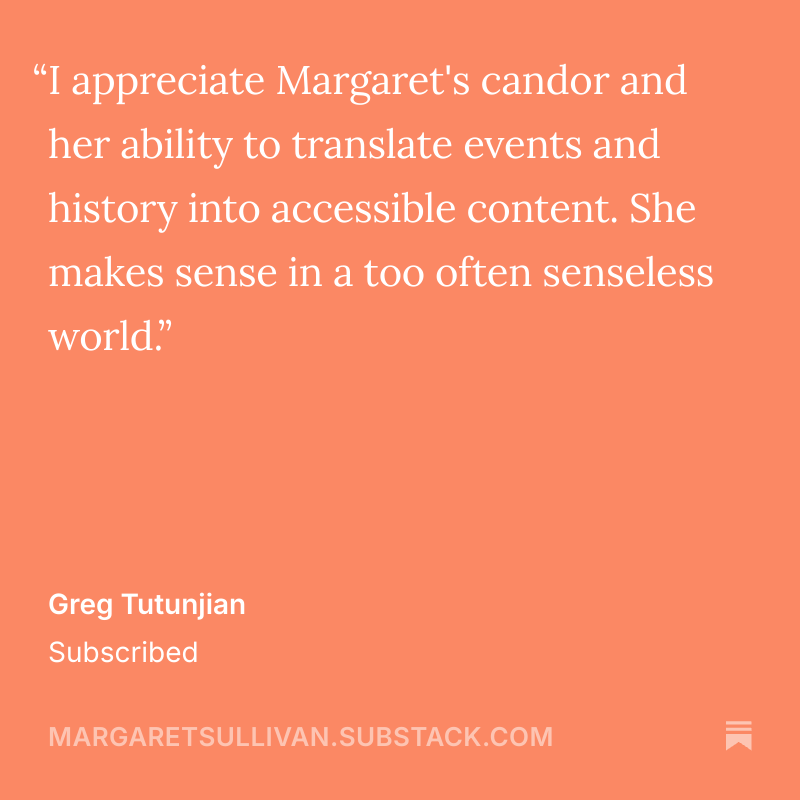
Thanks to all for supporting this venture of mine that advocates for journalism that does its crucial job in our democracy. Because I removed the paywall a while back, I very much appreciate those who have stepped up as paid subscribers so I can keep it going. For those who have sent kind messages with their paid subscriptions, please know how much those mean to me, and how encouraging they are.
Here’s one:
My background: I am a Lackawanna, NY native who started my career as a summer intern at the Buffalo News, my hometown daily. After years as a reporter and editor, I was named the paper’s first woman editor in chief in 1999, and ran the 200-person newsroom for almost 13 years. Starting in 2012, I served as the first woman “public editor” of the New York Times — an internal media critic and reader representative — and later was the media columnist for the Washington Post. These days, I write here on Substack, as well as for the Guardian US. I’ve also written two books, taught journalism ethics, and won a few awards, including three for defending First Amendment principles.
The purpose of ‘American Crisis’: My aim is to use this newsletter (it started as a podcast in 2023) to push for the kind of journalism we need for our democracy to function — journalism that is accurate, fair, mission-driven and public-spirited. That means that I point out the media’s flaws and failures when necessary.
What I ask of you: Shortly after Trump’s election in November of 2024, I removed the paywall so that everyone could read and comment. I thought it was important in this dire moment and might be helpful. If you are able to subscribe at $50 a year or $8 a month, or upgrade your unpaid subscription, that will help to support this venture — and keep it going for all. Thank you!