
On the ‘Market Failure’/‘Public Good’ Debate and the Future of News
Welcome to Second Rough Draft, a newsletter about journalism in our time, how it (often its business) is evolving, and the challenges it faces.
I was struck within a couple of days last month to see competing assertions about what has brought us to the business crisis of news. This week I want to explore the difference in those perspectives.
The new president of the Ford Foundation, Heather Gerken, in announcing her seven new strategic priorities, declared that, “The moment has come to treat information as a public good.” She decried an excessive concentration of private power, “a business model that distorts and damages public discourse” and a governmental policy failure to address these changes. (Her essay, very much worth reading, disappointingly fails to use the words “journalism” or “the press” in discussing these questions, but that’s a topic for another day.)
Just a week earlier, Richard Gingras, former head of news at Google and now chair of the Canadian for-profit local news company, Village Media, wrote on Substack about what he says is “The Myth of Market Failure.” (Village is launching a major expansion into the US, aided by a $5 million investment from Knight Foundation.) Gingras, also worth reading, asserts that “the news industry is NOT a case of market failure,” but rather “a failure of thoughtful market assessment, a failure of imagination, and a failure of innovation.” If there has been no market failure, there is presumably no need for philanthropic or government funding of news.
I agree on Gingras’s three failures, and have been saying so for more than two decades. But that doesn’t mean there hasn’t also been a market failure, nor that local news and accountability reporting, haven’t become public goods.
Clarifying terms
Maybe we should go back to what these economic terms mean. A market failure occurs when private capitalism (the market) fails to produce the amount of a good or service consumers would like to consume. A public good is one which is sufficiently important to society that, when the markets fail to produce it, some combination of government action and private philanthropy are called upon to try to do so. Classic examples are national defense and clean water and air.
Gingras says we have today a “vast and highly competitive marketplace of expression” and that “the successful publishers are, more often than not, new entrants.” But he fails to reckon with the fact that, in both accountability reporting and local, these new entrants are preponderantly nonprofits. They are organized this way not out of choice but because for-profit solutions were not available.
It’s worth remembering, for instance, that the founding funders of ProPublica, the Texas Tribune, the Marshall Project, CalMatters, Deep South Today and the Baltimore Banner were all quite successful capitalists. They could—and would—have started new for-profits if they had seen an opening to do so. And the nonprofit conversion of the Salt Lake Tribune, the gift of ownership of the Philadelphia Inquirer to a nonprofit and the drift of leading papers like the Minnesota Star-Tribune, Seattle Times and perhaps even the Boston Globe toward nonprofit operations are further indications of similar judgments.
The sheer aggregate scale of American nonprofit news is strong evidence that there has been a market failure. It’s worth noting that there is no meaningful provision in our society, for instance, of nonprofit hamburgers or clothes or cars. The market amply provides them.
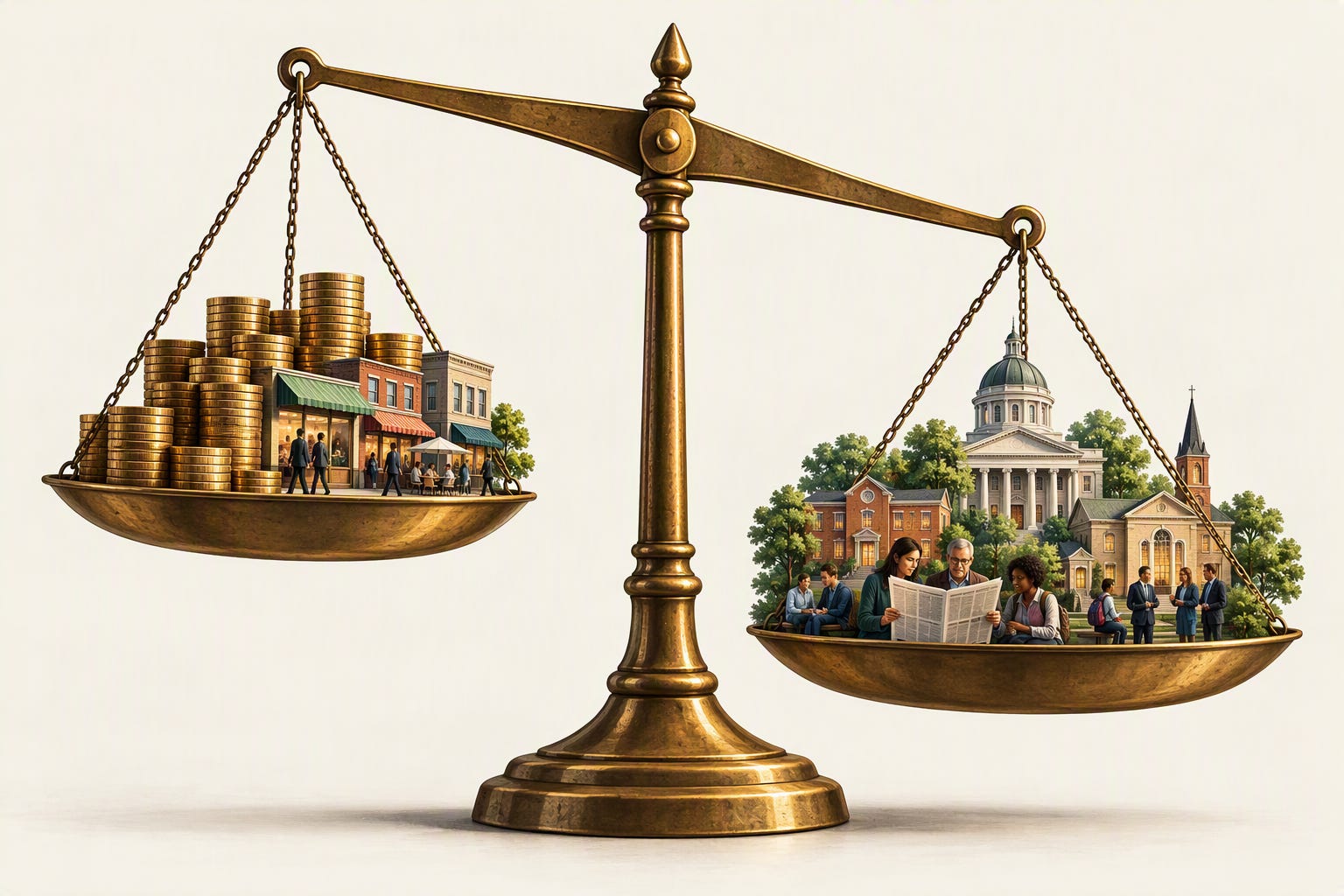
Gingras, fresh from 15 years at Google, insists that, “News publishers continue to claim, ‘platforms stole our ad revenue.’ Almost none of that ad revenue moved to the platforms.” He points out that most Google advertisers are small businesses, while ignoring the fact that the same was true of local newspapers.
Putting aside the word “stole,” which I agree is incorrectly used in this context, it is a sobering fact that five companies (Google, Meta, Amazon, Microsoft and Tik Tok), now control roughly two-thirds of the entire US advertising market. This has occurred because the platforms built better mousetraps, because they leveraged other businesses (search, online retail and software) and because digital delivery caused unheard-of efficiencies from enormous scale. But while a market dominated in this way by so few players may be competitive from the perspective of the platforms themselves, it surely is not from the perspective of their customers. It is, rather, a classic oligopoly.
Nothing is certain
It is true, as Gingras says, that philanthropic and governmental funding are necessarily uncertain foundations for businesses. But so, of course, is for-profit organization. When I was born, the second most important newspaper in this country was the New York Herald Tribune. It failed before I hit my teens. When I started my career in news, the big new success was USA Today. Today, it is sliding into oblivion.
Gingras cites the current success of the New York Times and Canada’s Globe and Mail without noting that both are shielded from the full force of the market by family control. In response to questions, Gingras tells me that Village Media itself receives about $3 million annually from the Canadian government through its Local Journalism Initiative and special tax credits for journalism; he adds that the company was profitable before this aid began, would still be without it and is very profitable in established markets. He declined to say how Village’s current overall profits compare in scale to the subsidy. Cynics often quip that “nonprofit is a tax status, not a business model,” but the same is true of for-profit.
To conclude that there have been market failures in accountability and local journalism, as I do, and that, if so, they are public goods (which I think is generally accepted) is the beginning rather than the end of further debate. There is no societal consensus, now or most of the time, about whether we are adequately or intelligently funding national defense, or whether our air and water are clean enough. Nor, even if we agree on unmet needs in such areas will there always, or even ever, be complete agreement on the best means for getting where we want to go. The debates, though, are worth having, and I’m delighted you and I can have them, here and elsewhere.
Second Rough Draft paid subscribers support nonprofit journalism To receive new posts, become a free or paid subscriber.