
Making College Rankings Great Again.
This post is not about the emergencies of the moment.1 Instead I am writing about a very long-standing issue that lies behind many of the urgent tensions of the day.
That issue is how we think about, and support or oppose, US higher education overall:
- The ways in which it is a vehicle for opportunity, rather than one of exclusion.
- How it is connected to, or separate from, the communities where it is based and the country as a whole.
- How it eases, or intensifies, the economic and political divisions of our times. (“College” vs “non-college” voting patterns and income gaps, the growing burden of student debt, and so on.)
- Whether there is any realistic way to assess how schools are “better” or “worse” than their competitors. Leading to…
- How to recognize institutions that are doing most to meet the challenges of this era, and then to share the practices they have applied.
In specific I’m talking about “college rankings,” as pioneered by US News, and how a system that has been mainly pernicious can be transformed into something more constructive and valuable.
-This is a subject I know something about, having once been the editor of US News and having tried, with limited success, to clean up the ranking system.
-It’s a subject I care about, having heard so often from so many people about the distorting effects of trying to move “up” and “down” on these capricious measures. And it’s one I’ve written about regularly at this time of year, for instance in 2021, 2023, and 2024.2
-It’s timely subject, with the annual US News rankings coming out soon.
-And it’s a frontier on which I think there’s hope, based on a different approach to rankings now.
That promising approach is one honed over the past 20 years by The Washington Monthly, the publication on which I began my magazine career in the early 1970s. The magazine has taken an important step forward this year.
Background: How we got here.
I don’t often say, “There’s an article from a small magazine, back in 2001, that explains our whole problem these days.” But I’ll say it in this case.
Back in 2001, in The Washington Monthly, Amy Graham, whom I had worked with at US News, and Nicholas Thompson, whom I met in that era (when he was a college student) and who is now CEO of The Atlantic and author of a forthcoming book, together wrote “Broken Ranks,” a seminal piece that laid out the problem with rankings. The fundamental issue is that rankings mostly measure input, or what the colleges have, rather than output, or what the colleges do. As Graham and Thompson put it:
Unfortunately, the highly influential U.S. News & World Report annual guide to “America’s Best Colleges” pays scant attention to measures of learning or good educational practices, even as it neatly ranks colleges in long lists of the sort that Americans love. It could be a major part of the solution; instead, it’s a problem.
U.S. News’ rankings primarily register a school’s wealth, reputation, and the achievement of the high-school students it admits. At one time, most academics believed in one simple equation: Good students plus good faculty equals good school.
The rankings reflect this outlook, tabulating things such as percent of faculty with a doctorate (to measure the quality of the professors) and SAT scores of the freshman class (to get at quality of the students). That’s like measuring the quality of a restaurant by calculating how much it paid for silverware and food: not completely useless, but pretty far from ideal.
Still, such rankings matter deeply on college campuses. Administrators wait with bated breath for them to arrive each fall and brag when their schools do well; trustees fret about them; campuses even hire independent consultants to help figure out how to game them.
There’s a whole literature on the questionable standards behind US News-style rankings, and the unquestionably powerful distorting effects they have on campus. Some of these articles are by me.
For now, the important point is the response, and solutions. Rankings that mainly highlight how rich an institution is, or how many students it rejects (making it more “selective”), aren’t going away. But their effect can be diluted by more, and better rankings —which is where The Washington Monthly comes in.
The headwinds for higher ed.
American higher-ed has problems far beyond rankings, and even beyond the assault from MAGA. A crucial one is simple supply-and-demand. We already have a good idea of how many US-born 18-year-olds will be around to consider college in 2030, and even 2040. They already exist, as children born between 2012 and 2022. Here’s the trend line for native-born 18-year-olds in the US, by decade, starting in 1970:
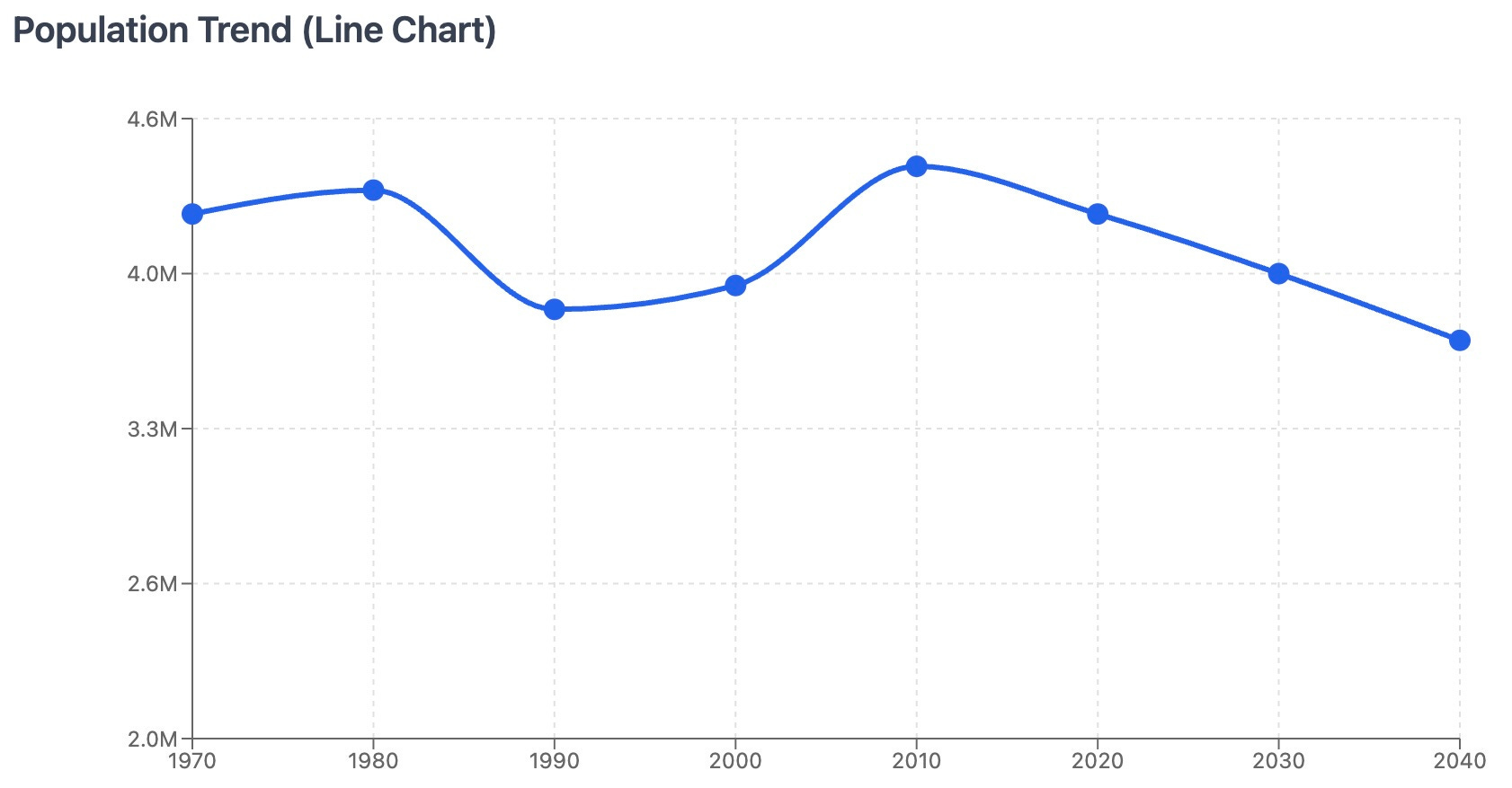
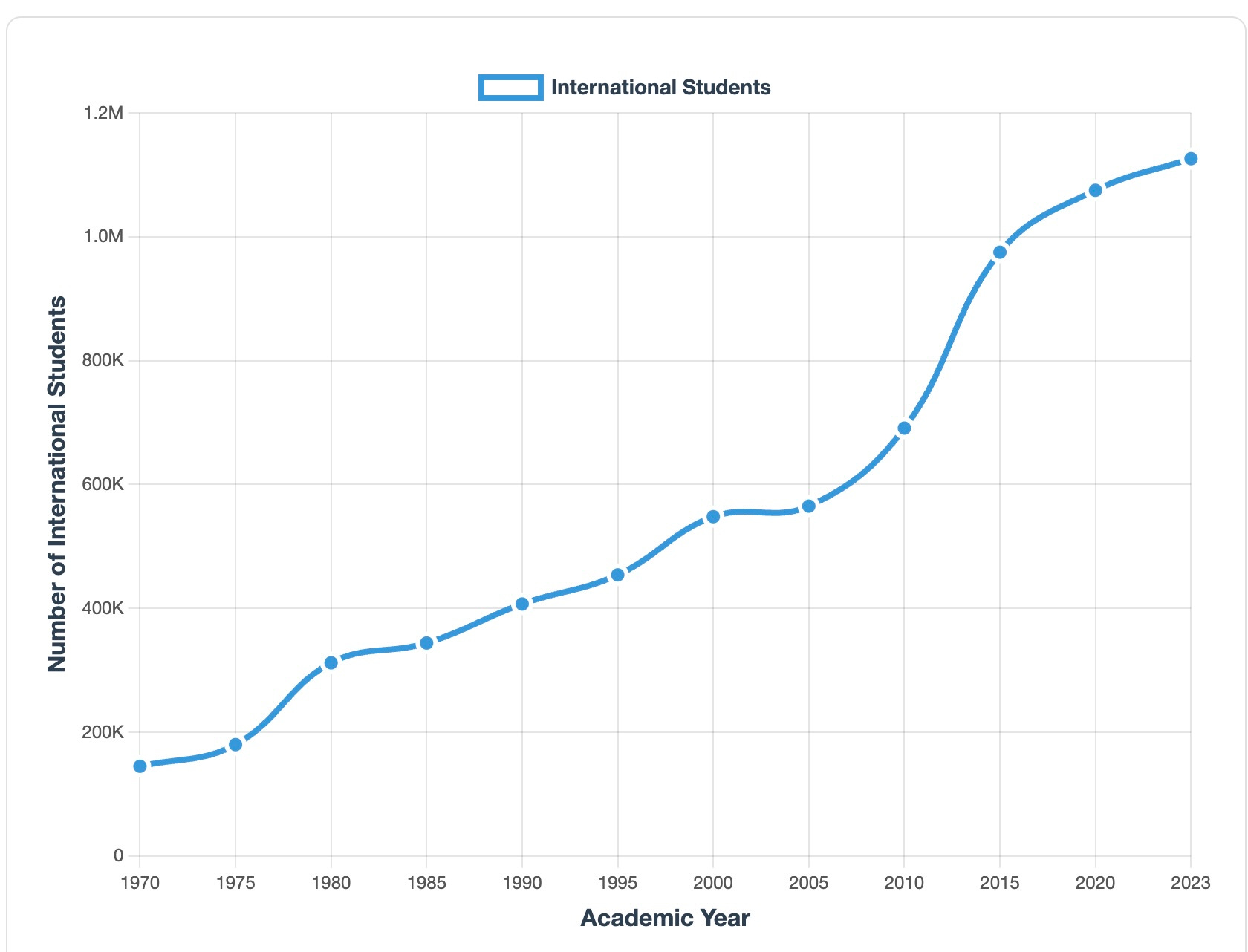
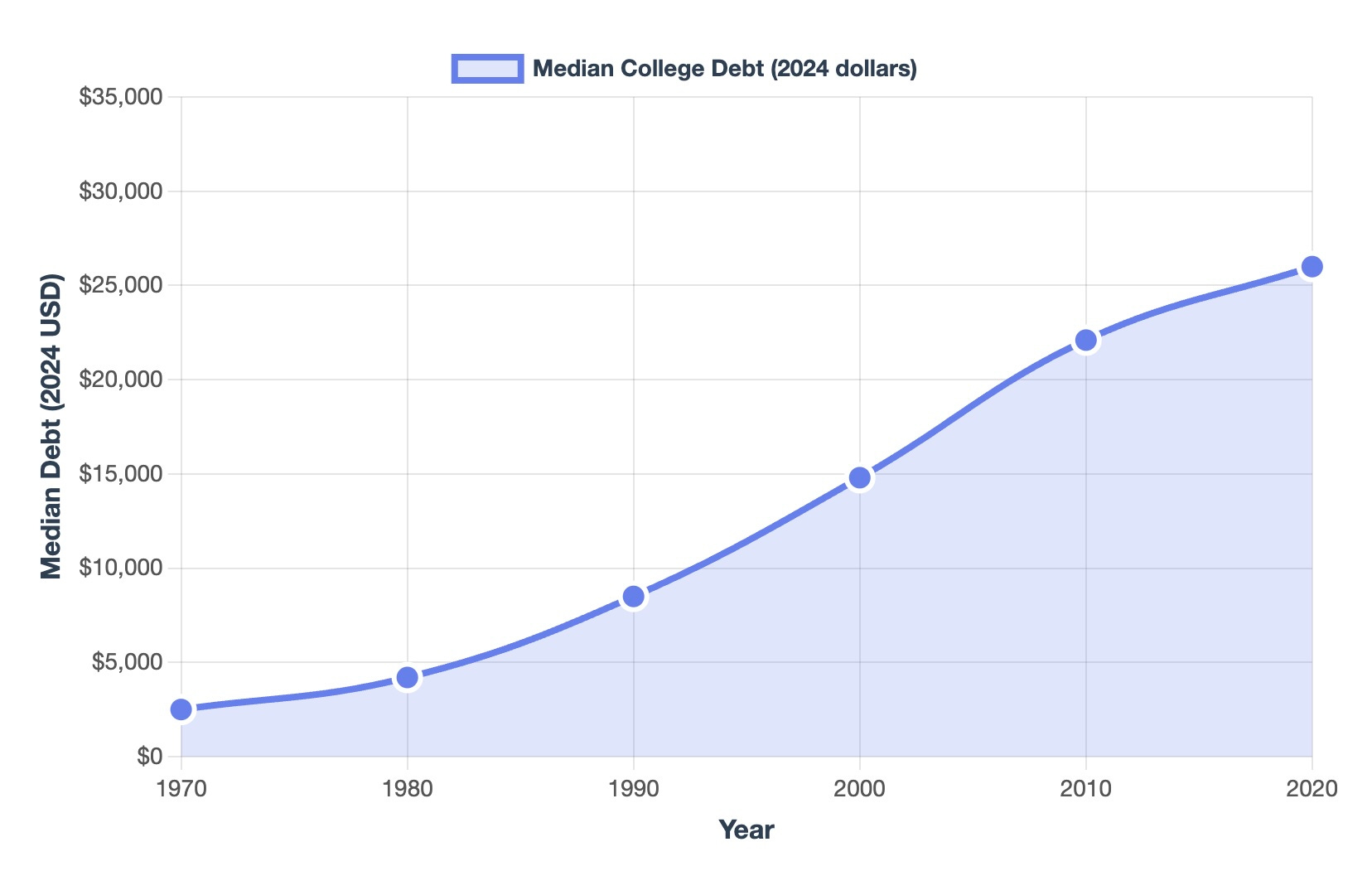
In this and the next two graphs, numbers are from Census and Department of Education data, which I have checked. The illustrations are rendered by Claude AI.
Of course the story is more complicated, as immigrants, “non-traditional” students, and others offset the decline in 18-year olds. Still, it is a headwind.
And we have an idea of how important international students have been for US enrollment. This graph gives an idea of how US education has enjoyed a golden age of international enrollment over the last half-century. And of how much is at stake, if visa restrictions make these numbers plunge.
And, finally, here is a rough-and-ready approximation of median student debt for US college graduates through these same years. Figures are in inflation-adjusted 2024 dollars. Exact numbers vary from different sources, but the upward trend is clear.
Ranking colleges on ‘output,’ for students, rather than ‘input,’ of assets and advantages.
What does this all mean? A million things, but at the heart of them is the need for clearer measures of what kind of education pays off—for individuals, for communities, for the country as a whole.
I think the 2025 edition of TWM’s rankings takes a big step in that direction.
Please check it out for yourself. And read the many other excellent articles in that same issue. But as an overview I’ll quote this recent note about the approach from the Monthly’s longtime editor, Paul Glastris, who is a longtime friend. Emphasis added by me.
This is the 20th year we’ve been putting out this alternative to the U.S. News rankings, and each year we’ve managed to chip away at the toxic values built into U.S. News’s metrics, which reward colleges for their wealth, prestige, and exclusivity.
This year we’ve significantly changed our methodology to take account of new realities facing higher education—including federal attacks on the sector—and to provide an even clearer picture of how individual colleges are performing based on the measures we think most students and taxpayers care most about: how much colleges help ordinary middle- and working-class students get ahead economically and become good citizens.
Paul points out that, because of this different approach, the Monthly’s hierarchy of “Best Colleges for Your Tuition (and Tax) Dollars” differ sharply from US News-style lists:
- The University of Texas–Rio Grande Valley ranks 21 slots above Harvard on the Washington Monthly’s rankings.
- Florida International University places eight positions above Duke University.
- The highest-ranking elite school, Princeton University, comes in at number five, immediately below three campuses in the California State University system, including second-place Fresno State.
- The number one college in America, according to the Washington Monthly, is Berea College, a liberal arts school in rural Kentucky.
Paul Glastris adds another angle, which I agree with:
There is a [larger] sea-change around how colleges are being judged—less on prestige, more on their ROI to less-affluent students….It has clearly been picking up steam since the Obama administration started releasing the College Scorecard data….
This is all part of the current public backlash against higher ed, which is easily overstated, primarily partisan, and generally focused on “woke” but also rooted in real public frustration with college costs and the exaggerated importance given elite schools.