
Live updates: Pope Francis death and Vatican news
In Canada, Pope Francis will be remembered for his historic apology to Indigenous people
From CNN’s Lex HarveyThese words, delivered by Pope Francis to Canadian Indigenous leaders during their historic visit to Rome in 2022, were decades in the making.
Francis apologized for the Catholic Church’s role in what he said were “deplorable” abuses at Canada’s residential schools, which forcibly assimilated Indigenous children into Canadian society, stripping them of their language and culture.
More than 4,000 Indigenous children died from either neglect or abuse in residential schools, most of which were run by the church, according to Canada’s Truth and Reconciliation Commission. The last residential school closed in 1998.
The discovery of hundreds of unmarked graves on the grounds of former residential schools in British Columbia and Saskatchewan in 2021 further laid bare the extent of the horrors.
Indigenous leaders had fought for decades for a papal apology for the harm inflicted on First Nations, Inuit and Métis children.
Francis will be remembered in Canada as the pope who finally delivered that apology — first at the Vatican, then again during an emotional six-day “pilgrimage of penance” in Alberta, Quebec and Nunavut.
The pontiff’s visit was bittersweet for survivors, some of whom said it triggered more pain.
But Francis’ public recognition of the Church’s wrongdoing — abuses for which he said he felt “sorrow and shame” — were a crucial step toward reconciliation, according to many Indigenous leaders.
“We’ve lost an ally,” Assembly of First Nations National Chief Cindy Woodhouse Nepinak, told CNN affiliate CBC News. “He wanted to right the wrongs of the past.
One of the world’s most Catholic countries will have an important role in choosing the next pope
From CNN’s Helen ReganThe Southeast Asian nation of East Timor — one of the world’s most Catholic countries — has declared a week of national mourning for Pope Francis.
East Timor, also known as Timor-Leste, is the second-most Catholic country in the world, with 97% of the population identifying as Catholic, the highest share outside of the Vatican.
It hosted Pope Francis on his marathon trip through Asia last year. He received a rapturous welcome, with almost half of the country’s 1.3 million population attending his open-air Mass.
Churches in East Timor held special masses on Monday and flags will be flown at half-mast to honor the pope, whose death was described by its President Jose Ramos-Horta as a “tremendous loss for the world, not just only for Christians.”
East Timor is one of the world’s youngest countries and the Catholic Church was influential in its tumultuous and bloody fight for independence from Indonesia.
The East Timor government called the pope’s visit “a historic moment for our country.”
East Timor will also have an important role in choosing the next pope.
Cardinal Virgilio do Carmo da Silva is the country’s first cardinal after he was hand-picked by Pope Francis in 2022.
Carmo da Silva is named by the Vatican as one of 135 cardinal electors, making him the first person from East Timor to take part in a conclave, the millennia-old process of picking a new pontiff.
“We lost a man of peace”: Palestinians in the Holy Land mourn the pope’s death
From CNN’s Irene Nasser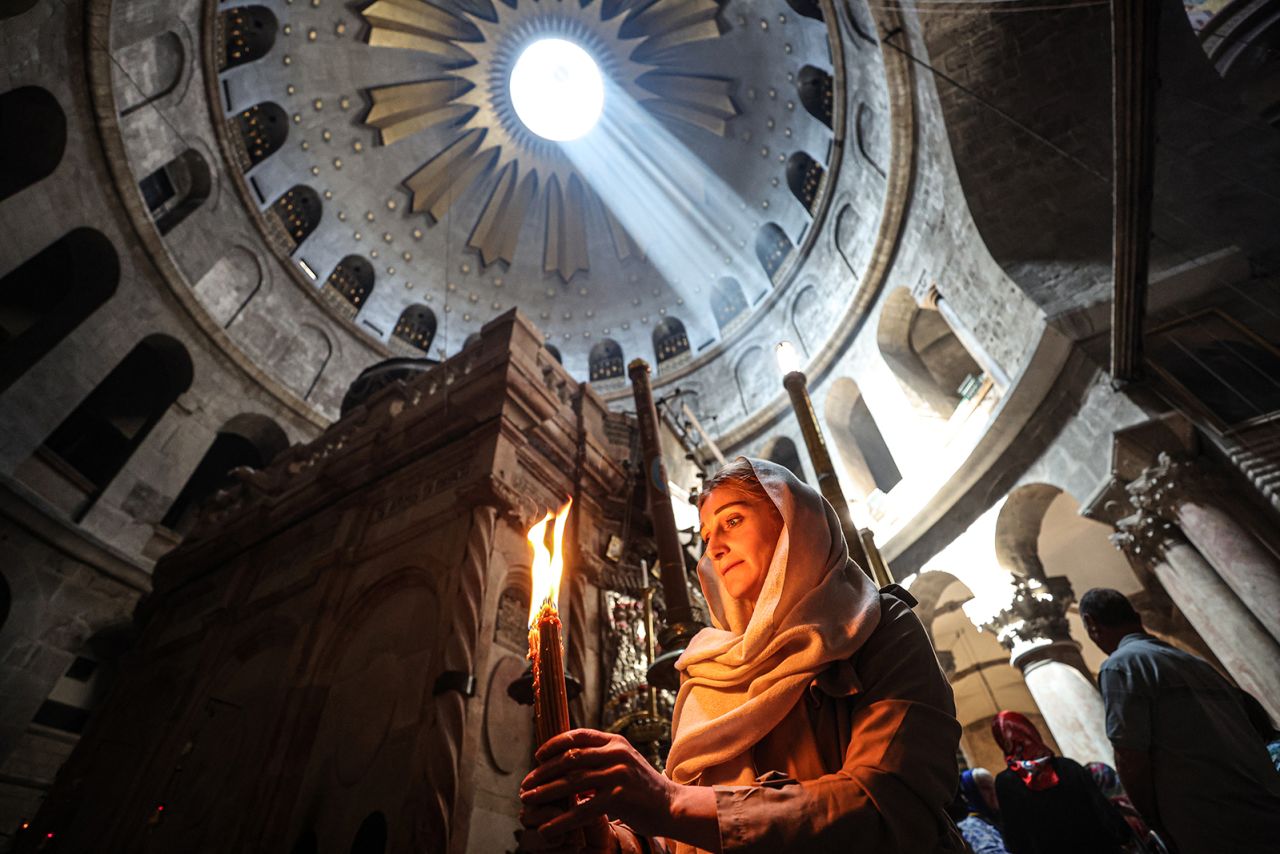
Christians mourn Pope Francis at the Church of the Holy Sepulchre following his death, in Jerusalem, Israel, on Monday.
Palestinians from Jerusalem, Bethlehem, and Gaza are mourning Pope Francis’ death, saying they’ve “lost a man of peace” who was “supportive of the Palestinian people.”
In Gaza, worshippers commemorated the pope at the Holy Family Church.
Francis, who had long criticized Israel’s war in Gaza, called for a ceasefire in the enclave. Throughout the war, he made nightly calls to Father Gabriele Romanelli, parish priest of the church in Gaza, where Christians and Muslims have often sought refuge from Israeli bombardment. The last call between the two was held on Saturday, Romanelli said.
Across Gaza, Christian and Muslim Palestinians mourned the pope.
In Bethlehem in the occupied West Bank, mayor Anton Salman said the loss is both to the “Catholic Church and to humanity.” The Pope used to “encourage [the people of Gaza] to stay and remain steadfast until this dark cloud clears from Palestinian skies.”
In Jerusalem, pilgrims and worshippers have been celebrating Easter at the Church of the Holy Sepulchre — believed to be the site of Jesus Christ’s tomb, from which he was resurrected.
Pope’s death delays canonization of world’s first millennial saint
From CNN’s Hilary WhitemanPope Francis had been expected to canonize the world’s first millennial saint at a service next Sunday attended by tens of thousands of teenagers from around the world. The event has since been postponed.
Born in London to Italian parents in 1991, Carlo Acutis was just 15 years old when he died of leukemia in 2006. He was beatified in Assisi, Italy, last year, where his body lies entombed in a transparent casket, covered by a wax mold of his likeness, wearing a track top, jeans and trainers, according to Reuters.
His mother Antonia Salzano Acutis told the news agency that her son showed an early interest in the church, but in many ways, he was just like an ordinary teen.
Becoming a saint requires the recognition of two miracles. Prayers to Acutis are credited with healing a 4-year-old Brazilian boy who suffered from a pancreatic illness, and a 21-year-old Costa Rican woman who was almost killed in a bicycle accident.
Acutis was known for his devotion to miracles and apparitions of the Virgin Mary and created a website to document them, according to Vatican News. His life was the subject of a documentary released earlier this month that depicts him as an ordinary sneaker-wearing teenager with a talent for web design.
Here’s how the millennia-old process of picking a new pontiff will unfold
From CNN’s Aditi Sangal, Rob Picheta and Christopher Lamb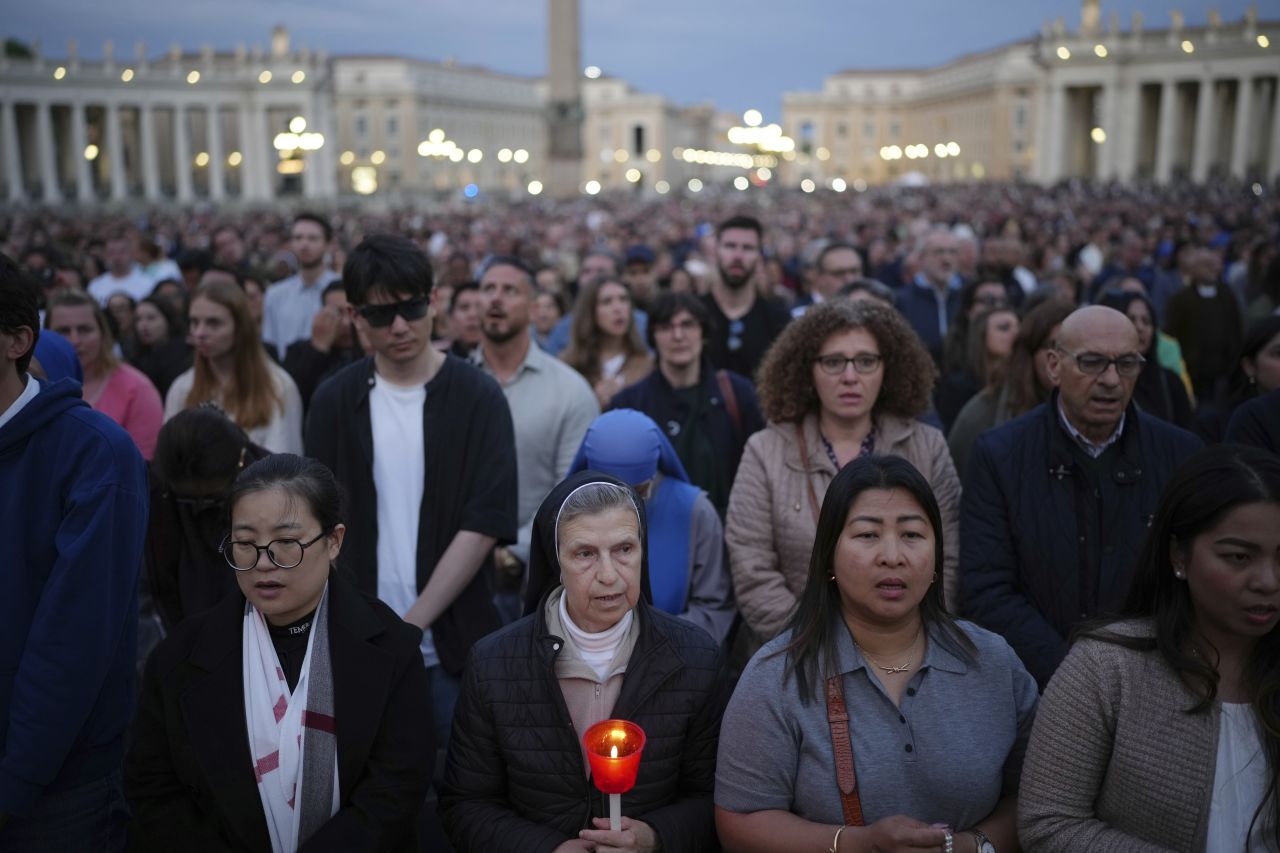
Faithful gather for a rosary prayer for the late Pope Francis, in St. Peter’s Square on Monday.
Pope Francis’ death has triggered the start of a millennia-old process of picking a new pontiff.
The mourning period: The pope’s passing marked the start of the “Papal Interregnum” — the period between the death of one pope and the election of another. The day of the pope’s death includes nine days of mourning known as the Novendiales, and the pope must be buried between the fourth and sixth day. Cardinals must now decide exactly when the funeral can take place. Until then, the pope will lie in state in a coffin.
The burial: Francis declared his wish to be buried in a simple tomb in the ground at Rome’s Basilica di Santa Maria Maggiore, a significant Catholic church and papal basilica. Seven past pontiffs are buried there, but he will be the first in over a century to choose this burial site, which is outside the Vatican. He had arranged for an unnamed benefactor to cover the expenses of his burial.
Picking a new pope: Cardinals from around the world must gather for the conclave to select Francis’ successor. The voting process is kept secret and typically takes between two and three weeks, though it can stretch slightly beyond that if cardinals struggle to agree on a candidate.
The interim: Cardinal Kevin Farrell, who holds the position of “camerlengo” or chamberlain, has become acting head of the Vatican. Farrell was also the cardinal who sealed the Papal Apartment of the Apostolic Palace, the traditional residence of the pope, to mark the beginning of the mourning period. The apartment was not used by Francis, who lived in Casa Santa Marta, and that apartment was also sealed. The closure of the pope’s residences is a symbolic gesture that historically served to prevent looting and symbolizes the formal end of the Francis pontificate.