
Legacy media's destructive addiction to describing Trump's 'winning'
One of the worst habits of the mainstream media is seeing politics and government as a game. Or maybe a horserace, but definitely something with clear winners and losers.
If you start paying attention, you see it everywhere, and it may push you over the edge, given the precarious state of the nation and world right now.
A few examples among a great many:
When the Supreme Court last year decided the president had widespread immunity from criminal persecution — one of the worst body blows our democracy has taken in recent history — was that really a win? NBC News saw it that way: Supreme Court gives win to Trump, ruling he has immunity for some acts in election interference indictment.
When Trump’s “big, beautiful bill” passed in July, benefitting the wealthy and throwing millions off their health care, was that really a win? CNN wanted you to think so: Trump lands first major legislative win, after Congress passes his massive domestic policy bill.
When a court tossed out a huge penalty against Trump for committing fraud, despite his conviction, was that really a win? Reuters thought so: In huge win for Trump, court throws out half-billion fraud penalty.
When the Supreme Court ruled that racial profiling by ICE was A-OK, was that really a win? Newsweek thought so: “Supreme Court Hands Donald Trump New Win.”
When Trump enacted a bunch of tariffs and pissed off friends and allies around the world, the New York Times saw it this way: “Trump is Winning His Trade War. What Does That Mean for the Economy?” (The American public is not actually happy with Trump’s economic moves, according to most polls.)
When Trump threatened to send the Army into U.S. cities and invaded Washington, D.C. streets with the National Guard, the AP headline told the story from his point of view: “Trump embraces tough on crime mantra amid DC takeover as he and Democrats claim political wins.” Here, note the seeming acceptance of “tough on crime” as a rationale.
Why does this happen so often? I see a few reasons. One is what I’ll call “headline-ese” — the shorthand language that comes from print journalism’s long history of dealing with a limited word count. You’ll notice that “win” is a nice, short word, however reductive and misleading.
A second is, as mentioned above, the media’s knee-jerk reduction of everything into a zero-sum game of winners and losers. During campaigns, this results in the “neck-and-neck as they approach the finish line” coverage and the over-reliance on undependable polls.
And the third, I’m sorry to say, is a brutal combination: laziness, combined with a failure of mission. To get across the nuance of who is actually affected by these “wins,” you’d have to be coming at news coverage from a different point of view.
Let’s just say that your newsroom’s clear and well communicated aim was to constantly have the public’s interest as your top priority. Let’s say that you cared about poor and middle-class people — vulnerable people — as much or more than the rich and powerful.
You could never then write a headline that portrayed the ability to racially profile people and throw them into vans without due process as a win for anybody. You might see some headlines about losses, though — like a loss for democracy, or a loss for low-income people. You might even see a “win for democracy” headline if voting rights, for example, were upheld.
But the public interest is not what many mainstream media outlets are focused on. They are focused on not looking biased; they are focused on taking things down the supposed middle; they are focused on performative fairness to Trump and to MAGA — even while this president and his allies are trying to destroy what journalists do. The scope of that effort is mind-boggling. The New York Times described Trump’s all-out campaign against the press and media organizations in the story that led their print front page on Friday. (Gift link in my last sentence.)
Separately, here’s a fascinating story in Semafor that you may not have seen, but probably will ring true: ‘Look at the charts’: Democrats desert legacy media for new outlets. The story begins: “Establishment media corporations’ capitulation to the Trump administration has alienated Democrats — and opened the door for a new crop of independent partisan outlets hoping to capitalize on left-of-center audiences’ discontent.”
One outlet that has benefited, the story notes, is The Bulwark, which was begun by “never-Trump Republicans,” and now has 100,000 paid subscribers on Substack and 1.5 million on YouTube. It quotes founder Sarah Longwell, noting that audiences “feel deeply betrayed by a lot of the mainstream news organizations that they felt they could rely on when things started to go off the rails” during the first Trump administration.
Readers, are you among those who have decamped? Or have you merely branched out and hung on to the older sources? Please tell me your reasons and where you are now getting your news and commentary.
Here’s my Guardian US column about how ABC once again “obeyed in advance” by indefinitely suspending Jimmy Kimmel’s late-night show after his commentary about Charlie Kirk. (On Monday, after huge blowback from many quarters, Disney announced Kimmel would return today). I ask, in frustration, at the column’s end: “What good is the First Amendment when so many in power don’t seem to know it exists?”
Finally, many thanks to crack researcher Natalie Goldberg for help in hunting down “winning” headlines and, as always, to Abraham Kenmore who expertly produces these posts.
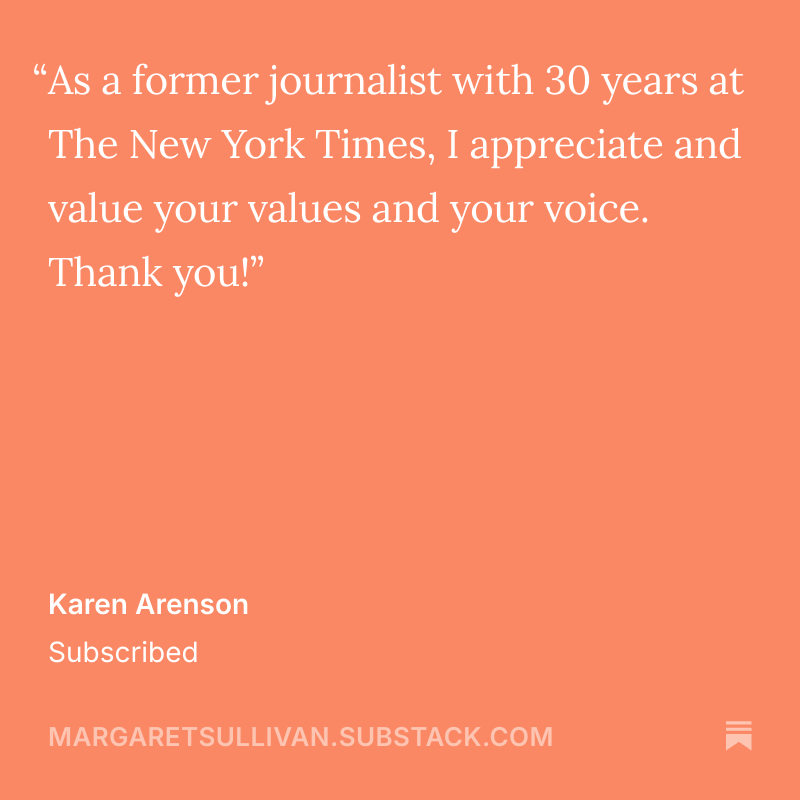
A warm welcome to all who have recently joined us here. Below the kind words from a new paid subscriber is some information about who I am and the mission of American Crisis.
My background: I am a Lackawanna, NY native who started my career as a summer intern at the Buffalo News, my hometown daily. After years as a reporter and editor, I was named the paper’s first woman editor in chief in 1999, and ran the 200-person newsroom for almost 13 years. Starting in 2012, I served as the first woman “public editor” of the New York Times — an internal media critic and reader representative — and later was the media columnist for the Washington Post. These days, I write here on Substack, as well as for the Guardian US, and teach an ethics course at Columbia Journalism School. I’ve also written two books and won a few awards, including three for defending First Amendment principles.
The purpose of ‘American Crisis’: My aim is to use this newsletter (it started as a podcast in 2023) to push for the kind of journalism we need for our democracy to function — journalism that is accurate, fair, mission-driven and public-spirited. That means that I point out the media’s flaws and failures when necessary.
What I ask of you: Last fall, I removed the paywall so that everyone could read and comment. I thought it was important in this dire moment and might be helpful. If you are able to subscribe at $50 a year or $8 a month, or upgrade your unpaid subscription, that will help to support this venture — and keep it going for all. Thank you!
x
Related Knowledge Center: Democracy and politics
News organizations are scrambling to find a coverage approach that adequately informs the American public about the country’s slide from democracy to authoritarian rule.
Related Knowledge Center: Information integrity
In an increasingly fractured media landscape, truth has been a casualty in the public discussion. Coverage has been warped by the business needs of struggling news organizations, and a significant segment of the public relies on bad-faith outlets that are little more than propagandists. While fact-checking has become routine, some organizations are exploring other ways to combat the trends. And misinformation spewed by AI-driven chatbots has become more of a feature than simply a bug.
Fact-checking and its detractors