
Lee pushes Korea-U.S. alliance through shipbuilding and nuclear power, but semiconductors remain uncertain
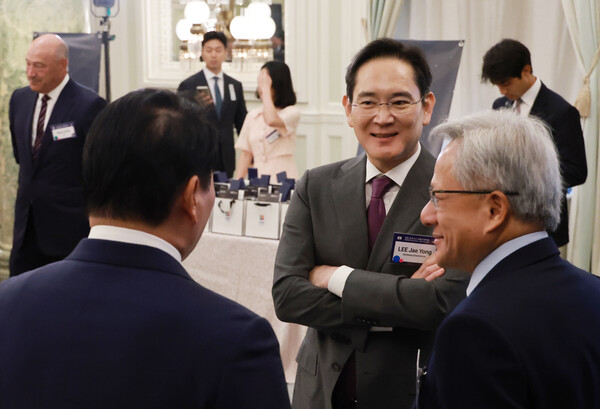
Samsung Electronics Chairman Lee Jae-yong strengthened Korea-U.S. cooperation in shipbuilding and nuclear power during the recent summit, reinforcing the role of Samsung Group in the strategic industries of both nations. However, concrete investment plans in the semiconductor sector, widely seen as the centerpiece of technological rivalry, remain elusive.
Samsung Heavy Industries signed a strategic partnership with U.S.-based Vigor Marine to participate in the maintenance, repair, and overhaul (MRO) of U.S. Navy support vessels. The agreement allows Samsung Heavy to expand its scope into naval MRO projects, with the potential for future joint construction with American shipyards. Unlike Hanwha Ocean or HD Hyundai, which build defense-specific vessels, Samsung Heavy is broadening its portfolio through this partnership.
Meanwhile, Samsung C&T signed a cooperation MOU with Korea Hydro & Nuclear Power and U.S. energy company Fermi America to jointly advance the AI Campus Project in Amarillo, Texas. This large-scale initiative includes the construction of four nuclear power plants, two small modular reactors (SMRs), combined cycle power plants, solar power, and ESS facilities, supporting a hyperscale AI data center.
Despite these significant steps, the semiconductor sector yielded no new announcements. Market watchers had anticipated fresh investment plans in Samsung’s Taylor, Texas foundry, expected to reach 54 trillion KRW by 2030, alongside supply deals with Tesla and Apple. Hopes also surrounded Samsung’s high-bandwidth memory (HBM) cooperation with Nvidia, but no official details were disclosed.
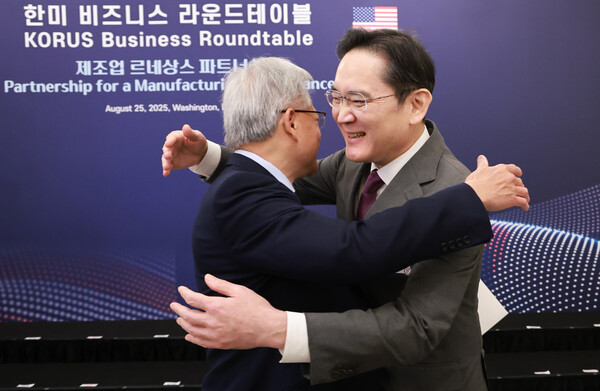
Symbolically, Chairman Lee was seen warmly embracing Nvidia CEO Jensen Huang during the Korea-U.S. Business Roundtable, underscoring their shared interest in AI collaboration. Still, uncertainties persist. U.S. President Donald Trump has warned of a 100% tariff on semiconductor products while offering exemptions for companies that establish U.S.-based plants. His administration also converted Intel’s subsidy into an equity stake, raising speculation about similar moves targeting Samsung and TSMC.
Although the summit reaffirmed earlier tariff negotiations, no new agreements on semiconductor tariffs or equity participation were disclosed. Korean firms such as Samsung and SK hynix are expected to continue expanding U.S. investments while cautiously navigating risks.
Kim Yong-bum, Policy Director at the Presidential Office, emphasized: “There was discussion on supplying optimized semiconductors for Nvidia’s supercomputers by SK and Samsung, reaffirming the possibility of bilateral cooperation in AI industries.”
While Samsung Group secured visible results in shipbuilding and nuclear cooperation, the path forward for semiconductors—the core of the tech rivalry—remains a key challenge.