
Kleptocracy Inc
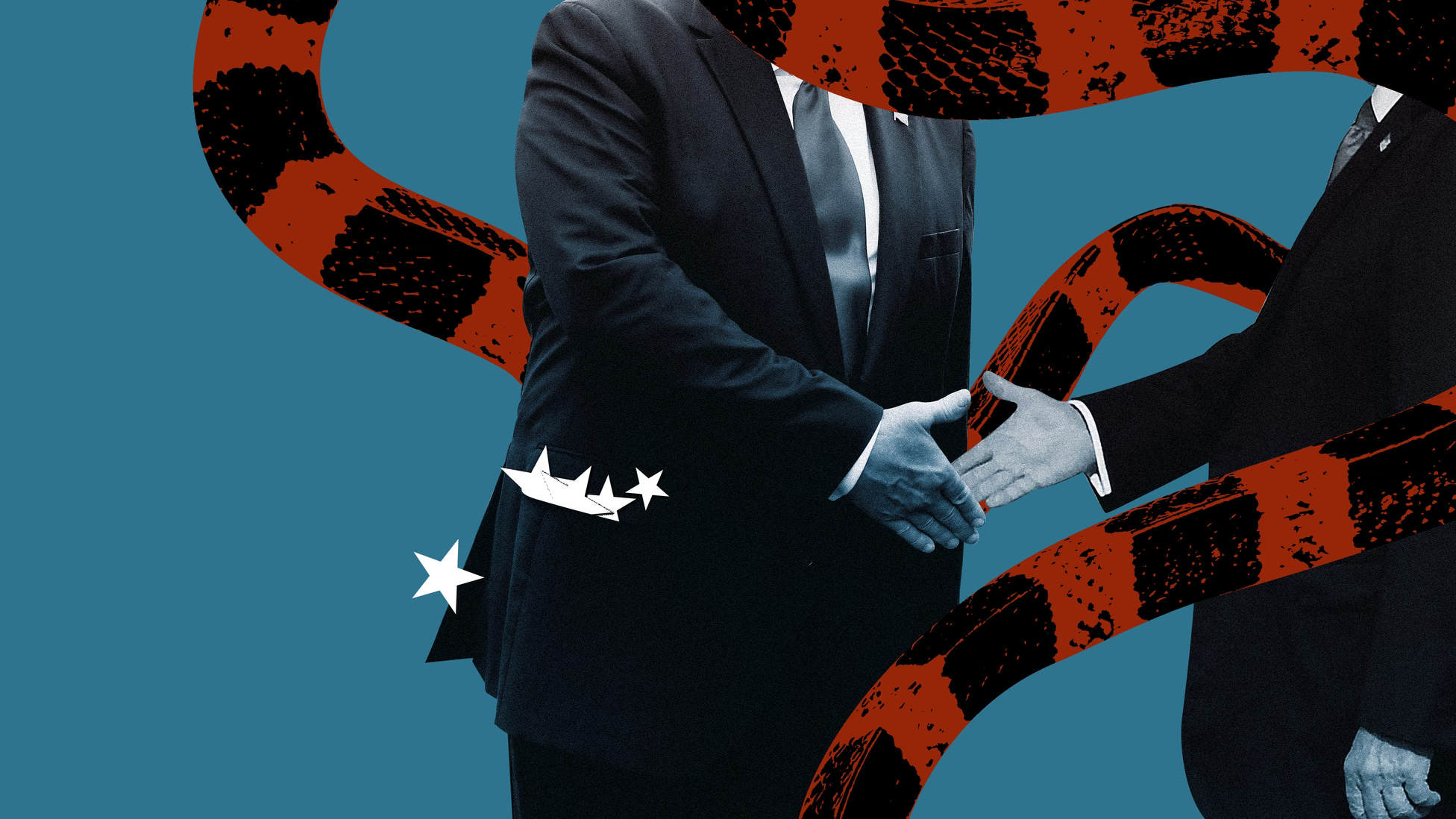
For just over a year now, starting last April, I’ve published regular editions of my Kleptocracy Tracker. Most weeks, this list contains examples of the president’s conflicts of interest (at least those that have been uncovered by the media) as well as those of his cabinet and associates. I have also listed policy changes that weaken enforcement of existing laws on corruption (an example here). I have had a particular focus on potential violations of the emoluments clauses of the US constitution, which explicitly prevent the president and other federal officials from accepting gifts from national and foreign leaders: “any present, Emolument, Office, or Title, of any kind whatever, from any King, Prince, or foreign State.”
You can see the content of the Tracker on this SNF Agora Institute chart. Or you can find all of the editions in my past Substacks. But from time to time I will also take stock of the broader impact. For although the US is not a full-blown kleptocracy — a state whose primary purpose is to enrich its rulers — we are heading in that direction.
Of course, there have been conflicts of interest in Washington before. But eighteen months after Trump’s second election, it’s clear that we are now living in a completely different world. The amount of money involved is in the billions of dollars. The impact on US foreign policy, and on domestic regulatory decisions, is far-reaching and perhaps irreversible. Also, some of the patterns are new. Here are a few:
The presidential family. No previous presidential family has actively done business with foreign leaders who have significant stakes in US foreign policy. In the past, relatives of the president have indeed traded on their proximity to the president. But now, the president’s son-in-law is both a business partner of the Saudi government and one of the two main Middle East negotiators. The president’s sons also deal directly with companies whose owners have deep security and military relationships with the US government, and a clear interest in influencing American decisions. There are domestic examples too: after Donald Trump Jr.’s venture capital firm invested in an American rare earth mining company—then valued at $200 million—the Trump administration took a $50 million stake in the firm, helping raise its valuation to $2 billion.
The use of cryptocurrency. The New Yorker had an excellent account last January of how foreign people and governments — Emirati, Pakistani, Chinese, Canadian — have enriched Trump and his family through their crypto company, World Liberty Financial. In many cases, these investors were simultaneously looking for favors or otherwise interested in decisions made by the US government. Some of the investments don’t look like real investments, and it’s not clear they could ever be profitable, or whether they were even meant to be profitable.
The scale of pardons. There has long been a whiff of impropriety around presidential pardons, which have in the past been given in exchange for what appear to be favors. But the Trump administration is simply issuing them in greater numbers, and to people who have committed more serious crimes, than ever before. Some have been issued following major donations to MAGA candidates or Trump’s own campaign funds.
The dismantling of enforcement. In any previous presidency, these kinds of conflicts of interest would have triggered Department of Justice or FBI investigations. But professionals have been fired or stymied at those organizations. Instead, the president has hired sycophants and loyalists, who are unlikely to investigate him, or his family, or the foreign and domestic actors who are buying into their companies. That’s why this continues: there is no one to stop it.
Taken together, the potential impact of these changes is dramatic. All around the world, and all across America too, anyone with an interest in any US government decision has just one question: who do I pay.
So far, the political impact is muted. The scale and nature of this change doesn’t seem to be broadly understood. Congressional investigations are hampered by the Republican majority. Although some Democratic politicians do talk about oligarchy and kleptocracy, nobody has yet followed Alexei Navalny or Péter Magyar in creating a major campaign linking high-level corruption with falling middle class living standards. In Hungary, this was one of the arguments that finally defeated Prime Minister Viktor Orbán. Indeed, Hungarian businessmen with links to Orbán’s government are reportedly now leaving the country, or else sending their money abroad. Magyar, who hasn’t taken office yet, has alleged that “Orbán-linked oligarchs are transferring tens of billions of forints to the United Arab Emirates, the United States, Uruguay and other distant countries,” and has promised to use his office to stop them.
In the US, oligarchs are still accumulating their wealth with impunity. More to the point, nobody is yet trying very hard to stop them.
Before the election, I dedicated an episode of my Autocracy in America podcast to kleptocracy. It holds up quite well (and was accompanied by the great illustration at the top of this substack). Read the transcript here, or listen:
Kleptocracy Tracker
And here is this week’s edition!
(Read my original article, Kleptocracy Inc and check out the SNF Agora Institute chart)
April 19
Syrian billionaire Mohamad Al-Khayyat used a proposal for a Trump golf course in Syria and Congressional campaign contributions to successfully lobby both the president and several members of Congress to repeal sanctions imposed on Syria during the Assad presidency.
April 20
Corporate beneficiaries of government contracts, including a subsidiary of ICE contractor GEO Group, have contributed millions of dollars to Trump’s super PAC, MAGA Inc., helping to raise a record $350 million ahead of November’s midterms.
April 21
Trump said he would “remember” companies that do not seek tariff refunds from the government after the Supreme Court ruled his use of the International Emergency Economic Powers Act illegal, implying that he would continue using executive power to punish companies that displease him.
April 22
Traders placed a series of bets worth $430 million on a drop in crude oil prices just 15 minutes before Trump said he would extend a ceasefire with Iran—the fourth such well-timed trade since the war began.
The Trump administration established a legal framework to keep hundreds of millions of dollars donated to fund construction of the White House ballroom anonymous, curtailing federal conflict-of-interest reviews.
April 24
Despite Trump’s public statements condemning prediction markets, Trump Media Group launched its own such platform last year, and Donald Trump Jr. has extensive ties to both Polymarket and Kalshi.
Paramount Skydance CEO David Ellison hosted a dinner for Trump and top members of his cabinet—including acting attorney general Todd Blanche—as he awaits Department of Justice approval for his firm’s $111 billion acquisition of Warner Brothers Discovery.
Health and Human Services Secretary Robert Kennedy Jr.’s son William is seeking to raise $100 million for a fund tied to his father’s Make America Healthy Again movement, in an attempt to capitalize on Kennedy’s cabinet position.
Trump pardoned Republican Las Vegas city councilwoman Michele Fiore of her fraud conviction for using funds she had raised for a statue honoring a slain Las Vegas police officer to pay for cosmetic surgery, rent, and her daughter’s wedding.
April 25
Clark Construction, the firm building the White House ballroom, received a no-bid contract from the Trump administration last January to repair two ornamental fountains in Lafayette Park. The National Park Service subsequently increased the contract’s value several times, ultimately reaching $17.4 million.
Trump hosted a second dinner—this time at Mar-a-Lago—for the top 297 investors in his memecoin $TRUMP, with a follow-on reception for the top 29 investors.
April 28
Less than a month after the Trump administration announced criminal charges and sanctions against a transnational crime syndicate it accused of stealing billions of dollars from Americans, World Liberty Financial announced a partnership with a digital currency firm whose leaders had been sanctioned in that same crackdown.
April 29
After a decade of avoiding Trump venues, the PGA Tour will be held at Trump National Doral in Miami from April 30 to May 3, where a golden statue of the president — sponsored by cryptocurrency group Patriot Token — will preside over the Cadillac Championship.
An analysis by Popular Information revealed that Trump has promoted his businesses at least 110 times since the beginning of his second term through Truth Social posts, public remarks, and event locations.
Amazon is considering launching a reboot of The Apprentice, this time with Donald Trump Jr. as host.
April 30
An analysis by the non-profit advocacy group the Anti-Corruption Data Collective found that half of all longshot bets—defined as wagers of $2,500 or more at odds of 35% or less—on military or defense actions placed on prediction markets such as Polymarket and Kalshi are successful, suggesting many users are trading on privileged classified information.
A shell company backed by Eric and Donald Trump Jr. merged with a critical minerals group that received up to $1.6 billion from the US government last year to mine tungsten in Kazakhstan.
A drone firm also backed by the brothers—Powerus—landed its first US government contract for an undisclosed number of interceptor drones for the US Air Force.
The Mazovian Museum of Rural Life
pictures taken at Muzeum Wsi Mazowieckiej in Sierpc, on a lovely spring day
Open Letters, from Anne Applebaum is a reader-supported publication. To receive new posts and support my work, consider becoming a free or paid subscriber.