
The kids are alright: Hong Kong AI scientist offers a vision for ‘parenting’ AI
For years, the story of artificial intelligence (AI) has been cast as a high-stakes contest between the US and China – a technological arms race with global consequences. But to De Kai, a pioneering machine learning scientist and advocate for AI ethics, this framing fundamentally misunderstands the technology.
“I would prefer to think about it as the AI climate change challenge,” De Kai said in an interview with the Post at the Hong Kong University of Science and Technology, where he is a professor of computer science and engineering. “Literally, AI is a change to the [social] climate that humanity is competing in.”
De Kai, whose surname is Wu but who professionally goes by only his given name, has spent four decades at the forefront of AI research, going back to his work in natural language processing during his PhD at the University of California, Berkeley, in the early 1980s. His new book, Raising AI: An Essential Guide to Parenting Our Future, released on June 3, argues that living with AI requires a paradigm shift – one in which people “parent” these systems as if they were their children.
“What’s the single thing in folks’ lives that makes them most want to become better versions of themselves?” De Kai writes. “Having kids, most grown folks say.”
Since AI is learning by absorbing everything we do and say online, we need to be conscientious about who we are around our AI “children”, the argument goes.
This is not a new concern for De Kai, who has served on the board of The Future Society and was an inaugural member of Google’s short-lived AI ethics council.
In a 2019 interview with the Post, he warned of many of the same dangers he sees today: AI’s potential to manipulate, deepen social divides, and empower bad actors with weapons of mass destruction such as bioweapons. But now he is promoting a framework for building a more “mindful” AI – systems capable of reflecting on their own thinking.
Addressing current efforts to solve the so-called alignment problem – adjusting AI’s interests to reflect those of humanity – De Kai asked, “Alignment to what?”
As with children, De Kai argues, there will be many different types of AI instilled with different values. There will be people who are bad parents to their AI, he concedes, but that makes good parenting all the more important.
As AI systems grow more capable, they will eventually prove too clever to be governed by hard rules like science fiction author Isaac Asimov’s famous Three Laws of Robotics. There are always loopholes and contradictions, so we must be good role models to counteract poor impulses, he said.
De Kai likens today’s generative AI to “System 1” thinking – fast, impulsive and emotional. He predicts that these models will soon merge with more methodical, logic-driven “System 2” systems.
For now, he says, we have been “extraordinarily negligent” when it comes to setting a good example for AI. Better parenting, in his view, means greater involvement: establishing something akin to parent-teacher associations for AI, and holding tech companies accountable for how their systems are trained.
Given that societies hold different values, he argues, AI must be trained on “metavalues” – values about values. He uses the Golden Rule as an example, noting that some form of the principle to treat others as you want them to treat you can be found across cultures, although its application varies.
02:01
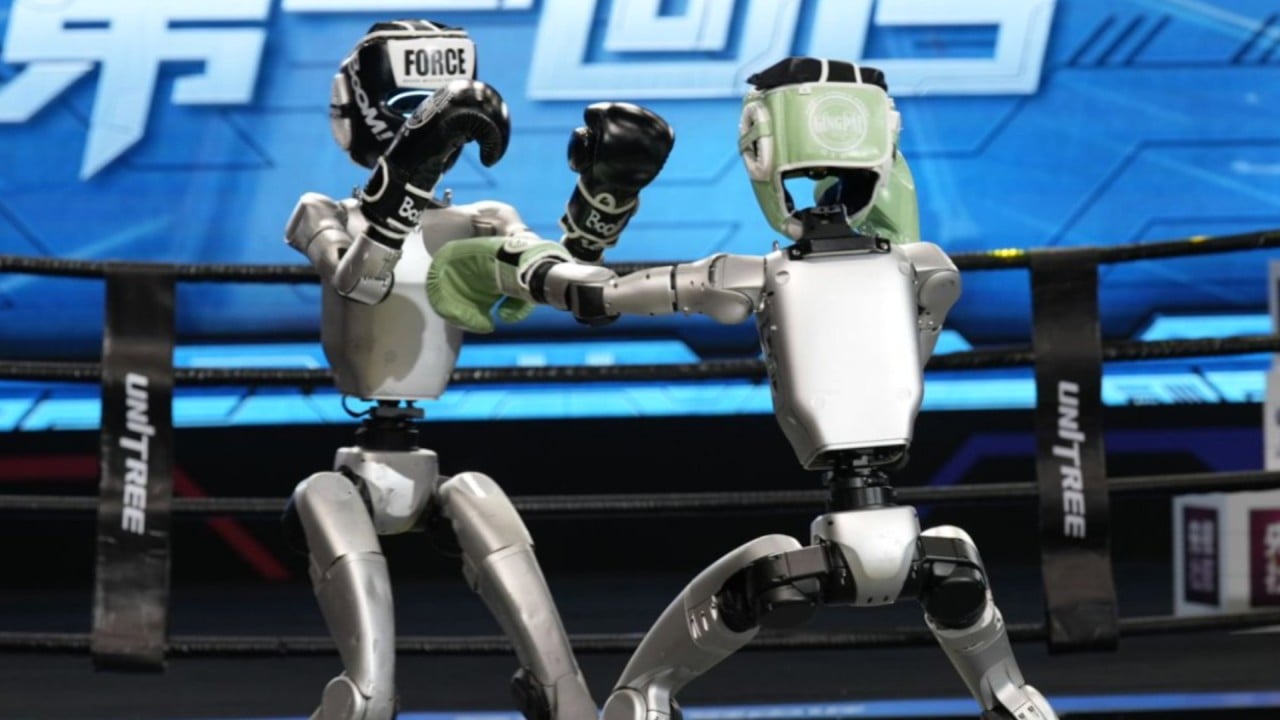
China’s humanoid robots test skills in unique kickboxing competition
China’s humanoid robots test skills in unique kickboxing competition
Yet De Kai does not shy away from making some value judgments. “We need to raise AIs to value diversity, creativity, respect, inclusion, and open-mindedness,” he writes. They should also be “schooled in the Enlightenment principles” with respect for “objectively observed, statistically sound, logically consistent, fully informed conscious reasoning” – meaning AI must have a “scientific method mindset”.
But even humans are still divided on these ideals. The administration of US President Donald Trump, for example, has targeted programmes seen as aligning with the values of “diversity, equity and inclusion”. Meanwhile, China considers political censorship to be the most judicious way of training its AI.
“A lot of those questions are based on an assumption that AI is going to remain static the way that ChatGPT and DeepSeek are, and that’s the form of AI, and it’s how they’re trained,” De Kai said. “That is, from a technical standpoint, incorrect.”
This is what makes taking a parental mindset so vital in De Kai’s view. “[AIs are] going to be dynamic just like humans are,” he said. “And they will keep on learning, be influenced by whoever they’re around and who they talk to online, just like we are.”
Raising AI reads as a treatise not on specific methods of training AI, but more on how to keep our current conversations going in the digital realm so that AI can grapple with differing opinions just as humans must.
To fail in this endeavour could mean winding up with “psychopaths incapable of cognitive empathy”, as he writes.
“The last thing we can afford to be raising with the massive reach of technology in our era is artificial sociopaths, artificial psychopaths.”