
It's a Shame, but Sure, Kill the Ump
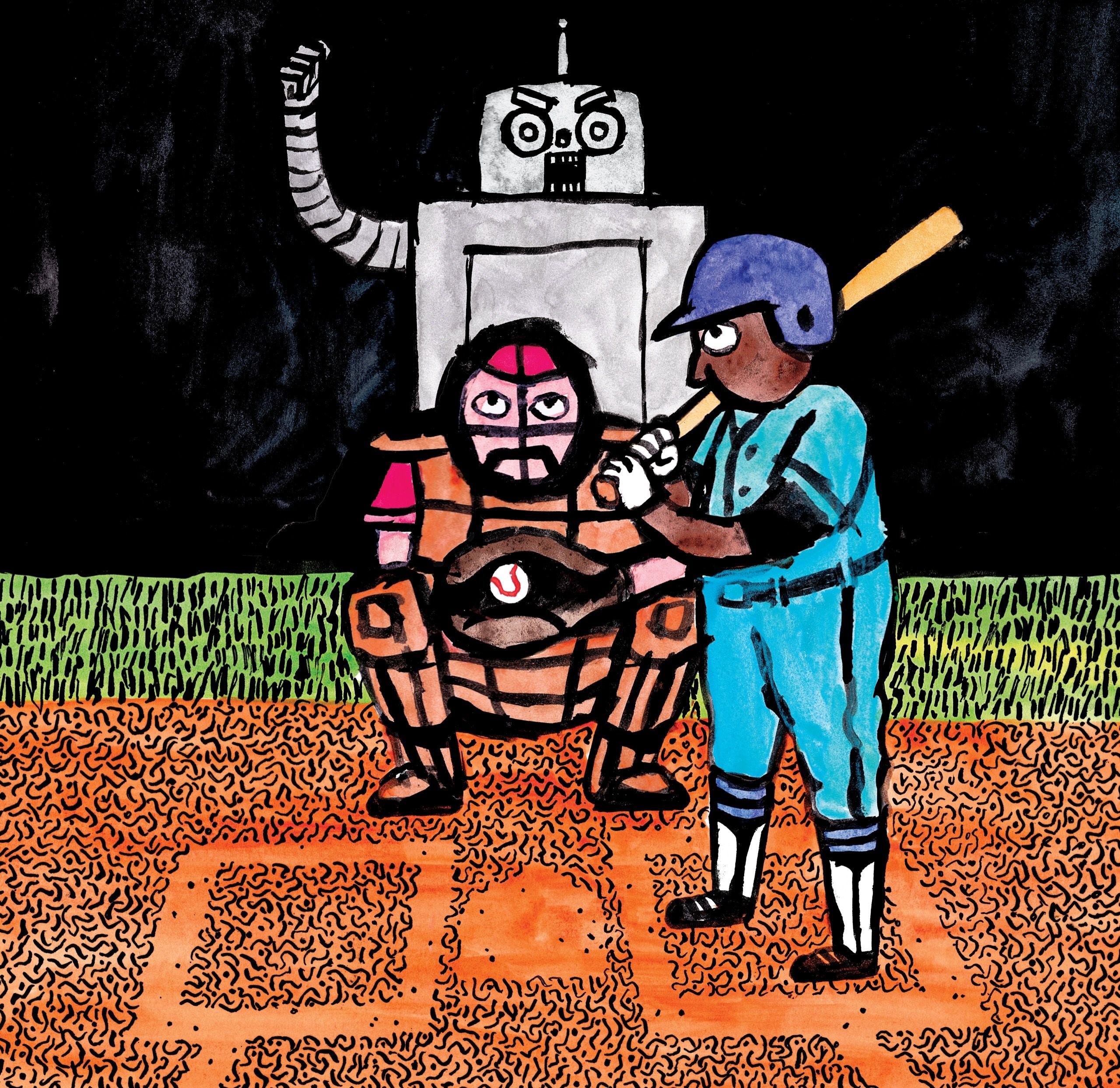
Tonight the new baseball season begins, and with it, a controversial experiment. For the first time in the major leagues, players will be allowed to question the home-plate umpire’s ball-strike calls, and the arbiter will be a robot.
I have considered this seriously. I have weighed all the arguments, pro and con — and each has merit. I have finally taken a position. I’m for the new system because I love the United States and detest Donald Trump.
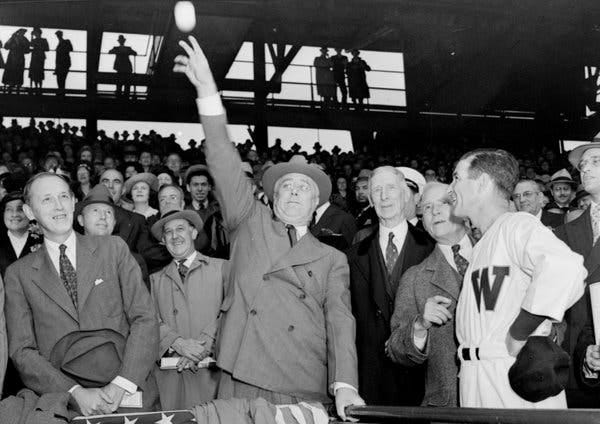
The experiment is controversial because many ardent fans of baseball cherish the sport for its historic “human element” — the fact that it depends, for better or worse, on human beings making sometimes flawed human decisions. It has been this way since the age of Abner Doubleday, who is credited with inventing the game, but sportswriter and sports historians got that wrong; hey, we’re only human, right?
The whole thing is corny and wonderful. It fueled generations of “Whaddaya blind, ump?” corny camaraderie among fans in the cheap seats. It even gave us one of the most thrilling moments in all of baseball history — a moment I am connected to, directly, as you will see. And now it is just …. thrown out, but unceremoniously — unlike the first pitch of a season. I will mourn it.
But.
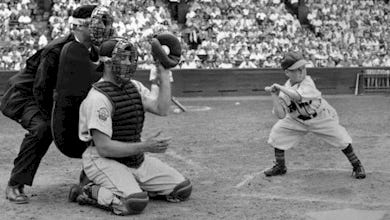
The aim of the new system is improved accuracy; quibblers are wondering whether it will even be more accurate than humans behind the plate. The answer is, yes. It will be more accurate exponentially. Quibblers say it will overly rely on a player’s measured height to gauge his vertical strike zone — the midpoint between the top of the batter’s shoulders and the top of their uniform pants, down to the hollow beneath the kneecap — but ignore his “stance.” A player who bats from a crouch has generally been gauged to have a smaller strike zone; this is, and has always been, as ridiculously and manipulatable as when St. Louis Browns owner Bill Veeck send Eddie Gaedel a 3-foot-7-inch midget, to bat. He wore the uniform number 1/8, and drew a four-pitch walk.
Quibblers say it will minimize the importance of a catcher’s “framing” skills. “Framings” skills are a frame-up, a fraud. Catchers are rated on their ability to “frame” pitches — catch them in such a way (with a blur of the wrist and a twist of the glove) that the umpire can be deceived as to where the pitch actually arrived at the plate. Lying, in other words. Some catchers are paid a lot more money that other catchers because of their ability to lie. Eff that, buddy.
As you know, I don’t like AI. Robots replacing humans at uniquely human enterprises. But that’s not what this is about. This is about the times we live in, with a congenital liar in the White House, surrounded by accommodating accomplices. Truth has become an elastic commodity, something that can be stretched until it is unrecognizable, or ignored outright. It goes unpunished, forgiven.
Yes, he was tempted and he fell,
But judge him not too hard,
I does take character to sell
Elastic, by the yard.
— Piet Hein
Today it is being reported that people appear to have made millions of dollars by anonymously betting on oil prices, bets recorded 15 minutes before Donald Trump lyingly announced that a settlement with Iran was just around the corner. This is not just insider trading, it is treason.
Lying and cheating and stealing is the name of the game in the United States today and here’s a small chance — a small, symbolic chance — to address it. Bring on the robots.
What we will miss should be mourned, though. It has given us some great moments.
On October 8, 1951, my father had somehow obtained two free tickets to Yankee Stadium, to watch game five of the World Series between the Yankees and their damned crosstown rivals, the Brooklyn Dodgers. Don Larsen, a noodle-armed nebbish, was pitching for the Yanks.
My father loved baseball, and the Yankees. So did his father, my grandpa, who had taken my dad to the stadium many times to see Babe Ruth and Lou Gehrig play. On that day in 1951, who would my father take to the game? His father was apparently unavailable. My mother and older brother didn’t care about baseball. But what about … me?
Me was an idiot. I had just celebrated my fifth birthday a week before. I barely knew what baseball was. Still, my dad asked me if I wanted to go. I said no. My ma and brother were going to see Snow White at the movies, instead. I went with them.
This remains one of the great regrets of my life. It’s right up there with missing out on a very early Elvis Costello concert in Chicago in 1977, in a coffehouse as small as a big living room, because I didn’t know who he was and thought his name sounded stupid.
On October 8, 1956, noodle-armed Don Larsen pitched what was, and what still remains 70 years later, the only perfect game in World Series history.
But that’s only part of the story. The other part involves the Ump.
The umpire behind the plate that day was a former player named Babe Pinelli. It was the last time he would ever umpire behind home. Pinelli, well respected by his peers and by players, would retire three days later. He was known to have uncommonly excellent judgment of balls and strikes.
With two outs in the bottom of the ninth inning, with the world breathlessly watching and listening, Larsen got a 1-2 count on the final batter, pinch hitter Dale Mitchell. Mitchell had a sharp batter’s eye. He almost never struck out.
Larsen came set, and threw the ball. Mitchell, a left-handed hitter, checked his swing. Babe Pinelli called strike three.
The stadium went nuts. The world went nuts. Pipsqueak, pint-sized catcher Yogi Berra famously leaped into Larsen’s arms.
Everything was great. Historic. A memory for a lifetime. I kept my father’s ticket stub for 20 years until the day that my mother, an otherwise fine woman, accidentally threw it out.
Alas, that last pitch was not a strike. Not really close to a strike. It was about two and a half inches outside, and three inches high. The game was televised, and the kinescope remain indelible as a video. You can judge for yourself. That’s Vin Scully at the mike.
—
Later, virtually every player on the field said it was clearly a ball. George Will once infamously called it “a foot and a half” off the plate, which was a gross exaggeration, but argumentatively true. Experts in perception have vainly debated whether the “parallax” effect — an apparent shift in an object’s position when viewed from two different locations — might have distorted people’s judgment.
Don’t matter none. Back then, a call was a call and could not be challenged. Human error was part of the game. Pinelli was never openly criticized. The pitch was deemed “close enough.”
The Gene Pool will clear this up right now, for history. It was a ball, not a strike. And it was likely not even a human “error,” per se. Witnesses said Pinelli walked into the locker room after the game and burst into tears of joy. My God, how he had ended his career! Look what he had given the world!
But you’d have to be blind not to have seen it, Ump.
Or maybe just human. With a heart and a soul.
—
Under the new rules, a team will be only allowed only two unsuccessful challenges per game, which means there will still be disputed, unresolved calls. But mostly, the really big moments will be decided by a machine.
I am not saying good riddance to the old way. I am just saying goodbye. I’ll miss you. Just like Larsen missed the plate.
—
Today’s Gene Pool Gene Poll:
Today’s Mailbag has only one question.
Q: I thought this would be an intersting stack. I was wrong. It’s just a bunch of libatarians showing off their TDS.
A: I believe you mean “libetarians.” That would be the proper portmanteau of “liberal” and “libertarians.” Also, it is “interesting” not “intersting.” And welcome to the Gene Pool, Elmer. Thank you for your attention to this matter.
—
In honor of Elmer, I would like to hereby request that those of you with the means and motive, please take the opportunity to upgrade your subscriptions to “paid.” It is a mere $4.17 a month.