
It’s More Than Just a Little Routine Maintenance
The administration flouted a judge’s order and cut down more than 400 trees on the East Potomac Golf Course over the weekend. “I have no faith that the government is not going to cut them down unless there’s an order in place not to do so,” Federal District Judge Ana C. Reyes said during a hearing held on Zoom because of the federal holiday on Monday. “Now we’re all going to have a massive fire drill because the government can’t be trusted.”
Federal prosecutors have always understood that they could not afford to violate a judge’s trust. But now, behavior that does just that seems to have reached epidemic proportions. It started with the mass deportation case before Judge Boasberg, when the government sent Venezuelan migrants to CECOT prison in El Salvador without due process in early 2025. Contempt proceedings are currently under consideration by the en banc Court of Appeals. Then there’s the lawsuit Trump brought against the IRS—the slush fund case—where sanctions have been imposed after a judge concluded the proceeding was collusive, the Reflecting Pool case where DOJ moved to dismiss its own indictment, and a plethora of immigration and other cases where courts have expressed displeasure with the government’s candor, or lack of it.
Monday morning, it seemed to reach its height, at least to date. Judge Reyes had previously entered an order prohibiting the administration from making irreversible changes to the landscape, but permitting ongoing maintenance work. You know where this is heading—cutting down 400 trees is routine maintenance, according to the administration, and the Judge wasn’t happy about it. That’s an understatement. As one of my former DOJ colleagues put it, “I felt Reyes’s contempt all the way in Chattanooga, Tennessee.” She had ordered the administration to give her notice before beginning any major work or construction, which included the removal of 10 or more trees while the lawsuit is ongoing.
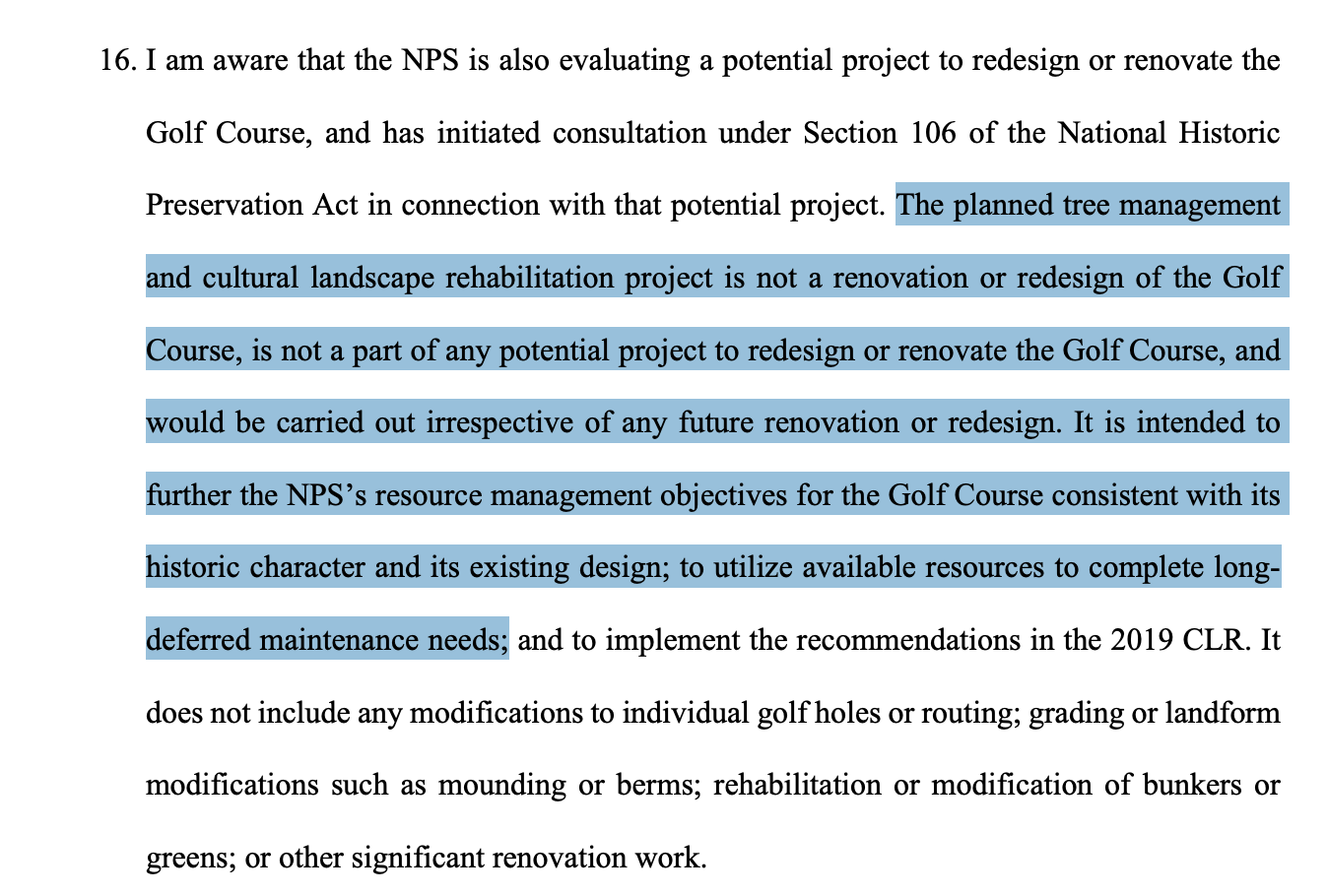
Friday night, after the long weekend had started, the Justice Department filed an eight-page declaration from Kevin Griess, the Superintendent of National Mall and Memorial Parks (NAMA). About five pages in, it finally got around to explaining that because the historical design of the course involved fewer trees than it does now, a “tree management and cultural landscape rehabilitation project” that “would implement” 2019 recommendations involving a “tree management plan through selective tree and woody vegetation removal” would take place. This, in the spirit of preserving the “historically open spatial character of the Golf Course.” Only one problem. Judge Reyes had already told them no.
This is the dodgy paragraph in the declaration where the government claims cutting down all of those trees is just routine maintenance. “The planned tree management and cultural landscape rehabilitation project is not a renovation or redesign of the Golf Course, is not a part of any potential project to redesign or renovate the Golf Course, and would be carried out irrespective of any future renovation or redesign,” Griess offered.
The Judge saw it like this: “I was hearing from everyone on plaintiff’s side that this was going to happen and I said ‘no’ repeatedly, ‘I trust the government.’ I trusted you all repeatedly to not do what you have done,” she said Monday after the plaintiffs filed the emergency motion that led her to hold the hearing despite the Columbus Day holiday. Judge Reyes wanted everyone in the chain of command on the decision to remove the trees present, but got only Griess, not his supervisors. This led her to summon his boss, Frank Lands, who testified over the phone, and order Interior’s Deputy Chief of Staff Greg Wischer and Jessica Bowron, the acting director of the National Park Service, to testify at another hearing next Monday.
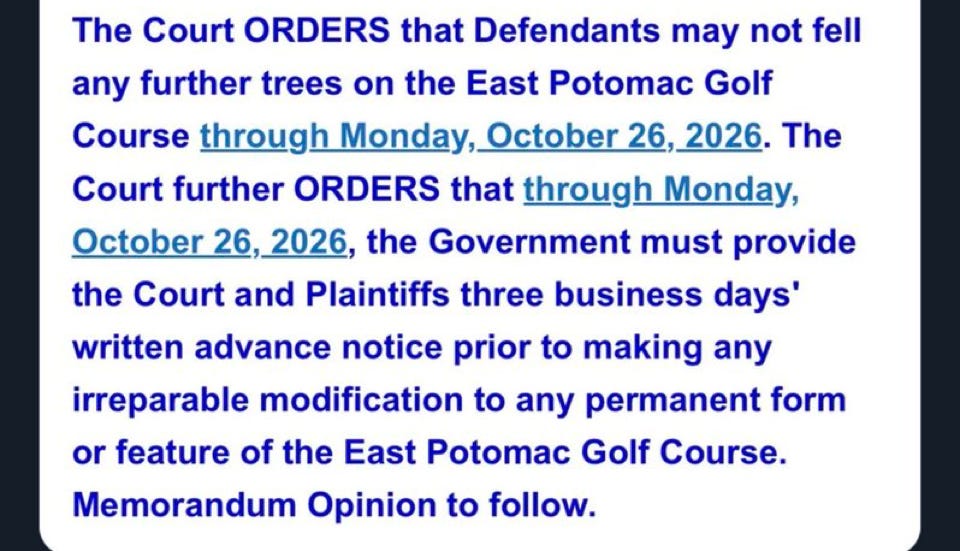
Tuesday, Judge Reyes entered a TRO that tells the government it “may not fell any further trees” on the golf course. Given the way this White House has trod on court orders, one wonders if they might not just cut the branches off and leave the trunk standing, and then maintain in court, with innocent looks on their faces, that the trees have not been felled.
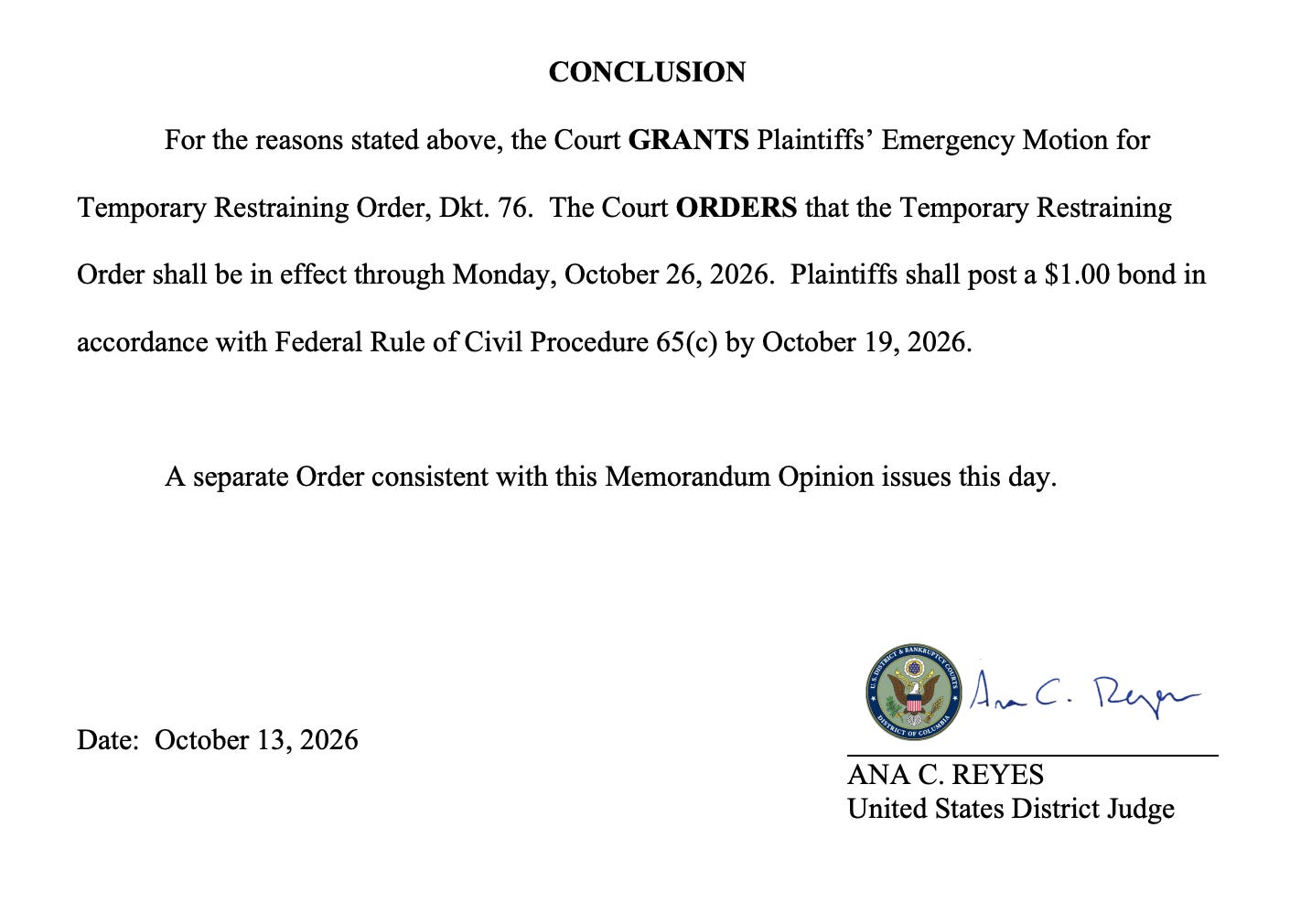
Tuesday night, just as I was about to hit send, Judge Reyes entered her written order. You should go read it after you finish tonight’s post. At 21 pages, it’s too long to quote in full. It starts like this, “In five days—from Monday, October 5, 2026, to Friday, October 9, 2026—the Department of the Interior ordered, considered, and approved a plan to remove hundreds of trees from the East Potomac Golf Course. Early the next morning, the National Park Service had bulldozers on site. By day’s end, it had removed about 430 healthy, non-invasive trees.” The government has lost her trust: “It is a coincidence, the Government seems to suggest, that DOI cut down hundreds of trees at the Course weeks after the President asked DOI to cut down trees at the Course, and not, say, any other time in the last seven years.”
The Judge goes on to note she trusted the government: “The Court opted instead to trust the Government to provide appropriate notice.” She writes that she “took the Government at its word” when it promised it wouldn’t cut down the trees without notice. “The Court has given the Government ‘the benefit of the doubt’ that it would not ‘act first and ask forgiveness later.’”
After establishing through testimony that there was no urgent reason to remove the trees, Judge Reyes writes that the government acted urgently, “internally, that is. There was no comparable rush when it came to providing Plaintiffs or the Court notice.” She concluded it was appropriate to enter a temporary restraining order until October 26, at which time she will presumably have heard more testimony, and will consider whether to enter a preliminary injunction that will remain in place while the litigation moves forward.
This is why federal prosecutors don’t violate a judge’s trust. It will impact them in this case; it will impact the Justice Department in the future. Judge Reyes goes to great lengths to detail the embarrassing experience of having trusted the government, only to have that trust abused. As we say in the South, fool me once, shame on you; fool me twice, shame on me. It’s unlikely Judge Reyes, and perhaps even others who become aware of this situation, will give the government the opportunity to fool them again. The presumption of regularity is lost.
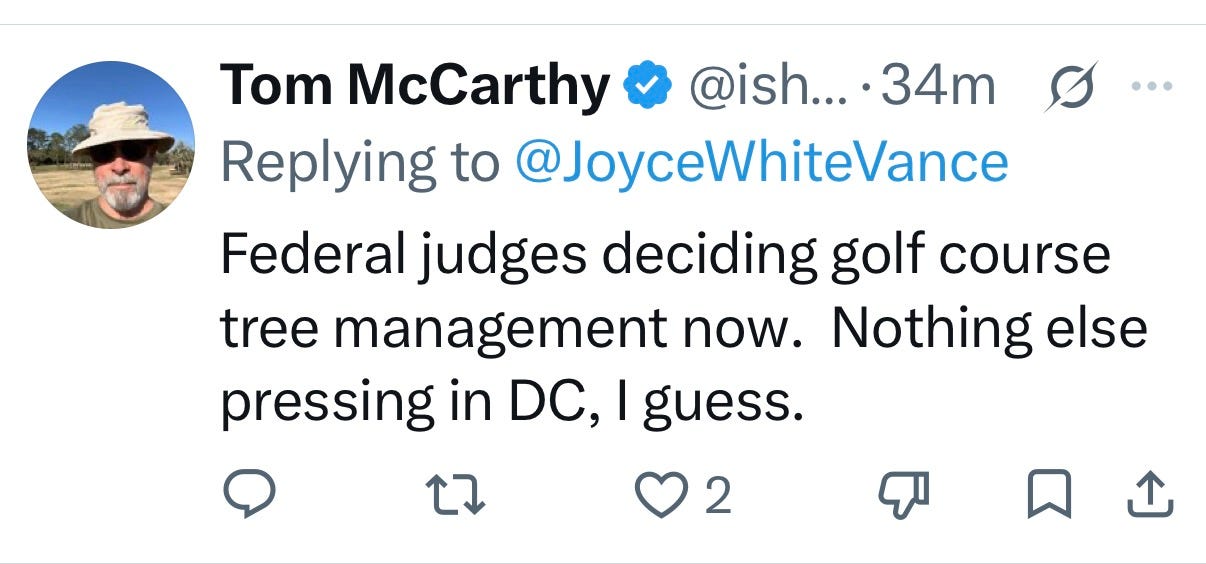
Of course, to MAGA, this is just another opportunity to belittle the federal judiciary. But it’s not about landscape design; it’s about following court orders, and there’s no longer any pretense that this administration does so.
Potomac Park is not the only place where the government flouted court orders this weekend. It also continued to air Trump’s political ads after another judge told the government to stop on Sunday after 7:00 p.m. ET. Judge Jennifer Rochon issued the temporary restraining order that should have brought the ads to an end. But as I wrote in The Week Ahead column that night, the ads still ran during 60 Minutes. And it turned out that wasn’t all.
The plaintiffs explained to the Judge just how bad it was: “Defendants’ ads ran in nearly 400 spots on programs that began airing at 7 p.m. Eastern last night—that is, after this Court’s order was in effect.” They continued on Monday: “as of 2:45 p.m. Eastern, ‘Maduro’ had aired in 20 spots, ‘Final Battle’ has aired in 11 spots, and ‘The Country He Loves’—which had not previously aired since October 6—has aired in one spot.’”
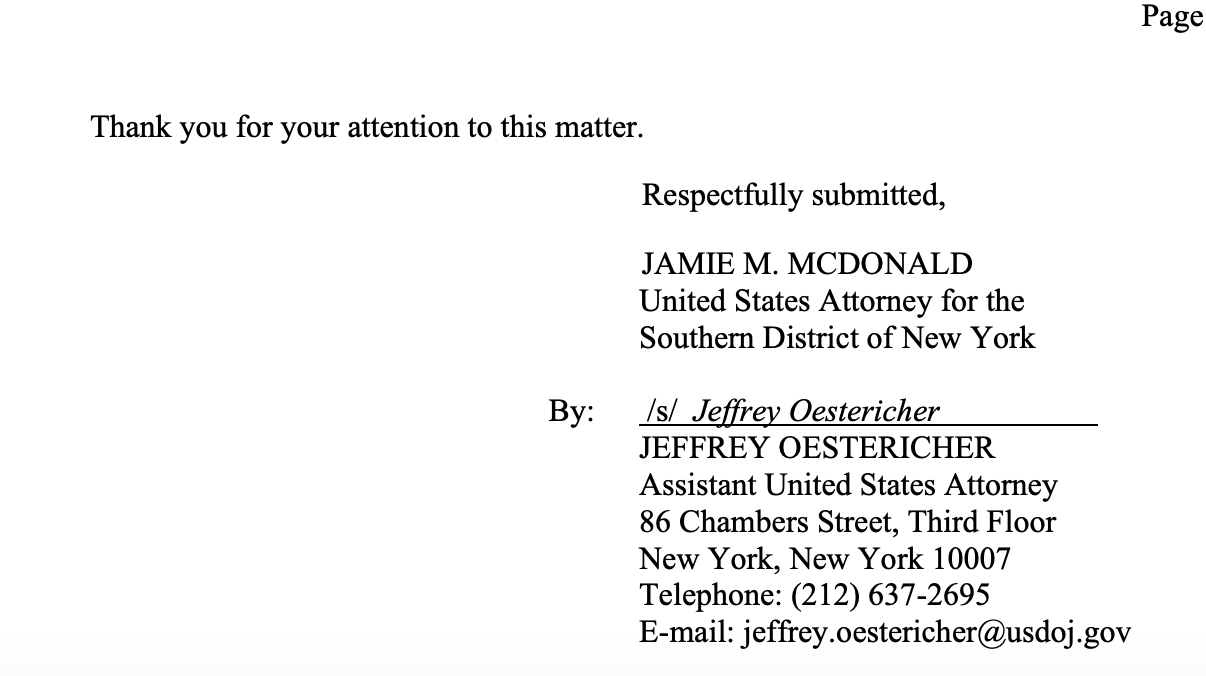
What did the government have to say for itself? This: The DHS lawyer missed an email. Oops. DOJ told the court that the judge emailed the restraining order to the parties at 6:46 p.m. Sunday, but DOJ lawyers failed to send it to DHS counsel until 7:58 p.m. Agency counsel, DOJ said, did not see the email until Monday morning. “The undersigned apologizes to the Court and the plaintiffs,” DOJ wrote. But the apology didn’t feel particularly sincere; in fact the letter closed like a Truth Social post from Donald Trump: “Thank you for your attention to this matter.”
Although the plaintiffs asked for a status conference to determine compliance, instead of immediately pursuing contempt, what happened is clearly unacceptable. Everyone involved on the government side knew what was happening. DOJ lawyers should have been prepared for the court’s ruling, should have had a plan in place for pulling the ads immediately if necessary, and should have transmitted the court’s order to DHS for immediate action. The DHS lawyer should have been checking email regularly. They should have given the DOJ lawyers a phone number where they were reachable 24/7 for precisely this eventuality. It’s not an unusual situation. Federal prosecutors and other government lawyers live like this. I can’t even begin to count the number of nights I slept with my cell phone on high beneath my pillow (sorry, Bob) or carried it with me over a holiday when we had something urgent going on. There should’ve been immediate communication between DOJ and its clients, and the ads should have stopped. Missed an email? The government might just as well have flipped a bird at the Judge.
The government seems to be dropping even the pretense that it respects the courts. The question is, what are the courts going to do about it? They don’t have armies to enforce their order, “just” the understanding we have always had in our democracy about the primacy of the rule of law. District judges now have to worry about not only whether the president will ignore their orders, but about whether the Supreme Court will back them or bend the knee to the president. But at some point they’ll have to rip off the Band-Aid and find out. And just maybe, as it did following January 6, the rule of law will still hold.
It’s time, long past time, for someone to tell Donald Trump no. Someone other than the courts should have done it first: his party, his political allies, his parents. But that hasn’t happened. Congress won’t do it, at least not before the midterms. It’s up to the courts.
Trump supporters characterized Judge Reyes as angry, unprofessional, and worse in the hearing on Monday. It’s easy to play the woman judge as overly emotional. But here’s a different interpretation: she was righteously angry. She understands the stakes. And she knows she can’t blink, as others have before her. Because if she does, this administration keeps taking it further, until there’s nothing left of the rule of law.
As I was getting ready to hit send (after already stopping just short of hitting send earlier to read Judge Reyes’ new order and add it in), Judge Timothy Kelly entered a preliminary injunction that indefinitely blocks Trump’s efforts to ban MS NOW, CNN, and Politico from the White House. More and more days are like this, with essential developments over the weekend and late at night. So much happens, and so much of it matters.
I do my best to sort through it for you and give you the information you need to make up your own mind. I try to prioritize what matters the most and avoid swamping you with an endless flood of news. And yet days like this, where it’s impossible to get to it all, still happen. I apologize for how long tonight’s post is, but it all matters. We’ll take up Judge Kelly’s order later this week. In the meantime, if Civil Discourse helps you make sense of what’s happening and keep your balance in these extraordinary times, I hope you’ll subscribe if you don’t already.
Thanks for being here with me.
We’re in this together,
Joyce