
It's Gall In a Day's Work
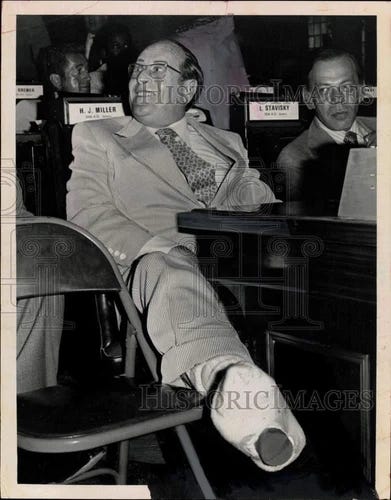
When I was 23 years old, I was writing about state government in Albany, N.Y. One of the people I covered was Stanley Steingut, the weaselly-looking, weasel-tongued speaker of the New York State Assembly. Stanley was a nasty sumbitch from Brooklyn, a product of that borough’s entrenched, patronage-soaked Democratic machine. He wheedled and needled and noodged and extorted and browbeat and cajoled and sweet-talked and swindled in order to cut shady deals for self-enrichment, but also to advance liberal causes, at which he was very effective. He was one of the earliest unwavering critics of the death penalty, long before it was politically wise. I liked him.
Like Donald Trump, he was also a mammoth asshole. I’m going to tell you about something Stanley did, and what happened because of it, and let’s see if it offers an instructive lesson for us all in these dark days that lie both behind and ahead of us, with our country in the thrall of a senescent mob boss and brazen kleptocrat.
We’re talking about Donald Trump, whose recent settlement with the IRS looks less like governance than tribute-paying: taxpayer money redirected into a political loyalty machine benefiting allies, cronies, and January 6 rioters. (Plus, it now turns out the arrangement also involved a sub-rosa deal guaranteeing that neither Trump nor members of his family will be prosecuted for any tax crimes they have committed … or will commit.)
So, back to yesteryear:
One day in 1973, Speaker Steingut was out in the streets of Brooklyn — schmoozing his constituents while campaigning for one of his cronies, the pint-sized, pugnacious machine politician Abraham Beame — when Steingut stumbled into a pothole in the street and broke the big toe on his right foot.
At the time, the city of New York was teetering on the edge of bankruptcy. (This was the era of the famous New York Daily News headline Ford to City: Drop Dead). There had been massive municipal layoffs, soaring transit fares, and frightening reductions of vital services like health care, fire safety, and sanitation.
In this climate, Steingut had the gall to sue the city — the taxpayers — for $100,000. Adjusted for inflation, that would be about $650,000 today. The lawsuit was settled out of court for $15,000, which would be around $100,000 today. For a broken toe. None of this arrogance was lost on New Yorkers, who constitute a particularly unforgiving political constituency.
Stanley Steingut was facing re-election in 1977. That he’d retain his seat was a foregone conclusion. Thus, he campaigned listlessly in his home borough, so busy was he attending to affairs of state in Albany. Plus, his reform-candidate opponent in the Democratic primary was a mere girl, a 26-year-old political newcomer named Helene Weinstein. (Yes, in the 1970s, everyone in New York was Jewish. Big whoop, okay? Fugeddaboudit.)
In any other year, Steingut would have been a shoo-in. Not that year. That year, he was getting intense governmental scrutiny, and was peripherally implicated in a nursing-home scandal, and was actually indicted on charges of taking campaign money in exchange for political favors. Those things hurt him, as did his continued stance against the death penalty in a city awash in violent crime.
Also, Ms. Weinstein proved to be a wily campaigner. Something had to be done. So Steingut wheedled and plotted, and eventually filed a lawsuit claiming his opponent didn’t live in the district in which she was running. On dubious evidence, but with legal authority, a local court agreed. Weinstein was off the ticket.
There wasn’t much time left. What to do?
No problem, it turned out.
Helene’s dad, some total unknown named Murray Weinstein, took her place on the ballot. He lived in the right district. Murray was doing it for his kid, as any good father would do. What’s not to like?
Yeah, he won. Steingut was out on his ass, and would never return to elective politics.
Postscript number one: Murray Weinstein, despite knowing next to nothing about government or politics, gamely served in the State Assembly with honor if not impact for two years, all the while bluntly and modestly describing himself as “a placeholder.” Then he retired, and handed the seat to Helene, who won.
Surprise: Helene Weinstein turned out to be one of the greatest assembly members in New York State history, serving a historic 40 years in office and capably leading several high-power positions in the lower chamber, including chairing the Assembly’s powerful Judiciary Committee. Over the years the reformer became a consummate insider, a schmoozer, a cajoler, a hondler … but not a swindler or an extortionist. She became Steingut, without the arrogance, or the slime.
Postscript number two: The official accounts of Steingut’s political demise mention the nursing home thing, and the indictments, and the fact that he didn’t campaign hard. Few mention the toe, except in passing.
I always felt that it was under-credited. I remember New York City voters back then. When it came to politics, they were a cynical lot, given to shoulder-shrug acceptance of things as they are.
Several years after this whole fiasco, I had a chance to air my doubts.
I had left Albany for a job at the Detroit Free Press, and — for reasons I now forget — found myself on the phone with Albert Blumenthal, who had been one of my best secret statehouse sources. At the time, he had been the Assembly majority leader, Stanley Steingut’s right-hand man (who actually sat to Steingut’s left hand on the house floor.) That’s him at the top of the page, next to his boss.
Blumenthal was as courtly and smooth and direct as Steingut was not. For some reason, Albert had taken a liking to me and tipped me off to things.
Our discussion eventually slid to Steingut’s downfall. I told him what I thought, and he laughed.
“Nah,” he said.
Then he said:
“Well, yeah.”
Pause.
“New Yorkers can accept and even expect a little graft from a politician, but not arrogance. They don’t forgive chutzpah.”
Right.
Blumenthal was a straight shooter. I miss him. He died of cancer just a few years after our conversation, at 55.
—
The Donald Trump connection here is obvious, of course. But it may go deeper than surface similarities.
Maybe the MAGA crowd and MAGA hangers-on in 2026 might be just a little like the New York electorate in 1977 — feeling not merely betrayed, but insulted, conned by a leader whose greed finally curdled into contempt. Maybe Trump’s elephantine chutzpah has at long last caught up with him.
—
Today’s Gene Pool Gene Poll:
I’m going to re-ask a question I asked a couple of weeks ago, because circumstances have changed more than a bit.
—
The Gene Pool is a reader-supported publication. To receive new posts and support my work, consider becoming a free or paid subscriber.