
Is It All Grover, Now?
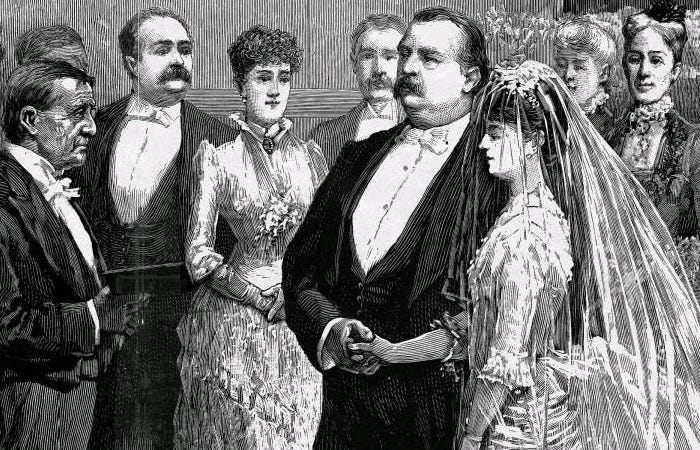
In reading about the Epstein files and the sickening debaucheries and treacheries that swirl within, I find myself thinking — like you, no doubt — about fat old Grover Cleveland.
In 1885, Grover waddled into the White House as only its second bachelor president. He’d often been asked to explain this stubborn marital status, as he was rising from sheriff to mayor to governor to presidential candidate in an era where marriage was de rigueur for public figures. His stock answer, delivered with an insouciant smile, was likely intended to preempt any followups: “I am waiting for her to grow up.”
What did this mean? It meant … whatever it meant. This was never elaborated upon, and in those prim Victorian times, no further questions were asked.
It turns out that Grover—known to be something of a humbug, a plodding, straitlaced straight shooter — was actually being characteristically honest. There was this girl. And she was only a girl, a girl he knew quite well. And Cleveland indeed waited many years until she achieved her majority, and then married her at 21. In the White House. It was the first and (still, to date) the only White House marriage of a president.
—
A certain disturbing presumption lies beneath the sordid details spooling out in the agonizingly slow release of the Epstein files: the presumption that many men want to have sex with post-pubescent but pre-adult girls. Further, that men of power and influence actually get to do it, shielded by their importance, with an invulnerability conferred by their connections … while countless other men merely wish they could.
Other men, as a group, tend to indignantly deny this is true. Then, sometimes, come the stammered qualifications.
Take me, for example! I have had sex with a girl of 17. But I was also 17.
The question lingers: Do a sizable percentage of adult men dream of, and pine for, this sort of tainted, sordid, predatory “conquest”?
No, right? “Hands off” is not just a legal imperative; it’s hardwired, no? It has to be, right? We’re not, by and large, creeps. Are we?
And yet, the Epstein files. They suggest otherwise. From this small subset of the rich and entitled, there do seem to be plenty of outwardly ordinary, respectable men who prefer, in Donald Trump’s ghastly euphemized terms, ladies “on the younger side,” even if it means preying on the naive and vulnerable and powerless. Is this a more universal desire than we like to think — or is it some sign of our grimy, shameless, power-drenched, entitlement-poisoned, amorally opportunistic era? Something … modern?
This brings us to the enigma that was Grover Cleveland, and a tantalizing, enduring mystery for our times.
—
Cleveland was a lawyer in Buffalo, New York in the middle of the 19th Century. He practiced in partnership with an older man named Oscar Folsom, whom he deeply admired. Folsom had a daughter named Frankie. When Grover first made her acquaintance, Frankie was a newborn. He bought her first baby carriage, as a gift for his friend. And as Frankie grew up, she called Grover “Uncle Cleve.”
(Is this getting icky yet?)
On July 23, 1875, Oscar Folsom was killed while driving a buggy in the city streets. He hit another vehicle, and his horse reared and bolted. Folsom fell into the gutter and broke his spine and then was run over by his own carriage wheel. Cleveland became the executor of his friend’s estate, which involved overseeing the financial needs of the newly widowed Mrs. Folsom, and the extended, avuncular care of Frankie, who had just turned 11.
Over the years, clearly, Cleveland began to admire Frankie as much as he had admired her father. Even more so, evidently.
When Cleveland was elected president in 1884, Frankie was 20, a cultured, well educated, bright-eyed, raven-haired, porcelain-skinned, full-figured beauty. In the light of hindsight, that’s when Cleveland’s enigmatic answer to the bachelorhood questions begins to reek a little, perhaps.
That also mirrored the time when Frankie decided she would henceforth be called “Frances.” It sounded … older.
—
At the time, due to the social niceties of the day, Grover Cleveland’s suddenly announced romance with Frances Folsom was accepted as just that and nothing more. It was seen as charming. Cleveland was seen as a rectitudinous gentleman, a man who had long before sown hia wild oats, been embarrassed by it, and who had reformed into a harrumphing fuddy-duddy..
During the election campaign of 1884, Cleveland had been credibly accused by his opponent of having once fathered a child out of wedlock — a boy — with an older woman of ill repute. Cleveland had admitted the indiscretion. He had taken legal and financial responsibility for the child, though he had apparently confided to others that was never sure that he was the father. It turns out there was another candidate, and it was possibly significant that the boy was named “Oscar Folsom Cleveland.” At the time of conception, Grover was a bachelor. Oscar was not. It was speculated, but never proven, that Grover took a bullet for his friend. And, later, you know, took his daughter.
Their budding romance — or whatever it was — remained a closely held secret. One speculation in the press at the time leading up to the wedding announcement was that the new president may have been courting Frances’s mom — the widow Folsom.
It all seems a little weird. Furtive, a little. In retrospect.
You keeping track of all this?
—
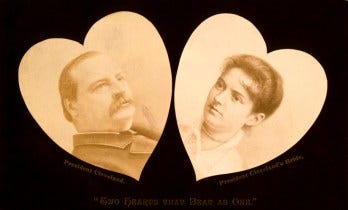
The marriage of Grover Cleveland, 49, and Frances Folsom, 21, proved a strong one. She become an active and influential first lady — the youngest ever, still. The couple’s firstborn child, Ruth, became a household name when a candy bar — “Baby Ruth” — was styled after her. It was a great candy — oil-roasted pebbly peanuts, caramel, nougat under a generous mantel of milk chocolate — and it still survives. It’s my favorite.
Cleveland died in 1908 at 71. Frances, in 1947, at 83. Grover was generally seen as a fine president who restored honor and probity to the White House after a period of rampant corruption in American politics; Frances is seen as one of the best first ladies we’ve ever had. No (additional) scandal ever attached to husband or wife.
But….
Would Grover Cleveland, in a different time, have been an Epstein islander? A frequent flyer on the Lolita Express?
I have always believed that that sort of man was an outlier, an aberration — the sort of oily sleazebag caught on TV by that other oily sleazebag Chris Hansen. But what if he is not? What if there are more Woody Allens around than we thought? The Epstein files contain a photo of Bill Gates posing with a young woman whose face is blacked out but whose body language suggests coercion. Noam Chomsky is in those files! Who takes a chance like that? What is Noam Chomsky without his reputation?
—
Today’s Gene Pool Gene Poll:
Okay, that’s it for today. I am awaiting, with trepidation, news about the newsroom of The Washington Post.