
Insanity in Missouri
It’s utter insanity in Missouri, or as NBC’s Lawrence Hurley put it on Twitter this morning, the “Show Cause State.”
Currently, six Republicans and two Democrats represent the state in Congress. That is the case even though roughly 33% of registered voters are Democrats and 17% are Independents. But not satisfied with even that lopsided balance, Secretary of State Denny Hoskins and Attorney General Catherine Hanaway want to use a new gerrymandered map drawn in 2025 that makes it more difficult for Democrats, including incumbent Congressman Emanuel Cleaver, to win reelection.
Missouri’s legislature passed the law authorizing new maps last September. Civil rights groups went to court to challenge these new mid-decade maps. Then, a group called People Not Politicians collected over 300,000 signatures to put the question of which maps the state should use on the ballot for voters to decide. Nonetheless, earlier this year, the Missouri Supreme Court signed off on using the 2025 maps for this year’s elections and they were used in the primaries.
A state court judge sided with Secretary of State Hoskins’ request to keep a referendum on the maps off the ballot. But then, on September 3, the Missouri Supreme Court ruled that the referendum petition was valid. The court concluded that meant the older maps from 2022 were reinstated, and the 2025 map was invalid.
I hope you’re not hopelessly confused already, because it gets worse.
Hoskins asked the U.S. Supreme Court to block that decision. On September 8, Justice Brett Kavanaugh denied the request, leaving the Missouri Supreme Court decision in place, requiring the state to use the older maps instead of the newer, gerrymandered ones. This, no surprise, was a shadow docket ruling, so there is no opinion that lays out Kavanaugh’s reasoning.
Then, in a separate case, federal District Judge Stephen Clark, a Trump appointee, ordered Hoskins to use the 2025 maps. The group People Not Politicians appealed to the 8th Circuit Court of Appeals, but lost, with the court finding that they lacked standing and that even if they did, they couldn’t meet the standard necessary to get an injunction against Judge Clark’s decision.
That brings us to tonight, when People Not Politicians asked the Supreme Court to intervene. Justice Kavanaugh has ordered Hoskins to respond by 10 a.m. tomorrow morning.
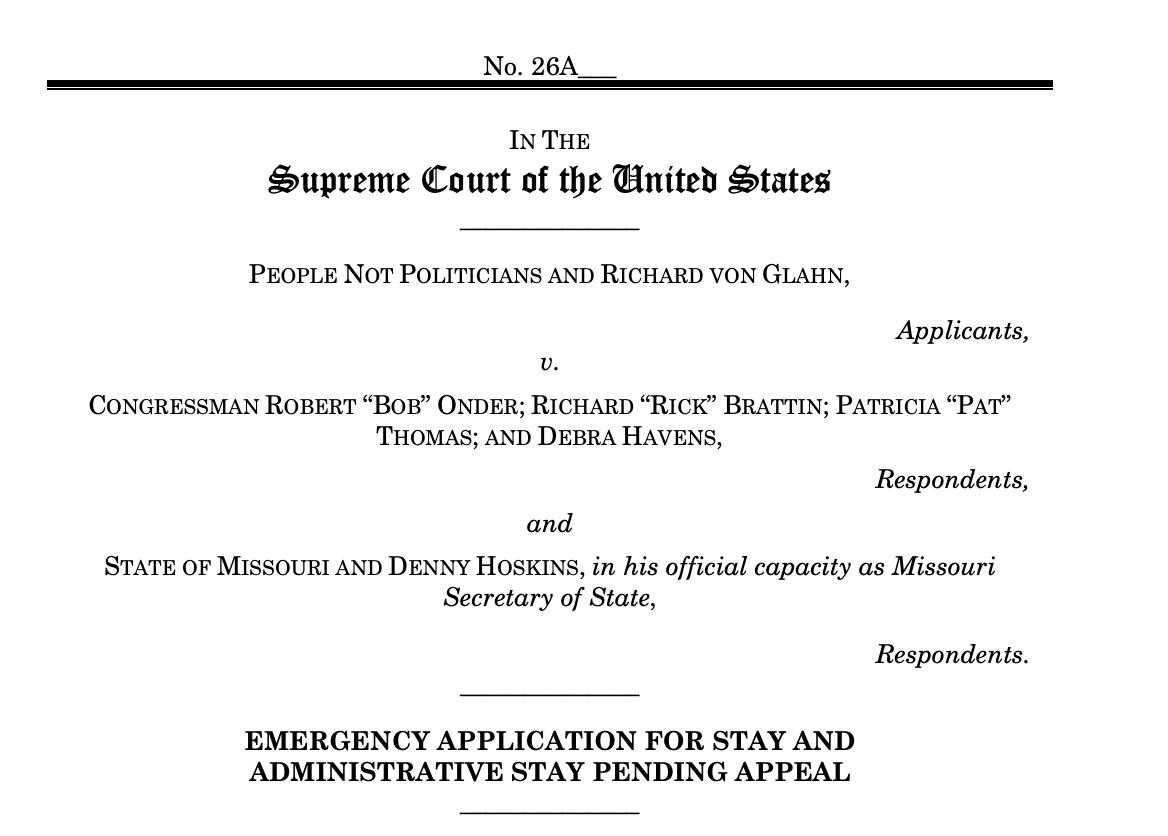
You’ll recall this mess started with the state court case that Hoskins asked Justice Kavanaugh to weigh in on. People Not Politicians is also arguing that Judge Clark’s decision is improper federal interference into an ongoing state court case, that he could not issue a decision like this alone and a three-judge court should have been convened, and that his decision violates the Purcell principle.
And as if that’s not enough, Richard von Glahn, the individual who intervened in the case along with People Not Politicians, has now filed “Suggestions of Contempt,” asking the state supreme court to hold Hoskins in contempt of that court’s prior order, claiming the contempt is “open and obvious.” Von Glahn points out that even “[I]f Respondent is not willing to comply with the Court’s injunction,” he should still have to explain “why he should not take no action in all things related to the congressional district map until guidance is received from a higher court with jurisdiction to review the Court’s judgment and injunction and the federal district court’s injunction.” That’s a fair point with the matter currently sitting before the Supreme Court.
But common sense or even compliance with legal norms isn’t at work in Missouri right now.
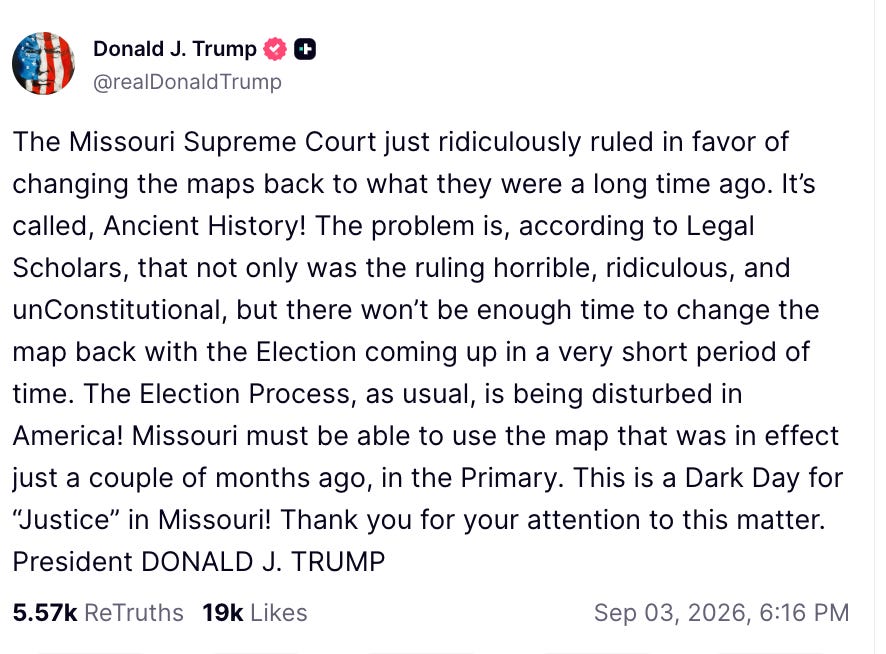
This is the kind of chaos that Donald Trump thrives on, and where better to inject it into American society than our elections. Unsurprisingly, he has already weighed in on the case—it’s still shocking to see a U.S. president disagree with a state court so publicly—after the Missouri Supreme Court decision, calling it a “Dark Day for ‘Justice.’”
Roy Temple, a Democratic strategist and former state party leader in Missouri said that voters “can’t possibly understand who they’re going to be voting for.” He opined that “The sad part is that it’s almost entirely inflicted by people whose responsibility was to ensure the orderly conduct of elections.”
And isn’t that the bottom line here? None of this was necessary. Once the state supreme court spoke, the secretary of state should have just complied. Certainly he could have done so after the first decision by Justice Kavanaugh.
But there was never a need to go that far. A lawful process obtained sufficient signatures from Missouri voters to let citizens decide which maps to use. Instead, Hoskins and Hanaway tried to secure 8-0 Republican representation in Missouri, shutting out Democrats entirely. This sort of partisanship is a malignancy in a democracy. Even Hoskins and Hanaway ultimately acknowledged that a ballot referendum had been duly authorized; they conceded that there would be one in their filing with the U.S. Supreme Court last Friday.
In his brief, the state’s solicitor general wrote: “On the one hand, Richard von Glahn — the referendum petition’s proponent — will get his referendum vote on Missouri’s congressional map regardless of what this court does. The only question is whether he (joined by a small minority of the state’s voters) can void a congressional map before he gets his vote.” It was only ever about gamesmanship to those state officials, and the game was shutting down Democratic representation in the Congress for state voters.
The U.S. Supreme Court now faces a quagmire not of its own making. Missouri must hold elections on schedule. Voters need certainty, as much as possible at this late date with so much confusion now baked in. The Supreme Court is likely to rule quickly given the late date. Will they countermand the state supreme court and permit the 2025 maps to be used? They are, after all, the maps that were used in the primary. But the state’s own high court says they are invalid because of the proper demand for a referendum on the maps. That court says the voters should choose, even though two Republican elected officials in the state wanted to prevent it from happening. Now it’s up to the U.S. Supreme Court.
If you’ve made it through the Missouri mess with me, you understand why I write Civil Discourse. Sometimes, the only way to understand what’s happening is to read the briefs and court orders and sort it all out, especially when contradicting decisions come at blistering speed from both state and federal courts. I try to do that for you when important situations like this develop. You can support my work by becoming a paid subscriber if you aren’t already one. If you already subscribe, thank you for being here with me.
We’re in this together,
Joyce