
Important Reminders from News Coverage of Politics in My Backyard
Welcome to Second Rough Draft, a newsletter about journalism in our time, how it (often its business) is evolving, and the challenges it faces.
If you’ve been in the news business long enough, you’ve experienced that awful feeling when a story in which you find yourself even peripherally involved becomes the subject of coverage you know is off the mark. Of course, this happens also to people not in our business as well, and while it may not make them as unhappy, it surely doesn’t promote confidence in journalism.
I was reminded of this recently as a high-profile congressional primary in a district in which I have lived most of my adult life becomes the subject of national attention. I wanted to write about it this week because it can serve, I think, as an object lesson of how the press needs to be more careful than it often is when seeking national meaning in what are often essentially local stories.
Setting the scene
My congressional district is New York’s 12th, and the June 23 Democratic primary there will almost certainly be tantamount to election. (Kamala Harris got 81% of the district’s vote in 2024, running just ahead of Rep. Jerry Nadler, who was re-elected with 80%, and is now retiring after 17 terms.) The district is almost entirely in Manhattan, covering the island from river to river, and from roughly 14th Street up to roughly 96th Street, a rectangle about two miles wide and four miles long. (Roosevelt Island, with fewer than 15,000 residents, or less than 2% of the district overall, is also included.)
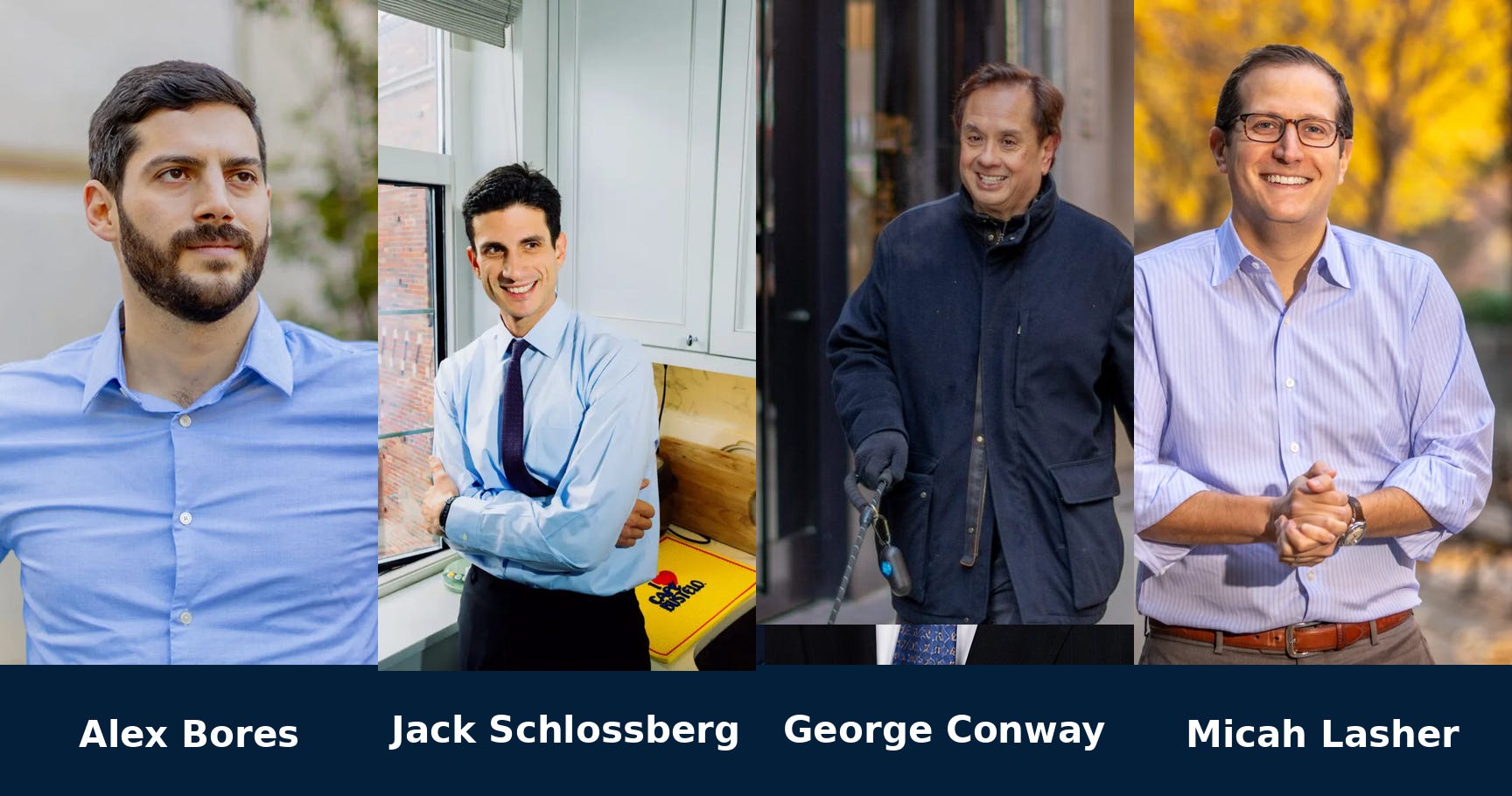
Two of the four leading candidates are not career politicos but are somewhat well known even nationally; the two better-funded candidates are elected officials but not as well known even locally, so the race is pretty interesting, and it’s far from clear who will win. All of the polls reported so far have been candidate-sponsored, and their results vary. Nor am I yet sure how I will cast my own vote.
Here, briefly, are the contestants:
- Alex Bores, 35, is a second term member of the State Assembly (representing about 40% of the congressional district) who worked nine years in technology, including five at Palantir, before entering politics.
- George Conway, 62, was a conservative Republican lawyer and a serious candidate to be solicitor general in the first Trump Administration, where his then-wife Kellyanne, previously Trump’s campaign manager, served in the White House. He moved into very vocal opposition to Trump and played a leading role in the Lincoln Project, switched parties and moved to New York after getting divorced.
- Micah Lasher, 44, is a first term Assemblyman (representing about one-third of the congressional district), and a former aide to Nadler, to former New York Mayor Mike Bloomberg, and to current Governor Kathy Hochul.
- John Bouvier Kennedy (“Jack”) Schlossberg, 33, is the grandson of President Kennedy. In addition to his former senator grand-uncles and his current cousin in the cabinet, cousins of his have held office as governor of California (by marriage), lieutenant governor of Maryland and member of Congress (three of them). While Schlossberg is well educated (Yale College, Harvard Law and Business), he does not ever seem to have held a regular job.
What the press sees— and doesn’t
I was moved to write about this campaign by a New York Times story about the big money coming into the campaign both for and against Assemblyman Bores. Bores, in the State capital in Albany, has pressed for regulation of AI, infuriating OpenAI, allies of which are spending millions to defeat him. More recently, tech money more closely allied with OpenAI rival Anthropic, which is more amenable to regulation, is spending at least $5 million to support him. The implication of the Times story—echoing the same from other outlets, including earlier stories from Bloomberg, TechCrunch, NBC News, Politico Magazine, the Wall Street Journal and Vanity Fair and a later one from Politico (again)— is that the primary is becoming a referendum on AI.
Except that there’s no evidence that I can see anywhere in the district that that is the case. The OpenAI-linked efforts deride Bores’s work for Palantir, but don’t focus on his views on AI at all. Bores’s own campaign has recently taken to leaning into to the identity of his enemies. Perhaps OpenAI and its allies seek to become a sort of newer version of AIPAC, a lobby that can punish political foes and reward friends, and perhaps as with AIPAC more recently, this will backfire.
But living in the district, I can tell you that very few if any actual voters seem especially moved by AI in the campaign. Lasher’s campaign website lists AI last of 13 issues; Schlossberg puts it last of six. Conway’s campaign site doesn’t seem to have an issues section; a recent extensive Washington Post profile of him indicated he may not have any campaign literature either—and then didn’t pursue the matter.
Meanwhile, the other big money in the race so far comes from one of Lasher’s former bosses, with Bloomberg spending $5 million to help him. And the most inquiring candidate coverage to date has been of Schlossberg, whose mere consideration of the race merited a long (and largely unflattering) profile from no less than Maureen Dowd.
As with many primaries in safely-partisan districts, the candidates differ remarkably little on the issues. At a recent debate, all seemed to suggest the greatest problem in the country is Trump, with the only real split coming on the question of whether he can somehow be ousted before 2029, as Conway insisted and Schlossberg implied was possible, while Lasher insisted it was not and Bores craftily remained silent.
Will we learn anything?
It seems to me that it is going to be very hard to draw any national lessons from the voting next month, no matter the result. (One possible exception: a Schlossberg victory, given his meager resume and more limited funding than either Lasher or Bores, would tend to indicate that the Kennedy name remains more magical in politics than some have come to believe.)
Former House Speaker Tip O’Neill loved to observe that “all politics is local.” It’s surely less local than it was in O’Neill’s time (he retired in 1987), but the importance of the point remains. In an area of just eight square miles and a likely low turnout (the congressional seat is the highest actively contested office on the ballot), my own guess is that the victor in the primary will be the person who worked hardest, made the most connections, met the most voters.
That may well be as it should be, but it’s something hard to spot from Washington— or from anywhere if you insist on viewing someplace you don’t know well through the prism of where you’ve come from. My own neck of the woods, in other words, is reminding us right now that our coverage of politics still needs to get better.
Second Rough Draft paid subscribers support nonprofit journalism. To receive new posts become a free or paid subscriber.